

Discover why water heater fails prematurely in San Antonio and learn effective prevention tips to extend its lifespan and save money.
TL;DR:
- San Antonio’s very hard water causes premature water heater failure by accelerating rust and sediment buildup. Regular maintenance, including frequent anode rod inspections and tank flushing, can significantly prolong the lifespan of your unit. Customized care based on local water conditions is essential to avoid costly repairs and early replacements.
Your water heater is one of the hardest-working appliances in your home, and in San Antonio, it faces challenges that most national guides completely ignore. The reality is that many San Antonio homeowners replace their water heaters years earlier than they expected, not because of a defective unit or bad luck, but because of something in the water itself. Hard water is the silent culprit behind premature tank failure, accelerated corrosion, and skyrocketing energy bills. This guide breaks down the real causes of early failure and gives you practical, locally relevant steps to protect your investment.
Table of Contents
- Why water heaters in San Antonio fail early
- Top causes of water heater failure: The science explained
- How maintenance (or neglect) determines your water heater’s lifespan
- Can you predict or prevent water heater failure?
- What most guides get wrong about water heater failure in San Antonio
- Get help with water heater repair, maintenance, or replacement
- Frequently asked questions
Key Takeaways
| Point | Details |
|---|---|
| Hard water risk | San Antonio’s hard water cuts water heater lifespan nearly in half without regular maintenance. |
| Catch failure early | Unusual noises, rust, or reduced hot water are early signs your heater may soon fail. |
| Essential maintenance | Annual flushing and anode checks can add years to your water heater’s life. |
| Softener caution | Water softeners protect against scale but make anode checks more critical to prevent tank rust. |
Why water heaters in San Antonio fail early
Having set the local context, let’s break down why water heaters here fail sooner than most guides suggest.
San Antonio has one of the most aggressive water supplies in the country when it comes to your plumbing. San Antonio’s water hardness registers between 12.7 and 16.7 grains per gallon (GPG), placing it firmly in the “very hard” category. To put that in perspective, water is considered hard at just 7 GPG. San Antonio homeowners are dealing with water that is nearly double that threshold every single day.
What does hard water actually do inside your tank? It deposits calcium and magnesium minerals on every interior surface it touches. Over time, those minerals form a crusty layer called scale. Scale acts like insulation on the bottom of your tank, forcing your heating element or burner to work overtime just to reach your set temperature. The harder those components work, the faster they wear out.
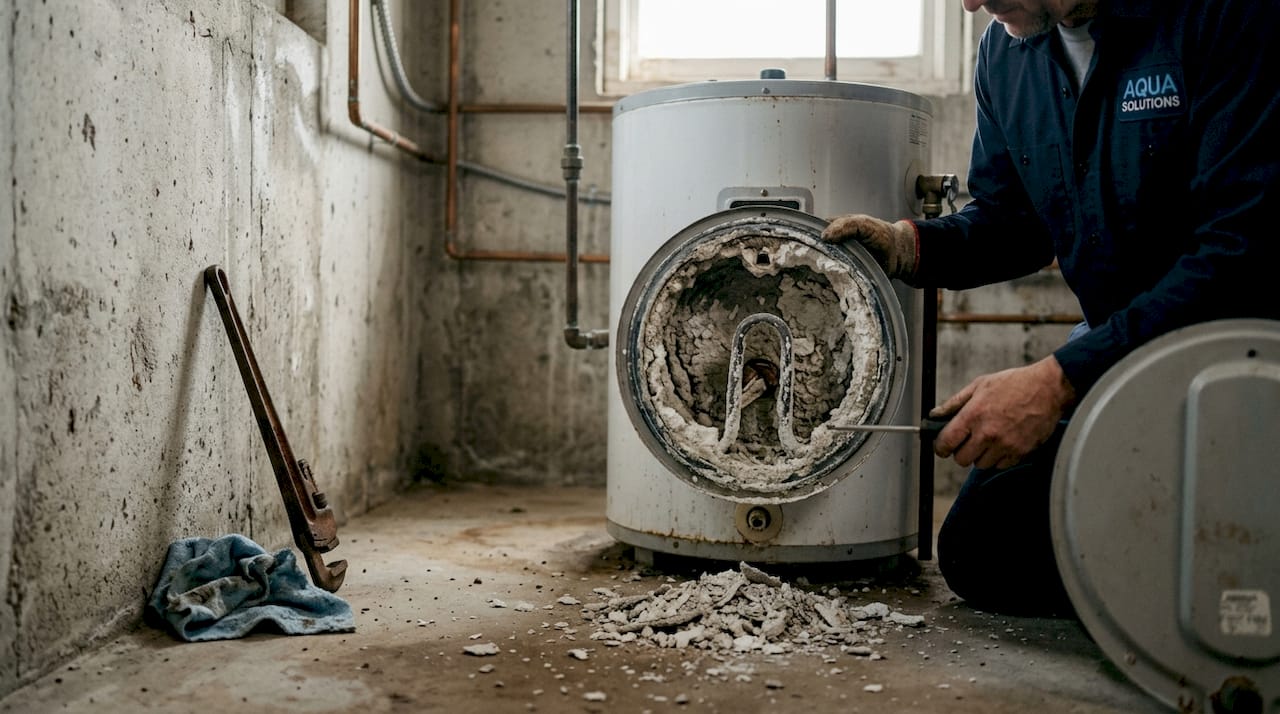
Nationally, tank water heaters last between 8 and 12 years. In San Antonio, without consistent maintenance, that lifespan shrinks to 4 to 8 years. That is not a small difference. That is potentially thousands of dollars in early replacement costs.
| Factor | National average | San Antonio (no maintenance) |
|---|---|---|
| Water hardness (GPG) | 3.5 to 7.0 | 12.7 to 16.7 |
| Average tank lifespan | 8 to 12 years | 4 to 8 years |
| Sediment buildup rate | Moderate | Very high |
| Anode rod depletion | Every 5 to 6 years | Every 1 to 3 years |
The top failure mechanisms we see in San Antonio homes include:
- Tank corrosion from depleted anode rods that can no longer protect the steel interior
- Sediment accumulation that overworks the heating element and causes cracking
- Rapid anode rod depletion driven by mineral-rich water constantly attacking sacrificial metal
Knowing these signs your water heater needs replacement early can save you from a full emergency situation. But before you get to replacement, you need to understand exactly how each failure mechanism works.
Top causes of water heater failure: The science explained
Now that we know why water heaters in San Antonio are under extra stress, let’s look at the science of exactly how they fail and what warning signs to watch for.
Every tank water heater comes with a metal rod inside called an anode rod. It’s usually made of magnesium or aluminum, and its entire job is to corrode so your tank doesn’t have to. This process is called galvanic sacrifice. As long as the anode rod is intact, it absorbs the electrochemical reactions that would otherwise eat through your steel tank. Once that rod is fully depleted, your tank becomes the target. Anode rod depletion is the leading pathway to rust, tank leaks, and eventual failure.
Here’s how the three primary failure mechanisms connect and what symptoms to watch for:
| Failure mechanism | Root cause | Visible symptoms |
|---|---|---|
| Tank corrosion | Depleted anode rod | Rusty water, metallic odor, visible exterior rust |
| Scale buildup | Hard water mineral deposits | Popping/rumbling sounds, slow heating, higher energy bills |
| Pressure relief valve failure | Excess pressure or sediment blockage | Dripping valve, water pooling near unit |
The three things most homeowners miss that lead to early failure are:
- Skipping anode rod inspections entirely. Most people never open the tank to check this rod. By the time rust shows up in your tap water, the rod is long gone and damage is already done.
- Ignoring the sounds. Popping, banging, or rumbling from the tank is sediment being superheated on the bottom of the unit. Many homeowners assume this is normal. It is not. It means the tank is working far harder than it should.
- Letting the thermostat run too high. A setting above 140 degrees Fahrenheit accelerates mineral deposits and stresses the tank unnecessarily. Keeping it at 120 degrees Fahrenheit is safer and gentler on the system.
Understanding these water heater warning signs is exactly what separates homeowners who get 10-plus years from a unit and those who replace theirs every five years.
Pro Tip: Check your anode rod at least once every two years in San Antonio. When you pull it out, if it is less than half an inch in diameter or heavily coated in white calcium deposits, replace it immediately. This single step can add years to your water heater’s life.
If you notice water heater repair signs early, calling a professional before full failure saves significant money over an emergency replacement.
How maintenance (or neglect) determines your water heater’s lifespan
Understanding failure modes means you can put prevention front and center. Here’s how to make your water heater last, especially in San Antonio’s unique environment.
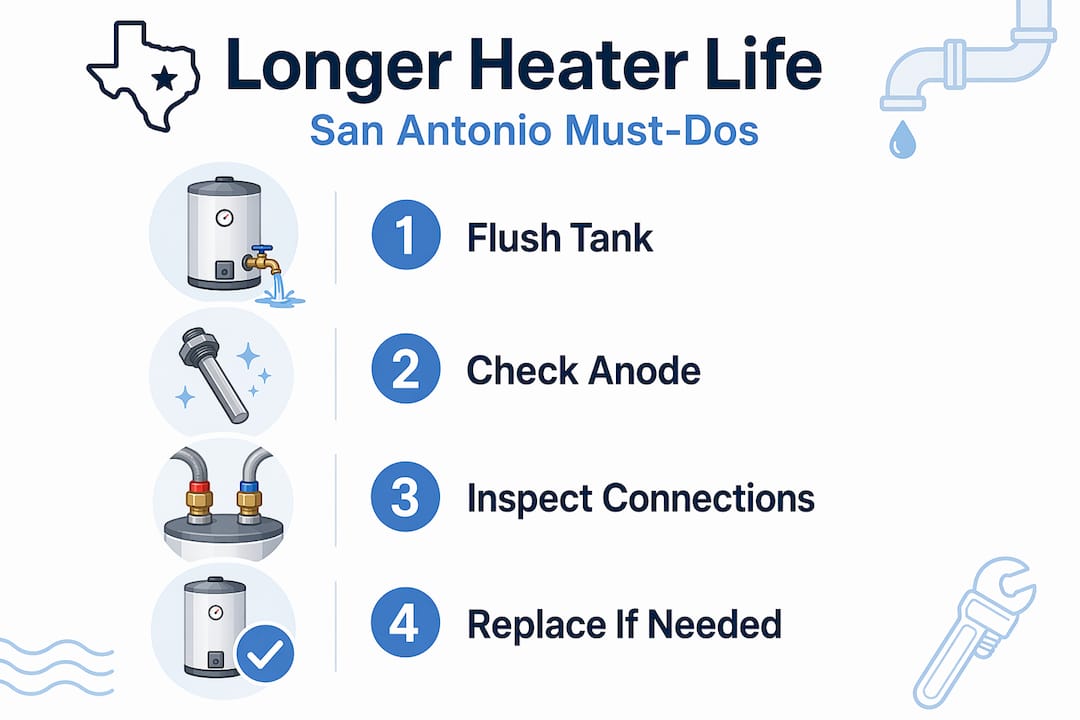
Annual maintenance is not optional here. It is genuinely the difference between a water heater that serves your family for a decade and one that leaves you scrambling for a cold shower replacement on a hot July afternoon.
Here is a practical, step-by-step maintenance checklist built specifically for San Antonio conditions:
- Flush the tank annually. Attach a garden hose to the drain valve at the bottom of the tank and flush until the water runs clear. This removes settled sediment that builds up rapidly with hard water. Flushing once a year in San Antonio is the bare minimum.
- Inspect the anode rod every 1 to 2 years. Given anode inspection intervals are typically every 3 to 5 years nationally, San Antonio’s water chemistry demands a much faster schedule. Locate the rod (usually under a plastic cap on the top of the unit), use a socket wrench to remove it, and inspect it visually.
- Test the pressure relief (T&P) valve. Lift the lever briefly to verify it releases a small burst of water and snaps back. If it sticks, drips, or doesn’t release water, it needs replacement immediately.
- Check the temperature setting. Verify your thermostat is set between 118 and 120 degrees Fahrenheit. Higher settings accelerate scale formation and stress internal components.
- Inspect all connections for drips or moisture. Even small drips at the inlet or outlet pipes can signal early fitting corrosion.
One hidden danger many San Antonio homeowners miss: if you have a water softener installation in your home, your anode rod is actually at greater risk, not less. Softened water is more aggressive toward magnesium anodes and can deplete them twice as fast as hard water would.
Pro Tip: If your home uses a water softener, consider upgrading to a powered anode rod (also called an impressed current anode). Instead of corroding away, it uses a small electrical current to protect the tank. This eliminates the need for periodic rod replacement and is especially effective in softened water environments.
Red flags that mean you need a professional right away, not next month:
- Water pooling around the base of the unit
- A sudden drop in hot water output or temperature
- Any visible rust or cracks on the tank exterior
- The pressure relief valve dripping constantly
- A burning or sulfur smell coming from the unit
If any of these appear, this is not a wait-and-see situation. Knowing when to repair or replace your water heater is a decision that affects both your safety and your budget.
Can you predict or prevent water heater failure?
You’ve seen how to extend water heater life, but what if problems are already appearing? Here’s how to spot trouble before you wake up to a cold shower.
Most water heater failures don’t happen without warning. The tank almost always gives you signals weeks or months before a full breakdown. The challenge is knowing which signals mean “monitor this” and which mean “call someone today.”
Act now indicators:
- Rusty or discolored water from hot taps
- Visible water around the base of the tank
- The unit is more than seven years old and showing any performance changes
- Loud banging, rumbling, or cracking sounds during heating cycles
- Constant pilot light outages on gas heaters
Monitor and schedule maintenance soon:
- Slightly longer time to reach full hot water temperature
- Minor mineral buildup around fittings or the T&P valve
- Water temperature slightly lower than usual but still functional
- Faint popping sounds that happen occasionally, not every cycle
Local reality check: While the national water heater lifespan averages 8 to 12 years, San Antonio homeowners without regular maintenance should expect to evaluate their units at the five-year mark, not the eight-year mark. Getting ahead of failure by two to three years is the difference between a planned replacement on your terms and an emergency call on a weekend.
The cost of ignoring early signs is not just a water heater. A failed tank can release 30 to 50 gallons of water into your home before you notice, causing floor damage, mold risk, and serious repair costs that dwarf the price of a new unit.
If you’re seeing any warning signs now, checking out signs to replace your water heater can help you make a confident, informed decision fast.
What most guides get wrong about water heater failure in San Antonio
Here is what we see time and time again in the field that generic guides completely miss.
National maintenance advice is written for average conditions. San Antonio is not average. When a guide tells you to inspect your anode rod “every three to five years,” that advice was built around water hardness levels of 5 to 7 GPG. San Antonio water at 16 GPG is a completely different environment. Following that national timeline here means your anode rod has been gone for two or three years by the time you check it. By then, you are replacing a tank, not a rod.
The water softener trap is one of the most common situations we respond to. A homeowner installs a softener to fight San Antonio’s hard water, which is a smart move for pipes and fixtures. But nobody tells them that softened water depletes magnesium anodes two to three times faster than hard water does. The homeowner thinks they’ve solved the hard water problem, but they’ve actually created a new and faster failure pathway for their water heater.
We’ve arrived at service calls where a homeowner had a three-year-old water heater with a softener installed and the anode rod was already completely gone. The tank was starting to rust internally. That unit was three years old. No one told them that installing a softener meant their maintenance schedule needed to change immediately.
Our advice to every San Antonio homeowner: Don’t accept generic national guidance for your water heater. Ask your plumber specifically, “Given San Antonio’s water hardness and whether I have a softener, what maintenance schedule do I need?” If they give you a generic answer, push harder. Your water chemistry is specific, and your maintenance plan should be too.
The most cost-effective investment in your water heater is not a new unit. It is the right information, applied at the right time. Whether you need to repair or replace your water heater in San Antonio, the decision should always be grounded in your specific water conditions and the actual condition of your existing unit, not a guess based on how old it is.
Get help with water heater repair, maintenance, or replacement
If you’re ready for expert help or want a second opinion, here are your next steps.
At Stultz Plumbing, we understand San Antonio’s water chemistry because we work in it every single day. Whether your unit is making strange noises, you’re running out of hot water faster than usual, or you simply want a professional inspection before a small problem becomes a major expense, our team is ready to help. We tailor every recommendation to your specific home, water supply, and budget.

Our water heater service experts handle everything from anode rod replacements and tank flushes to full unit installations, with transparent pricing and no surprises. If your situation can’t wait, our plumbing emergency help team is available when you need fast, reliable service. Don’t wait for a failed tank to flood your home. Reach out to Stultz Plumbing today and protect your home with a plan built for San Antonio’s real conditions.
Frequently asked questions
How long should a water heater last in San Antonio?
In San Antonio, tank water heaters typically last 4 to 8 years without consistent maintenance, compared to the national average of 8 to 12 years, because of the area’s very hard water supply.
What are the first signs a water heater is failing?
Rusty or discolored hot water, loud popping or rumbling sounds during heating, visible water pooling near the base, or a noticeable drop in hot water output are all early warning signs that your water heater is in trouble.
Does San Antonio’s hard water require special water heater maintenance?
Yes. Because San Antonio’s water hardness registers at 12.7 to 16.7 GPG, anode rod inspections and tank flushing should happen every 1 to 2 years rather than the national recommendation of every 3 to 5 years outlined in the standard anode rod guide.
Can a water softener help or hurt my water heater?
A softener reduces scale buildup, but softened water depletes magnesium anodes two to three times faster than hard water, so you need annual anode rod checks or a switch to a powered anode rod to avoid accelerated tank corrosion.
Is replacing or repairing a water heater best for older units?
For any unit older than eight years or showing active signs of failure in San Antonio, replacement is almost always the smarter financial decision, since hard water conditions mean further repairs are unlikely to extend the unit’s life significantly.
Recommended
- Repair or Replace Your Water Heater | Stultz Plumbing
- 7 clear signs your water heater needs replacement now
- Repair or replace your water heater? Make the right choice
- Why December Is Worst for Water Heater Failure | Stultz
Jean runs growth strategy at AimSetWin, a performance marketing agency specializing in local service businesses across Texas. he's helped plumbers, HVAC companies, pest control operators, and home service brands build predictable revenue systems using data-driven advertising and conversion optimization.


