

Discover the top factors driving water heater repair in San Antonio, from hard water damage to repair costs, and learn when to repair or replace your unit.
TL;DR:
- Sediment buildup from hard water causes 70% of water heater failures in San Antonio. Regular flushing and water softening extend unit lifespan and prevent costly repairs. Replacement is recommended when repairs exceed 50% of the new unit’s cost or the heater is over 8 to 10 years old.
Most San Antonio homeowners assume their water heater failed because it got old or someone left the hot water running too long. The real culprit is usually already in your pipes before the unit ever turns on. Sediment buildup from hard water causes 70% of premature failures in San Antonio water heaters, which means most breakdowns are preventable. This article walks you through the core causes of water heater problems, the warning signs to watch for, how local water quality drives repair costs, and how to decide whether to repair or replace your unit.
Table of Contents
- Understanding the main factors in water heater repair
- Common symptoms and which repairs they signal
- How San Antonio’s hard water affects repair and prevention
- Repair costs and when to replace instead
- What most San Antonio homeowners miss about water heater repair
- Need expert water heater repair? Trusted San Antonio solutions
- Frequently asked questions
Key Takeaways
| Point | Details |
|---|---|
| Hard water is a top issue | San Antonio’s hard water causes most premature water heater breakdowns and shortens unit lifespan substantially. |
| Know repair vs. replace signals | Units older than 8 years, frequent breakdowns, or repair costs over 50% of replacement usually warrant a new heater. |
| Annual flushing is essential | Flushing the water heater each year prevents 70% of common failures and improves efficiency. |
| Professional help prevents bigger problems | Some repairs can be DIY, but gas, electric, or advanced scale issues require a licensed plumber for safety and best results. |
Understanding the main factors in water heater repair
When your water heater starts acting up, the first question we ask is: how old is it? Age is one of the clearest indicators of whether a repair makes sense. As a general rule, units under 6 to 8 years old are worth repairing, while units over 8 to 10 years are often better candidates for replacement, especially in San Antonio where hard water accelerates wear.
San Antonio’s water is notoriously hard. The city draws from the Edwards Aquifer and the Carrizo-Wilcox Aquifer, both rich in dissolved calcium and magnesium. These minerals don’t stay dissolved forever. Inside your water heater tank, they settle as scale and sediment, coating the heating elements, insulating the tank floor, and forcing your system to work harder just to heat the same amount of water. Hard water and scale issues are the leading driver of component failure in this region.
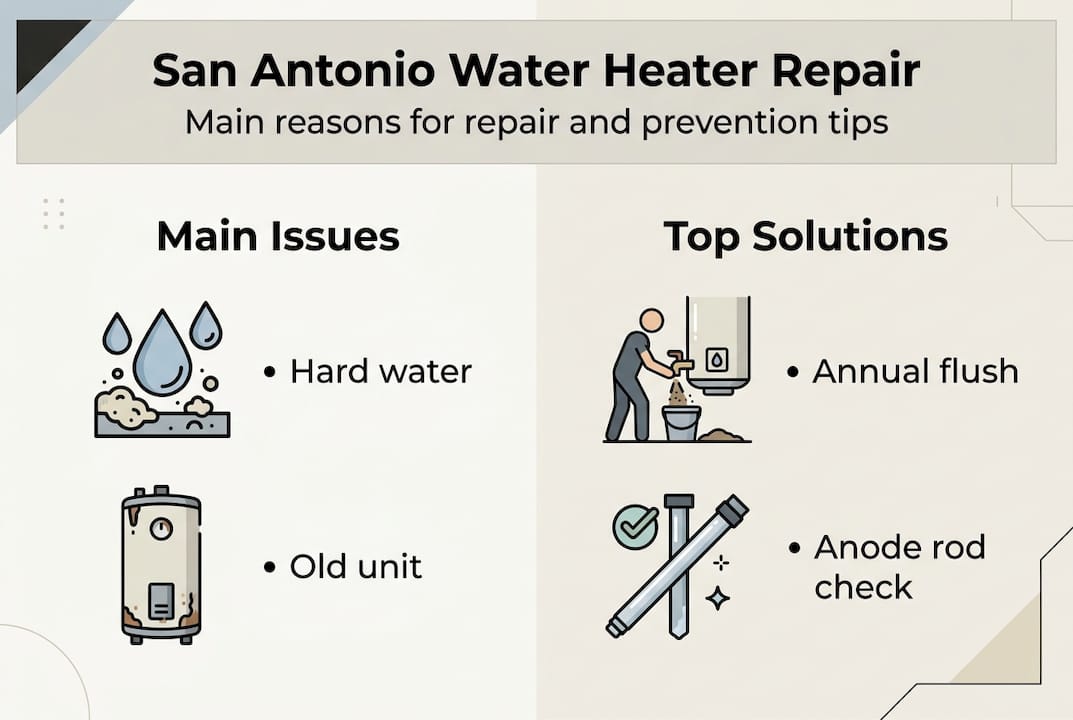
Here’s a quick look at the most common repair triggers and their typical causes:
| Component | Common failure cause | Repair or replace? |
|---|---|---|
| Thermostat | Scale buildup, electrical fault | Repair |
| Heating element | Sediment coating, burnout | Repair |
| T&P relief valve | Pressure buildup, corrosion | Repair |
| Anode rod | Depletion from hard water | Repair |
| Tank body | Internal corrosion, crack | Replace |
Beyond sediment, the most common component failures we see include:
- Thermostats: When scale coats the thermostat sensor, it reads water temperature incorrectly and either overheats or underheats your supply.
- Heating elements: Electric water heaters use two elements. Scale buildup causes them to burn out faster than normal.
- T&P (temperature and pressure) relief valves: These safety valves release pressure when it gets too high. Corrosion or mineral deposits can cause them to drip or fail to seal.
- Anode rods: These sacrificial rods protect the tank from corrosion. Hard water depletes them faster, leaving the tank exposed.
“Sediment is the primary failure cause in San Antonio water heaters. A unit that isn’t flushed annually is working against itself from day one.”
Symptoms that point to these failures include rumbling or popping noises (sediment boiling under heat), rusty or brown water (internal corrosion), and visible puddles near the base of the unit. Our water heater services team sees these patterns daily, and early action almost always saves money. If you’re already noticing signs, a water heater repair service call now is far cheaper than waiting for a full failure.
Common symptoms and which repairs they signal
Now that you know the underlying causes, it’s important to recognize how these factors show up in your home. Symptoms are your water heater’s way of telling you something is wrong before it completely stops working.
Here are the four most common warning signs and what they typically mean:
- No hot water at all. This usually points to a failed thermostat or a burned-out heating element. On gas units, a dead pilot light or faulty thermocouple is often to blame.
- Rusty or brown water. Discolored water signals internal tank corrosion or a depleted anode rod. If the rust is only in hot water, the tank itself is likely the source.
- Popping, rumbling, or banging noises. These sounds happen when water gets trapped beneath a thick layer of sediment and boils unevenly. It’s loud, and it’s hard on your tank.
- Visible leaks around the unit. Where the leak originates matters enormously. A dripping T&P valve or a loose fitting at the top is often repairable. A leak from the bottom of the tank almost always means the tank itself has corroded through.
The table below connects symptoms to likely repairs:
| Symptom | Likely cause | Typical action |
|---|---|---|
| No hot water | Thermostat or element failure | Replace component |
| Rusty water | Anode rod depleted or tank corrosion | Rod replacement or tank replacement |
| Loud noises | Sediment buildup | Flush or descale |
| T&P valve dripping | Pressure or valve fault | Valve replacement |
| Bottom tank leak | Internal corrosion | Full unit replacement |
According to major water heater failures research, leaking valves, tank noises from scale, and cold water from failed thermostats or elements are the top three reasons homeowners call for service. Our team handling fast water heater repairs confirms this pattern holds true across San Antonio neighborhoods.
Pro Tip: Never cap or tape a dripping T&P valve to stop the drip. That valve exists to release dangerous pressure. Blocking it creates an overpressure risk that can be genuinely dangerous. Always have it inspected and replaced by a licensed plumber.
Also, pay attention to leaking valves and troubleshooting cues specific to your unit type. Gas and electric heaters share some symptoms but require different diagnostic approaches.
How San Antonio’s hard water affects repair and prevention
Many homeowners underestimate just how much San Antonio’s water quality drives repair frequency. This isn’t a minor factor. It’s the central one. San Antonio consistently ranks among the cities with the hardest municipal water in Texas, and that reality has a direct dollar cost attached to it.
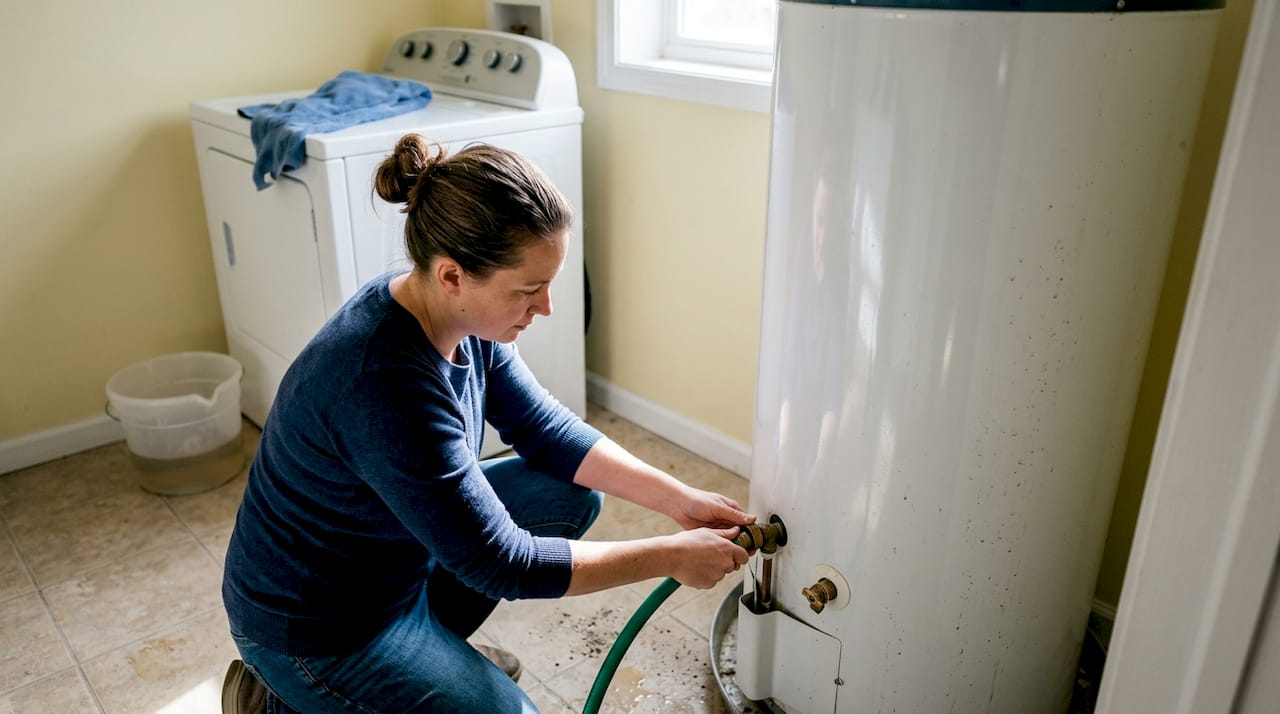
Hard water reduces efficiency by 20 to 30% and can shorten a water heater’s lifespan to just 4 to 6 years without proper maintenance. For context, a well-maintained unit in a soft-water area might last 12 to 15 years. That’s a significant gap, and it’s entirely driven by mineral content in your water supply.
Here’s how hard water damages your system over time:
- Scale accumulates on heating elements, forcing them to draw more electricity or gas to reach the same temperature.
- The tank floor collects sediment that acts as an insulating layer, reducing heat transfer and increasing energy costs.
- Anode rods deplete faster, leaving the tank walls exposed to corrosion sooner than expected.
- Pipes and fittings connected to the unit experience mineral deposits that restrict flow and strain connections.
The good news is that prevention is straightforward. The standard approach we recommend for San Antonio homes is an annual flush combined with a water softener installation. Flushing removes accumulated sediment before it hardens into a thick crust. A softener treats the incoming water so scale never forms in the first place.
Pro Tip: Regular annual maintenance, including flushing and anode rod inspection, can extend your water heater’s life by 3 to 5 years. That’s potentially thousands of dollars in delayed replacement costs.
For DIY homeowners, flushing involves attaching a hose to the drain valve, turning off the heating element, and letting the tank drain until the water runs clear. It’s manageable for most people. Descaling, however, is more involved and often requires a professional, especially if scale has hardened significantly. Our repair vs replace guidance can help you decide whether maintenance is still worth it or if a new unit makes more sense given your situation.
For additional key signs to watch that your unit is past the point of maintenance, review the indicators that signal it’s time to move on.
Repair costs and when to replace instead
Once you’ve weighed local water risks, the next factor is cost, both now and over time. Repair costs vary widely depending on what needs fixing, and knowing the typical price range helps you avoid overpaying or making a poor long-term decision.
Here’s a breakdown of common repair costs:
| Repair type | Typical cost range |
|---|---|
| Thermostat replacement | $150 to $300 |
| Heating element replacement | $200 to $350 |
| Anode rod replacement | $100 to $200 |
| T&P valve replacement | $100 to $250 |
| Full tank flush and descale | $100 to $200 |
| New water heater (installed) | $900 to $1,800 |
According to average repair costs and replacement thresholds, the widely accepted rule is this: if a repair costs more than 50% of the price of a new unit, replacement is the smarter financial move. That threshold drops even lower if your unit is already past 8 to 10 years old.
Here’s a practical decision framework:
- Under 8 years old, single repair needed: Go ahead and repair. The unit has useful life remaining.
- 8 to 10 years old, one moderate repair: Evaluate carefully. Factor in San Antonio’s hard water impact on remaining lifespan.
- Over 10 years old, any significant repair: Replacement is almost always the better investment.
- Any age, multiple repairs in 12 months: This is a cascade failure pattern. Stop spending on repairs and replace the unit.
- Bottom tank leak at any age: Replace immediately. There is no cost-effective fix for a corroded tank.
Pro Tip: If you’ve called for two or more repairs within a single year, that’s not bad luck. It’s a signal that the unit is failing systematically. Each new repair is money spent on a unit that’s already on its way out.
For a deeper look at the repair or replacement decision, including how to calculate your specific cost threshold, we’ve put together a detailed local guide. Also check water heater lifespan benchmarks to see where your unit stands.
What most San Antonio homeowners miss about water heater repair
Stepping back, it’s clear that a simple cost calculation misses the bigger picture for San Antonio homeowners. The most common mistake we see is treating each repair as an isolated event rather than a pattern. A thermostat replacement here, an element swap there, and suddenly a homeowner has spent $900 over two years on a 12-year-old unit that still delivers lukewarm water and costs 25% more to run than a new model.
Repairing older units can waste money and risk a cascade of more failures, particularly in hard-water environments like San Antonio where scale accelerates every failure mode simultaneously. A new high-efficiency unit can deliver 20 to 40% energy savings compared to a scaled, aging tank. That’s a real monthly difference on your utility bill.
What we’ve learned from years of service calls is that proactive homeowners who schedule annual maintenance and replace units on schedule almost never face emergency situations. The homeowners who wait until the tank floods a garage or stops working entirely pay far more, in repairs, water damage, and emergency service fees. Our professional water heater service team is built around helping you stay ahead of that curve, not just respond to it.
Need expert water heater repair? Trusted San Antonio solutions
If your water heater is showing any of the warning signs covered here, don’t wait for a full failure. At Stultz Plumbing, we provide fast diagnostics, honest repair recommendations, and transparent pricing across San Antonio and surrounding communities. Whether you need a quick element swap or guidance on a full replacement, our licensed technicians are ready to help. Explore our affordable plumbing services or review our detailed San Antonio repair guide to understand your options before you call. Ready to get started? Book free estimates today and get a same-day response from our team.
Frequently asked questions
How often should my water heater be flushed in San Antonio?
Flush your water heater at least once a year to prevent sediment buildup. Annual flushing removes sediment that causes 70% of premature failures in San Antonio’s hard-water conditions.
Does hard water really shorten my water heater’s lifespan?
Yes, significantly. Hard water accelerates scale buildup and can reduce a heater’s effective lifespan to just 4 to 6 years without proper maintenance and softening.
When is replacement better than repair for my water heater?
If repairs cost more than 50% of a new unit’s price or your heater is over 8 to 10 years old, replacement is usually the smarter move. Replace if repair exceeds 50% of new unit cost to avoid ongoing expenses.
What signs mean I should call a plumbing professional?
Call a pro immediately for leaks from the bottom of the tank, repeated outages, rusty water, or any gas smell near the unit. Tank leaks and corrosion require immediate expert inspection and cannot wait.
Is it safe to repair my water heater myself?
Simple tasks like flushing the tank or relighting the pilot are manageable for most homeowners. However, gas and electric repairs are risky without proper training and should always be handled by a licensed plumber.
Recommended
- Water heater repair vs replace guide for San Antonio 2026
- Get Fastest Water Heater Repair Service In San Antonio
- Water Heater Services in San Antonio TX
- Signs You Need Water Heater Repair | San Antonio TX
Jean runs growth strategy at AimSetWin, a performance marketing agency specializing in local service businesses across Texas. he's helped plumbers, HVAC companies, pest control operators, and home service brands build predictable revenue systems using data-driven advertising and conversion optimization.


