Learn how to diagnose, fix, and maintain your water heater with this DIY guide built for San Antonio's hard water conditions. Save money and extend unit life.
TL;DR:
- Hard water in San Antonio accelerates sediment buildup, cutting water heater lifespan significantly.
- Regular flushing and replacing the anode rod are crucial for maintenance in hard water areas.
- DIY repairs are possible, but professional replacement may be necessary for severe damage or leaks.
That first blast of cold water in the morning is a wake-up call nobody wants. Whether you’re dealing with no hot water at all, a strange rumbling from the utility closet, or water that looks faintly orange, your water heater is telling you something is wrong. The good news: many of these problems are fixable without calling a plumber right away. San Antonio homeowners face a specific challenge that most generic guides ignore, and that’s our city’s notoriously hard water, which accelerates wear and sediment buildup faster than almost anywhere else in Texas. This guide walks you through diagnosing problems, making safe DIY repairs, and building a maintenance routine that keeps your heater running for years.
Table of Contents
- Common water heater problems and warning signs
- What you need to start: tools, parts, and safety
- Step-by-step DIY fixes for typical water heater issues
- Hard water and preventive maintenance in San Antonio
- What most water heater DIY guides miss: The San Antonio difference
- Need expert help or a permanent fix?
- Frequently asked questions
Key Takeaways
| Point | Details |
|---|---|
| Identify heater issues | Symptoms like no hot water or leaks can reveal the specific problem you need to fix. |
| Stay safe first | Always turn off gas, electricity, and water before repairs to avoid dangerous accidents. |
| Tackle DIY repairs | Many problems, like relighting a pilot or flushing sediment, can be solved at home with simple steps. |
| Prioritize maintenance | Yearly tank flushing and anode rod checks extend your heater’s life, especially in San Antonio’s hard water. |
| Call experts when needed | Major leaks, corrosion, or persistent issues require professional plumbing help for safety and reliability. |
Common water heater problems and warning signs
Now that you know why water heaters often fail in San Antonio, let’s identify the specific warning signs of trouble. Spotting the right symptom early is the difference between a $20 fix and a $1,200 replacement.
Common water heater problems include no hot water, insufficient hot water, leaks, strange noises, and discolored water. Each symptom points to a different root cause, and knowing which is which saves you time and money.
Here’s what each warning sign typically means:
- No hot water at all: On a gas unit, the pilot light has gone out or the thermocouple has failed. On an electric unit, a heating element or circuit breaker is the likely culprit.
- Not enough hot water: The thermostat is set too low, one heating element is failing, or sediment has insulated the bottom of the tank and reduced its effective capacity.
- Leaks around the base: This could be a loose drain valve, a failing pressure relief valve, or, in the worst case, a corroded tank. Tank leaks mean replacement, not repair.
- Rumbling, popping, or banging sounds: Classic signs of sediment buildup. Minerals from San Antonio’s hard water settle at the bottom of the tank and get superheated, creating those alarming noises.
- Rusty or discolored water: Corrosion inside the tank or a depleted anode rod. If the rust is coming from the heater and not the pipes, your tank’s interior protection has failed.
San Antonio’s water hardness runs between 15 and 20 grains per gallon (gpg), which is classified as very hard. That mineral load is a recipe for accelerated sediment and scale. For water heater basics, most units are designed to last 8 to 12 years under normal conditions. Hard water can cut that lifespan dramatically if maintenance is skipped.
Stat to know: Sediment and scale from hard water account for up to 70% of premature water heater failures in the San Antonio area. That’s not a minor risk. It’s the leading cause of early replacement.
If you want a deeper breakdown of what each symptom means for your specific unit, our water heater troubleshooting guide covers gas and electric models side by side.
What you need to start: tools, parts, and safety
Once you spot a problem, it’s crucial to prep safely and gather what you need before starting any fixes. Skipping this step is how minor repairs turn into emergencies.
Safety first, always. Before touching anything on your water heater, shut off gas or electricity and the water supply. For gas units, turn the gas valve to the pilot position, then off. For electric units, flip the dedicated breaker in your panel. Turn off the cold water inlet valve at the top of the tank.
Warning: Never attempt repairs if you smell gas, see active sparking, or notice heavy rust on the tank shell. A corroded tank cannot be safely repaired. Call a professional immediately.
Here’s a quick comparison of what you’ll need depending on your heater type:
| Tool or part | Electric water heater | Gas water heater |
|---|---|---|
| Multimeter | Required (test elements) | Not needed |
| Element wrench | Required | Not needed |
| Screwdrivers | Required | Required |
| Adjustable wrench | Required | Required |
| Pipe wrench | Optional | Required |
| Thermocouple | Not needed | Required (if pilot fails) |
| Heating element | Required | Not needed |
| Anode rod | Required | Required |
| Garden hose | Required (flushing) | Required (flushing) |
Common replacement parts to have on hand:
- Heating element (electric models, match wattage and voltage)
- Upper and lower thermostats (electric models)
- Thermocouple or thermopile (gas models)
- Anode rod (magnesium for soft water, aluminum or zinc for hard water like San Antonio’s)
- Pressure relief valve (if yours is more than 6 years old)
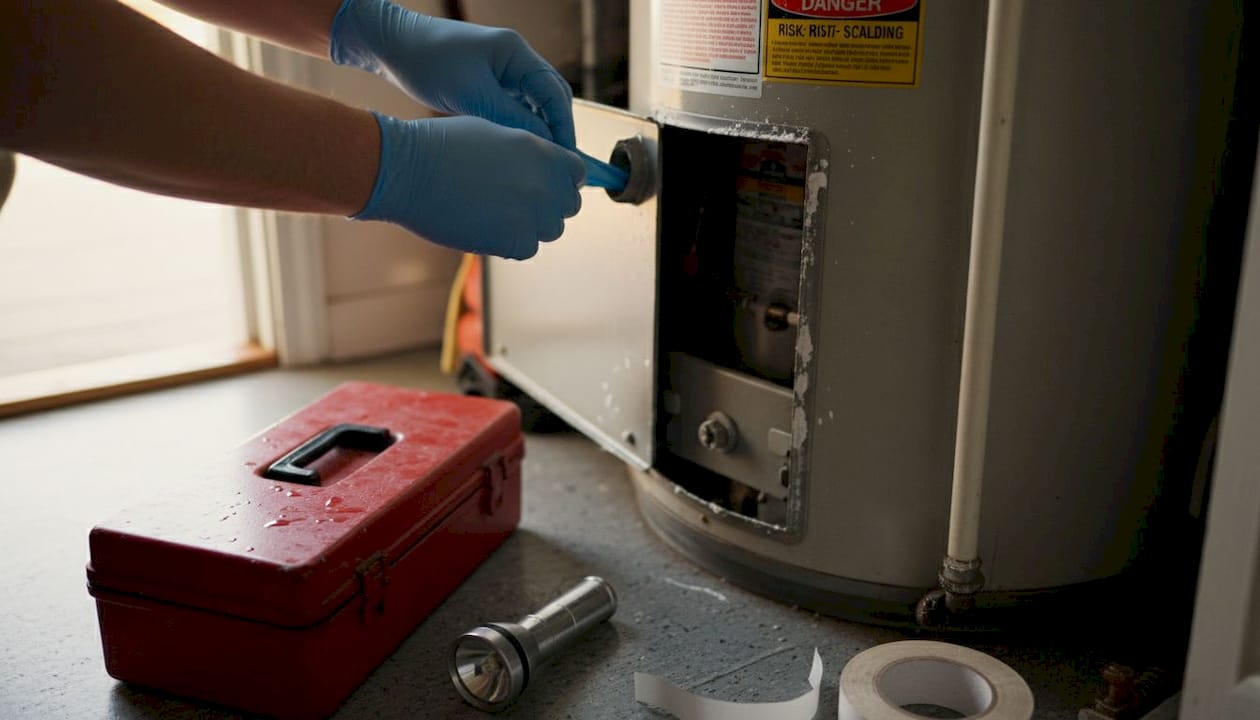
A local note worth remembering: San Antonio’s mineral-rich water leaves thick deposits on parts. Wear gloves and eye protection when removing old components. Mineral scale can flake and irritate skin and eyes. Review our DIY repair steps for a full parts checklist before you head to the hardware store.
Step-by-step DIY fixes for typical water heater issues
After safety is assured and your tools are ready, you can move step-by-step through the most common repair procedures. These are the fixes that most San Antonio homeowners can handle on their own with basic tools and patience.
Before you disconnect anything, take a photo of all wiring, settings, and connections. This one habit prevents hours of confusion during reassembly.
1. Relighting a gas pilot light
- Turn the gas valve to “pilot.”
- Press and hold the reset button while igniting the pilot with a long lighter.
- Hold for 30 to 60 seconds after ignition, then release.
- Turn the valve to “on.” If the pilot won’t stay lit, the thermocouple likely needs replacement.
2. Resetting the high-limit switch (electric)
- Turn off the breaker.
- Remove the access panel and insulation.
- Press the red reset button firmly until you feel a click.
- Restore power and test.
3. Replacing a heating element (electric)
- Turn off power and water. Attach a hose to the drain valve and drain the tank.
- Use an element wrench to remove the old element.
- Install the new element, matching wattage and voltage.
- Refill the tank before restoring power. Never energize an empty tank.
4. Flushing sediment from the tank
- Turn off power or gas and cold water inlet.
- Connect a garden hose to the drain valve and run it outside or to a floor drain.
- Open a hot water faucet inside to allow airflow.
- Open the drain valve and let the tank empty fully.
- Briefly open the cold water inlet to stir and flush remaining sediment.
- Close the drain valve, refill, then restore power or gas.
For fixing your heater with proper DIY steps, always restore water before restoring power.
Pro Tip: In San Antonio, flush your tank every six months rather than the standard annual recommendation. Hard water deposits accumulate twice as fast here, and a twice-yearly flush keeps efficiency high and extends unit life significantly.
| Fix | Tool needed | Est. time | Key caution |
|---|---|---|---|
| Relight pilot | Long lighter | 5 min | Gas smell = stop immediately |
| Reset high-limit | Screwdriver | 10 min | Power off first |
| Replace element | Element wrench | 45 min | Never power an empty tank |
| Flush sediment | Garden hose | 30 min | Drain fully before refilling |
Hard water and preventive maintenance in San Antonio
Getting your heater running again is great, but avoiding future breakdowns is even better, especially with San Antonio’s hard water challenges. Reactive repairs cost far more than proactive maintenance.
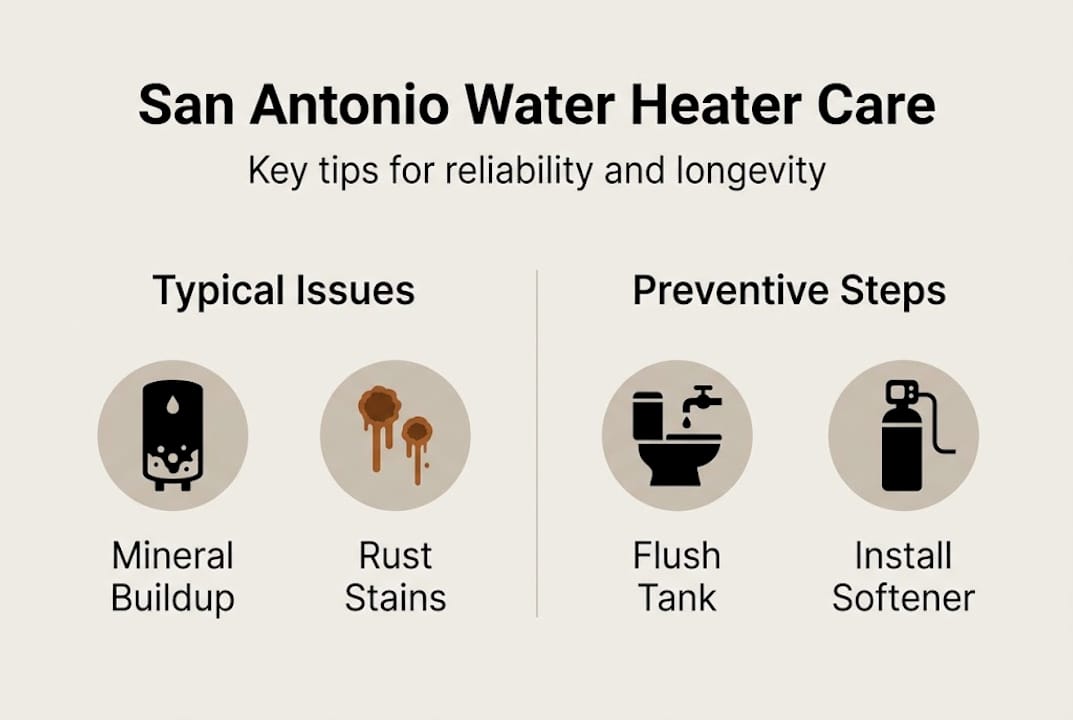
San Antonio’s hard water at 15-20 gpg causes rapid sediment and scale accumulation, contributing to roughly 70% of water heater failures in the area. Scale acts as insulation on heating elements and the tank floor, forcing your unit to work harder and consume 20 to 30% more energy just to reach the same water temperature.
Here’s your annual maintenance checklist:
- Flush the tank one to two times per year to remove sediment. In San Antonio, twice yearly is strongly recommended.
- Inspect the anode rod every two to three years. This sacrificial rod corrodes so your tank doesn’t. For anode rod replacement, shut off power and water, relieve pressure, remove the old rod with a socket wrench, and install the new one. In San Antonio’s hard water, choose aluminum or zinc rods.
- Test the pressure relief valve annually by lifting the lever briefly. Water should flow and stop cleanly.
- Check for corrosion on fittings, the tank shell, and connections. Rust on the outside often signals worse problems inside.
- Inspect the flushing schedule and log each service date on a sticker attached to the unit.
Stat to know: Skipping annual maintenance in San Antonio’s hard water conditions can reduce your water heater’s lifespan to just 4 to 6 years, compared to the standard 8 to 12 years with proper care.
Pro Tip: Installing a water softener is the single most impactful upgrade you can make for your water heater. A softener can extend unit life by 3 to 5 years and reduce energy loss by 20 to 30%, meaning it pays for itself over time in avoided repairs and lower utility bills.
If your heater is over 10 years old, showing persistent rust, or losing efficiency despite regular maintenance, that’s when professional evaluation makes more sense than another DIY fix.
What most water heater DIY guides miss: The San Antonio difference
With maintenance dialed in, let’s look at why standard advice can still let San Antonio homeowners down. Most national DIY guides are written for average water conditions, roughly 7 to 10 gpg of hardness. San Antonio sits at nearly double that. When a generic article tells you to flush your tank once a year and replace the anode rod every five years, that advice was never written with our water in mind.
We’ve seen it repeatedly: homeowners follow textbook repair steps perfectly, fix the immediate problem, and then skip the unique San Antonio factors that determine long-term reliability. Two years later, they’re shopping for a new unit. The hard water demands aggressive maintenance, meaning a softener paired with twice-yearly flushing isn’t optional here. It’s the baseline.
The uncomfortable truth is that a technically correct repair on a neglected tank in San Antonio is still a short-term fix. Addressing the root cause, which is mineral-saturated water attacking your system daily, is what separates homeowners who get 12 years from their heater from those who get 5. If you’re unsure whether repair still makes sense for your unit, our repair or replace decision guide gives you a clear framework.
Need expert help or a permanent fix?
If you reach a point where a fix feels risky or temporary, professional help is just a call away. Some situations go beyond DIY: major tank leaks, heavy corrosion, persistent hard water damage, or a unit that keeps failing despite repairs. In those cases, replacement is often the smarter long-term investment. Our repair vs. replace guide helps you make that call with confidence. At Stultz Plumbing, we handle everything from targeted repairs to full unit upgrades and water softener installation to protect your new investment from San Antonio’s hard water. Explore our full range of San Antonio plumbing services or call us directly for a fast, honest assessment.
Frequently asked questions
How often should I drain my water heater in San Antonio?
You should flush one to two times per year in San Antonio. The city’s hard water deposits sediment faster than average, so twice yearly is the smarter schedule for most homes here.
Can I repair a leaking water heater tank myself?
No. If the tank itself leaks, replacement is the only safe option. There is no effective patch for a corroded or cracked tank, and attempting one creates serious safety and water damage risks.
What safety steps should I take before repairing my water heater?
Always shut off gas or electricity and the cold water supply before starting any repair. If you smell gas or see heavy corrosion on the tank shell, stop and call a professional instead.
How do I know if my water heater needs a new anode rod?
Inspect the rod every two to three years. If it’s more than half-dissolved or heavily coated with scale, replace the anode rod immediately to keep the tank protected from internal corrosion.
How long should a water heater last in San Antonio with proper maintenance?
With consistent annual or semi-annual maintenance, expect 8 to 12 years of reliable service. Without it, San Antonio’s hard water can shorten that to just 4 to 6 years.
Recommended
- Water heater repair vs replace guide for San Antonio 2026
- Water Heater Services in San Antonio TX
- Get Fastest Water Heater Repair Service In San Antonio
- How to fix your water heater: DIY guide San Antonio 2026
Jean runs growth strategy at AimSetWin, a performance marketing agency specializing in local service businesses across Texas. he's helped plumbers, HVAC companies, pest control operators, and home service brands build predictable revenue systems using data-driven advertising and conversion optimization.