

Unlock the best for your home with our guide where water heater options are explained. Make smart choices and save on energy bills!
TL;DR:
- Water heating accounts for roughly 18% of household energy use, making proper selection crucial for savings. Heat pump water heaters are highly efficient and well-suited for San Antonio’s climate, especially with available tax credits. Proper sizing, professional installation, and maintenance ensure optimal performance and longevity of your water heating system.
Your water heater quietly shapes your monthly energy bill more than most people realize. Water heating accounts for about 18% of your home’s total energy use, which means picking the wrong unit costs you real money every single year. Yet most homeowners replace their water heater the same way they replaced their last one, without comparing what’s now available. With water heater options explained clearly in one place, you can make a confident, informed decision instead of a rushed, expensive one. This guide covers every major type, key efficiency metrics, and what actually makes sense for homes here in San Antonio.
Table of Contents
- Key takeaways
- Water heater options explained: the main types
- Understanding efficiency ratings before you buy
- Pros, cons, and real considerations for San Antonio homes
- How to choose the right water heater for your home
- Our honest take on water heater decisions in San Antonio
- Let Stultzplumbing handle your water heater the right way
- FAQ
Key takeaways
| Point | Details |
|---|---|
| Know your types | Tank, tankless, heat pump, and solar systems each serve different household needs and budgets. |
| UEF and FHR matter | These two efficiency ratings tell you more about real-world performance than tank size alone. |
| Heat pumps win on savings | HPWHs can cut annual water heating costs by more than half compared to electric resistance tanks. |
| San Antonio climate helps | Our mild winters mean heat pump water heaters run efficiently almost year-round with minimal backup heat. |
| Professional install is non-negotiable | Improper installation voids warranties and can fail code inspections, especially for advanced systems. |
Water heater options explained: the main types
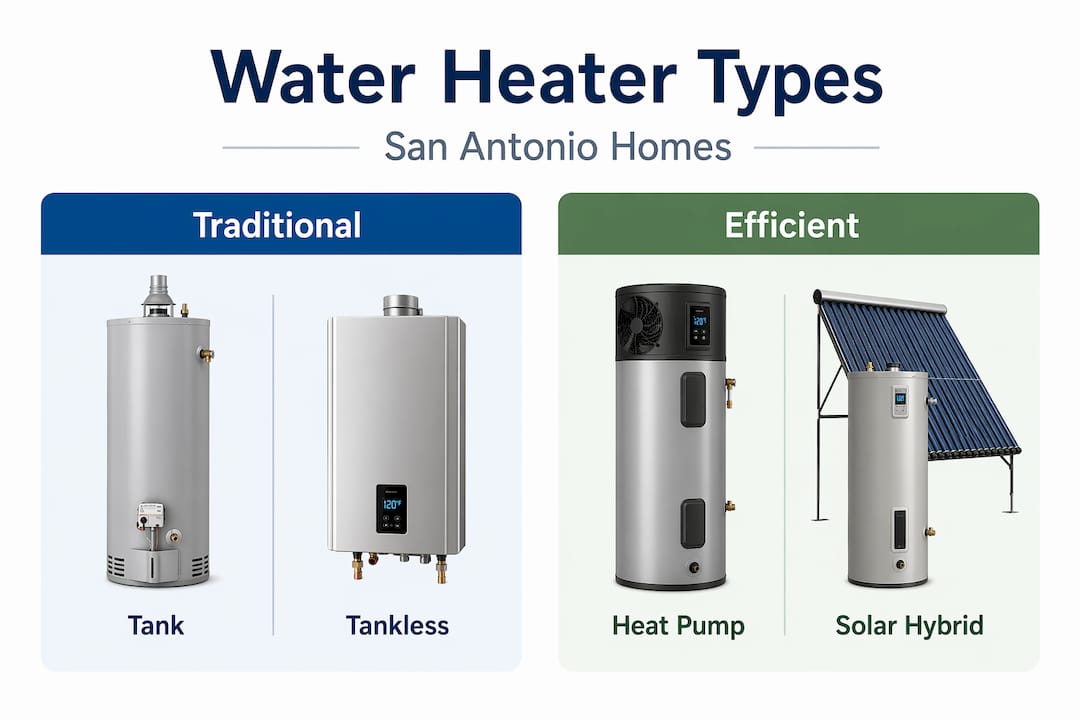
Understanding the types of water heaters available today is the foundation of any good buying decision. The market has changed significantly over the last decade, and not every option you see at a big-box store is the right fit for your home.
Storage tank water heaters
Storage tank heaters are the most common unit in American homes. They hold a reservoir of pre-heated water, typically 30 to 80 gallons, and use either electricity or natural gas to keep it at temperature around the clock. Gas models tend to heat water faster and usually cost less to operate per gallon than electric resistance models, but the gap is narrowing as electricity-powered technologies improve. These units are familiar, affordable to purchase, and easy to replace.
The trade-off is standby heat loss. You pay to keep water hot even when nobody is using it. In a home with a 50-gallon tank running 24 hours a day, that idle cost adds up fast.
Tankless (on-demand) water heaters
Tankless units heat water only when you turn on a tap. There is no stored water, so there is no standby heat loss. That is one of the clearest advantages in any water heater features comparison. They can run on gas or electricity and typically last 20-plus years, which is longer than most tank units.
One real limitation is what installers call the “cold water sandwich.” When you use hot water in short bursts, you may feel a brief surge of cold water between draws. Proper installation and sizing minimize this effect, but it’s worth knowing before you commit.
Heat pump water heaters
Heat pump water heaters, or HPWHs, work by pulling heat from the surrounding air and transferring it into the water. They do not generate heat directly. That is why HPWH efficiency ratings reach 2.0 to 4.0 UEF, compared to just 0.90 to 0.95 for standard electric resistance tanks. In simple terms, they deliver three to four times more hot water per dollar of electricity.
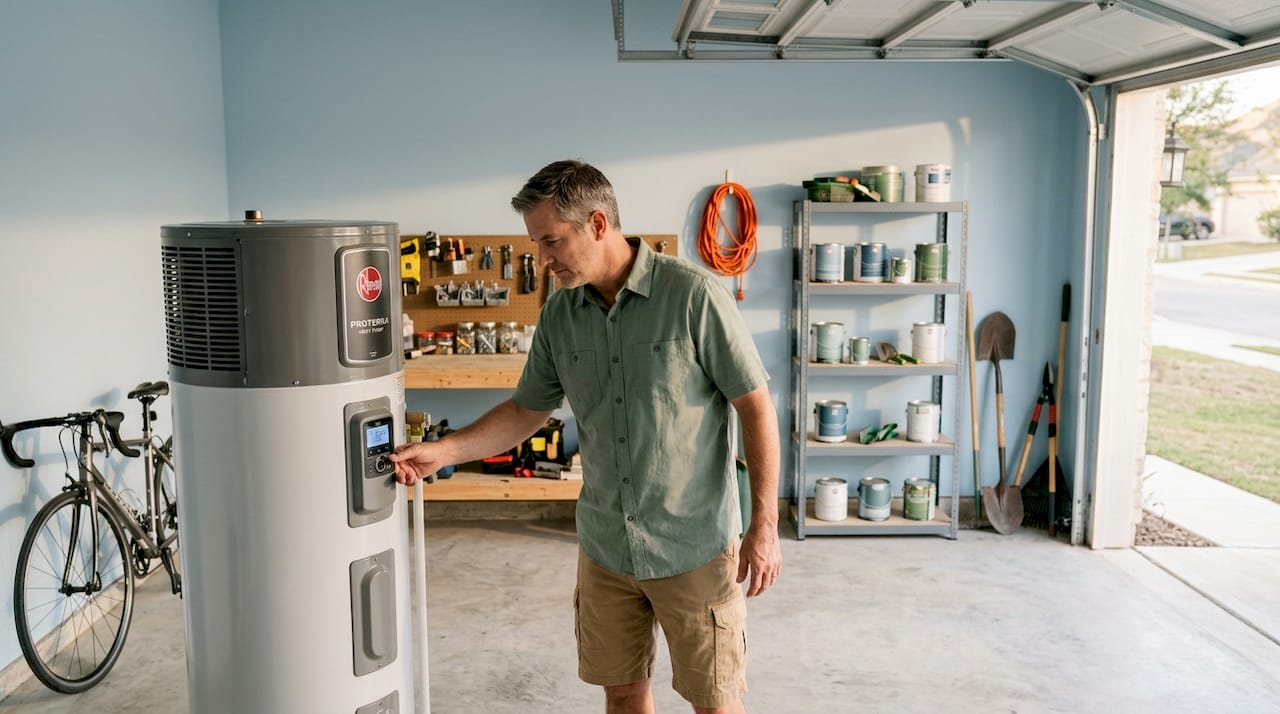
A bonus most people don’t expect: HPWHs can provide mild dehumidification and cooling in garages and basements as a byproduct of their operation. In San Antonio’s humid summers, that’s a genuine perk.
Solar and hybrid systems
Solar thermal water heaters use rooftop collectors to capture heat from the sun and transfer it to a storage tank. They work well in high-sun climates and can dramatically cut fuel costs. That said, they require a backup heating element for cloudy days and carry higher upfront installation costs. Hybrid systems combine technologies, such as a heat pump with a gas backup, to balance efficiency and reliability.
Pro Tip: If you’re comparing tankless water heater options against heat pump models, run the numbers on your actual electricity rate in San Antonio. The local utility environment often makes HPWHs the clear winner for electric homes.
| Type | Fuel Source | UEF Range | Best For |
|---|---|---|---|
| Storage tank (gas) | Natural gas | 0.60 to 0.70 | Budget-conscious buyers, fast recovery |
| Storage tank (electric) | Electricity | 0.90 to 0.95 | Simple installation, smaller homes |
| Tankless | Gas or electric | 0.82 to 0.96 | Small households, long-term savings |
| Heat pump (HPWH) | Electricity | 2.0 to 4.0 | Efficiency-focused, larger families |
| Solar thermal | Solar + backup | Varies | High-sun climates, eco-priority buyers |
Understanding efficiency ratings before you buy
Reading the yellow EnergyGuide label on a water heater used to be straightforward but not very accurate. The old Energy Factor (EF) rating did not reflect how most families actually use hot water. That is why UEF replaced the older EF rating to better reflect typical household patterns, using four standardized draw profiles from low to very high.
A higher UEF means more efficient operation. For most families, a unit with a UEF above 2.0 delivers significant savings. Electric resistance tanks rarely exceed 0.95, which is why heat pump models are changing the market.
First Hour Rating: the metric most buyers ignore
First Hour Rating (FHR) tells you how many gallons of hot water a unit can deliver in the first hour of use, starting from a full tank. Sizing a water heater by FHR is far more practical than sizing by tank capacity alone. A 40-gallon tank with a fast recovery gas burner can outperform a 50-gallon electric tank in a busy morning.
The key is to match FHR to your household’s actual peak demand. Add up hot water uses that happen within an hour at your busiest time of day: showers, dishwasher, laundry. That sum should be at or below your unit’s FHR.
Pro Tip: A family of four typically needs an FHR of at least 60 to 80 gallons. If you’re regularly running out of hot water, the problem is usually FHR, not tank size.
Tax credits that change the math
Under the 2026 Inflation Reduction Act, homeowners can receive up to $2,000 in federal tax credits when they install a qualifying heat pump water heater. That credit directly offsets installation cost and can make an HPWH cost-competitive with a standard electric tank from day one. Check current IRS guidance to confirm your unit qualifies before purchasing.
Pros, cons, and real considerations for San Antonio homes
Moving from types to real-world application means talking about money, space, and installation requirements honestly.
Tank water heaters: familiar but not always the best value
Standard gas and electric tanks are cheap to buy, typically $400 to $900 for the unit, and any licensed plumber can install them. The problem is long-term operating cost. A standard electric resistance tank can cost $500 to $700 annually to run. Over a 10-year lifespan, that is $5,000 to $7,000 in energy spending. Gas tanks are less expensive to operate but require proper venting and a gas supply line.
Tankless: great in the right situation
Tankless units eliminate standby losses entirely, but they come with higher installation costs. A gas tankless unit often requires upgrading the gas line and adding proper venting. An electric tankless unit may need a panel upgrade. For smaller households with predictable usage patterns, the long-term savings are real. For larger families with simultaneous demand, a single unit may struggle to keep up without proper sizing.
Here are the main practical factors to weigh:
- Upfront cost. Tankless units run $800 to $2,000 for the unit alone, plus $500 or more in installation depending on what upgrades your home needs.
- Recovery rate. Tankless units provide continuous hot water for one or two simultaneous uses. Running a shower and dishwasher at the same time can test the limits of a smaller unit.
- Lifespan. Tankless units frequently last 20-plus years, roughly twice as long as most tank models.
- Maintenance. Annual descaling in hard water areas like San Antonio is necessary to maintain efficiency and prevent scale buildup.
Heat pump water heaters: the strongest choice for most San Antonio homes
An HPWH installed in San Antonio costs between $1,200 and $3,500, depending on unit size and installation complexity. After the IRA tax credit, net cost drops to as little as $1,000 to $1,500 for many homeowners. Annual operating costs run $150 to $300 versus $500 to $700 for standard electric tanks.
There are real installation requirements. HPWHs need 700 to 1,000 cubic feet of surrounding air volume to operate correctly, along with condensate drainage. Most garages, utility rooms, and unconditioned spaces in San Antonio homes meet these requirements easily.
The efficiency does drop below about 40°F ambient temperature, when the unit switches to resistance backup mode. In San Antonio, that threshold is rarely hit for more than a few nights per year, which makes HPWHs a near-perfect match for our climate.
New 120V plug-in HPWH models simplify the retrofit even further by eliminating the need for a 240V circuit upgrade. Recovery rates are slower, but for households with moderate demand, they are a practical entry point.
Pro Tip: Before choosing between tankless or traditional water heater options, get a plumber to assess your current electrical panel and gas line. Your existing infrastructure often decides the most cost-effective path.
How to choose the right water heater for your home
The best water heater for your neighbor may be the wrong one for you. Here is how to approach the decision clearly.
Start by honestly assessing your household’s hot water demand. Count the number of people in your home, identify the busiest morning window, and note how many fixtures you run simultaneously. That picture shapes your FHR requirement and your capacity needs.
Then consider your fuel situation:
- Natural gas available. Gas tank or gas tankless units offer fast recovery and competitive operating costs. Gas tankless is a strong long-term pick for moderate households.
- Electric only. A heat pump water heater is almost always the best water heater choice for electric-only homes in San Antonio. The efficiency gap over standard electric resistance is too large to ignore.
- Looking to future-proof. HPWHs pair well with solar panels because they draw electricity when rates are low and demand is flexible.
Budget considerations matter too. If upfront cost is the constraint, a standard gas tank or a basic electric tank gets the job done today. If you can absorb a higher initial investment, an HPWH or gas tankless unit delivers meaningful savings over its lifespan.
For anyone weighing whether to repair or replace your water heater, a unit over 10 to 12 years old is usually at the tipping point where replacement makes more financial sense than continued repair.
Maintenance extends the life of any unit. Flush tank-style heaters annually to remove sediment. Inspect anode rods every two to three years. Descale tankless and heat pump units if you have hard water. San Antonio’s water supply can be mineral-heavy, so this step matters more here than in many other cities.
Our honest take on water heater decisions in San Antonio
By Jean
In my experience working with San Antonio homeowners across hundreds of installations, the biggest mistake I see is people defaulting to whatever they had before. If your last unit was a 50-gallon electric tank, the assumption is that the next one should be the same. That logic is money left on the table.
I’ve watched families pay $600 a year to heat water with an aging electric resistance tank when an HPWH would have cut that bill in half and paid for itself within four years. The tax credit changed the calculus even further. The honest truth is that for most electrically powered San Antonio homes, there is now a clear best answer: a heat pump water heater.
What I find people overlook most is the space requirement for HPWHs. Many homeowners assume their closet will work. Often it won’t. A garage or large utility room is the better fit. That’s a layout conversation to have before you buy, not after the unit arrives.
For smaller households or homes where gas is already plumbed, a tankless gas unit is my second recommendation. It handles daily demand cleanly and lasts long enough to justify its cost.
The technology is genuinely getting better every year. The new 120V plug-in heat pump models are opening up this category to homes that previously would have needed an electrical upgrade. That’s a meaningful shift for older San Antonio housing stock.
Pick the right type, size it correctly by FHR, and install it by a licensed professional. Do those three things and your water heater becomes a background appliance you stop thinking about. That’s exactly what it should be.
— Jean
Let Stultzplumbing handle your water heater the right way
Choosing the right water heater is only half the job. Getting it installed correctly, with the right permits and code compliance, is what protects your investment long-term.

At Stultzplumbing, we specialize in water heater installation and repair for San Antonio homeowners, including complex heat pump water heater retrofits that require proper condensate drainage, airflow verification, and electrical coordination. Our licensed technicians assess your home’s actual setup before recommending a unit, not after you’ve already bought one.
We handle water heater replacement in San Antonio for all major system types, including gas tank, electric tank, tankless, and heat pump units. We pull the required permits, handle the installation from start to finish, and walk you through the IRA tax credit paperwork so you can claim every dollar you’re entitled to.
Emergency water heater failures don’t wait for business hours. Our team offers prompt response for urgent replacements across San Antonio and surrounding communities. If your unit is failing or already gone, call us and we’ll get hot water back in your home fast. Reach out today for a free consultation and honest, upfront quote.
FAQ
What is the most energy-efficient water heater type?
Heat pump water heaters are the most energy-efficient option available, with UEF ratings between 2.0 and 4.0, compared to 0.90 to 0.95 for standard electric resistance units.
How do I know what size water heater I need?
Use the First Hour Rating (FHR) rather than tank size. Calculate the total gallons your household uses during your busiest hour and choose a unit whose FHR meets or exceeds that number.
Are heat pump water heaters a good choice in San Antonio?
Yes. San Antonio’s mild winters mean HPWHs rarely drop into less-efficient resistance mode, making them one of the best water heater choices for local homes, especially after the IRA tax credit.
What is the difference between UEF and EF ratings?
UEF (Uniform Energy Factor) replaced the older EF rating because it uses realistic usage patterns to measure efficiency. A higher UEF means lower operating costs in real-world conditions.
How long does a water heater typically last?
Standard tank water heaters last 8 to 12 years, while tankless units can last 20 years or more with proper maintenance. Heat pump water heaters typically fall in the 10 to 15-year range depending on installation quality and usage.
Recommended
- Essential Water Heater Basics for San Antonio Homeowners
- Water Heater Services in San Antonio TX
- Water heater repair vs replace guide for San Antonio 2026
- Tankless vs. Traditional Water Heaters | Stultz Plumbing
Jean runs growth strategy at AimSetWin, a performance marketing agency specializing in local service businesses across Texas. he's helped plumbers, HVAC companies, pest control operators, and home service brands build predictable revenue systems using data-driven advertising and conversion optimization.


