

Discover why maintain water heaters is crucial for saving money and reducing repairs. Simple steps can extend your heater's life. Click to learn more!
TL;DR:
- Neglecting water heater maintenance in San Antonio leads to sediment buildup, higher energy bills, and premature failure. Routine tasks like flushing, inspecting the anode rod, and safety checks significantly extend the system’s lifespan and safety. Professional support can ensure these tasks are done correctly, preventing costly breakdowns and water damage.
Your water heater is one of the hardest-working appliances in your home, and most homeowners treat it like it runs on autopilot. No filters to change, no visible wear to inspect, no obvious reason to open the utility closet door. But that “set-and-forget” attitude is quietly driving up your energy bills and shortening your equipment’s life. Tank sediment and mineral scale act like insulation around your heating element, forcing your system to burn more fuel to deliver the same hot water. A few simple steps each year can prevent this entirely.
Table of Contents
- What happens when you neglect water heater maintenance?
- How routine maintenance extends water heater life and safety
- Maintenance schedule: What, when, and how often for San Antonio homes
- DIY or call a pro? Handling sediment, worn parts, and safety checks
- The truth most homeowners miss about water heater maintenance
- Professional water heater support for San Antonio homes
- Frequently asked questions
Key Takeaways
| Point | Details |
|---|---|
| Save energy and money | Routine water heater maintenance lowers your utility bills by keeping the system running efficiently. |
| Prevent costly breakdowns | Regular flushing and checks reduce major repair risks and extend water heater life. |
| Boost home safety | Maintenance helps catch early safety issues, like valve problems, before they become emergencies. |
| Tailor your schedule | Adjust your maintenance routines based on San Antonio’s hard water and home usage for best results. |
What happens when you neglect water heater maintenance?
San Antonio’s water supply is notoriously hard, meaning it carries a high concentration of dissolved minerals like calcium and magnesium. Every time your water heater heats that water, those minerals separate and sink to the bottom of the tank as sediment. Over months and years, that layer thickens into a dense crust. What starts as a minor inefficiency becomes a serious problem.
Here is what neglect actually costs you:
- Higher energy bills. That sediment layer insulates the tank floor from the burner below, so your unit runs longer to hit its target temperature. You pay for every extra minute.
- Inconsistent hot water. A thick sediment bed reduces usable tank capacity and forces your heater to work harder, leading to lukewarm water mid-shower.
- Unusual noises. Popping, rumbling, or banging sounds from your water heater are almost always sediment being disturbed during heating cycles. It is not harmless.
- Premature failure. Sediment buildup leads to premature failure and inconsistent hot water performance, cutting years off your unit’s expected lifespan.
- Risk of leaks and corrosion. Sediment traps heat at the tank bottom, which accelerates corrosion from the inside out. A corroded tank can develop slow leaks before you ever notice a problem.
“Most homeowners don’t connect their rising utility bills to their water heater. But a heavily sediment-clogged tank can consume significantly more energy than a well-maintained one delivering the same result.” — Stultz Plumbing field technicians
Knowing the signs you need water heater repair before problems escalate is just as important as knowing your maintenance schedule. And if neglect has gone on long enough, it pays to review the water heater replacement signs so you are not pouring money into a unit that’s past saving.
Pro Tip: San Antonio’s hard water accelerates sediment buildup faster than softer water regions. If your home hasn’t had a water softener installed, plan to service your water heater more frequently than the national average suggests.
How routine maintenance extends water heater life and safety
The case for regular maintenance goes beyond saving money on your next utility bill. Done consistently, it keeps your family safe, protects one of your most expensive home systems, and prevents the kind of emergency calls that nobody wants to make at 11 PM on a weekend.

Regular maintenance extends lifespan by reducing corrosion risk and catching safety hazards early, including temperature-pressure relief valve failures that can go unnoticed until they become dangerous. A well-maintained water heater typically lasts 10 to 15 years. A neglected one in a hard-water city like San Antonio might fail in 7 to 8 years, or even sooner.
Here is what a proper maintenance routine actually covers:
- Tank flushing. Removes accumulated sediment and mineral deposits before they can harden into scale.
- Anode rod inspection. The anode rod (a metal rod inside the tank designed to attract corrosive elements) sacrifices itself to protect the tank walls. When it’s depleted, the tank corrodes instead. Replacing a worn anode rod costs far less than replacing a corroded tank.
- Temperature-pressure relief valve testing. This valve is a safety device. If internal pressure builds too high, it releases to prevent catastrophic failure. A stuck or faulty valve is a genuine hazard that regular checks catch before it becomes a crisis.
- Temperature setting verification. Your heater should be set to 120 degrees Fahrenheit. Too low and bacterial growth becomes a risk. Too high and you’re burning unnecessary fuel, plus creating a scalding hazard.
- Connection and fitting inspection. Catching a slow leak at a pipe fitting or connection point early prevents water damage that can run into thousands of dollars in repairs.
Stat to know: A water heater with significant sediment accumulation can operate at notably reduced efficiency compared to a clean unit, meaning routine flushing can produce measurable savings on your monthly energy costs year after year.
For more San Antonio water heater maintenance tips specific to our local water conditions, or to understand the full picture of how to extend water heater life, those resources break things down in practical detail.
Pro Tip: Test your temperature-pressure relief valve once a year by lifting the lever briefly and letting it snap back. If it doesn’t release water and reseat cleanly, call a professional. A failed valve is not a DIY fix.
Maintenance schedule: What, when, and how often for San Antonio homes
One of the most common questions we hear is: how often do I actually need to do this? The honest answer is that it depends on your water quality, household size, and how long your unit has gone without service. But here is a reliable framework.
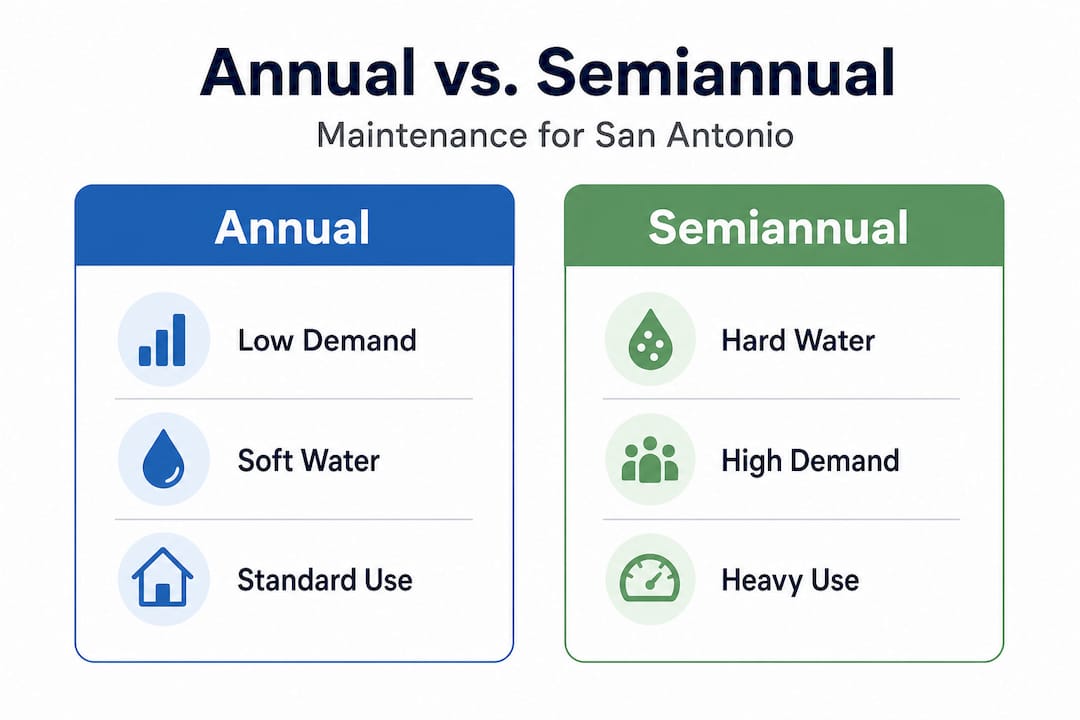
Flushing at least once a year is the standard guideline for regular use. For hard water or heavy household demand, every six months is the smarter approach. Some experts recommend flushing up to four times per year for areas with very hard water, which puts San Antonio squarely in the “more frequent” category for most households.
| Maintenance task | Recommended frequency | Why it matters |
|---|---|---|
| Tank flush | Every 6 to 12 months | Removes sediment and scale |
| Anode rod inspection | Every 2 to 3 years | Prevents internal tank corrosion |
| T&P valve test | Once a year | Critical safety check |
| Temperature setting check | Once a year | Efficiency and safety |
| Pipe connection inspection | Once a year | Catches early leaks |
| Full professional service | Every 1 to 2 years | Catches issues you might miss |
For most San Antonio homeowners, we recommend this step-by-step approach each year:
- Turn off the cold water supply to the heater and connect a garden hose to the drain valve at the base of the tank.
- Run the other end of the hose to a floor drain, driveway, or outdoor area where hot water can safely discharge.
- Open the drain valve and let the tank empty fully. Watch what comes out. Cloudy or discolored water is a clear indicator of significant sediment.
- Briefly open the cold water supply to flush remaining debris out through the drain hose.
- Close the drain valve, disconnect the hose, and refill the tank completely before relighting the pilot or restoring power.
- Test the T&P valve while the unit refills.
- Inspect the area around the unit for moisture, rust staining, or corrosion at any connection point.
Understanding water heater flushing frequency for San Antonio’s specific water chemistry matters here. And if your unit is aging or has had repeated issues, reviewing the factors behind repair or replace water heater decisions can save you from investing further in a unit that is near the end of its useful life.
Pro Tip: Mark your calendar the same month every year for your water heater flush. Treating it like a yearly appointment, the same way you would an HVAC tune-up, is the simplest way to make sure it actually happens.
DIY or call a pro? Handling sediment, worn parts, and safety checks
Not every maintenance task belongs on a homeowner’s to-do list. Some are genuinely simple. Others carry real risk if the unit is older, hasn’t been serviced, or has components in unknown condition.
| Task | DIY-friendly? | Notes |
|---|---|---|
| Annual tank flush (well-maintained unit) | Yes, with care | Only if drain valve is in good condition |
| T&P valve test | Yes | Stop if it doesn’t reseat properly |
| Temperature setting adjustment | Yes | Use a thermometer to verify accuracy |
| Anode rod replacement | Proceed with caution | Requires proper tools and knowledge |
| Sediment flushing on neglected tank | Call a pro | Risk of stuck valve or cracked fitting |
| Gas line or burner inspection | Always call a pro | Safety hazard without proper training |
| Electrical connection checks (electric heaters) | Always call a pro | Shock risk and code compliance |
If you have not flushed since installation, or you are uncertain about the condition of key components like the anode rod, calling a professional is the right call. Trying to drain a heavily sediment-clogged tank for the first time can damage the drain valve, making a simple maintenance task turn into an emergency repair.
Watch for these warning signs before and after any maintenance work:
- Discolored or rust-tinted hot water at your taps
- Rotten egg smell in hot water (a sign of bacterial growth or anode rod failure)
- Water pooling near the base of the unit
- The T&P valve leaking or dripping without being tested
Knowing the water heater warning signs that indicate something more serious is going on is just as important as the maintenance steps themselves. And if you are unsure whether your unit needs service or full replacement, our team offering water heater service in San Antonio can assess it quickly and give you a straight answer.
Pro Tip: Before attempting any maintenance, confirm whether your water heater is still under manufacturer warranty. Some warranties require professional servicing to remain valid, and a DIY flush could void coverage you didn’t know you had.
The truth most homeowners miss about water heater maintenance
Here is something we have seen play out many times in San Antonio homes: the homeowner who calls us for an emergency water heater replacement was often 30 minutes of maintenance away from avoiding that call entirely. That is the uncomfortable reality.
Most “unexpected” water heater failures are not really unexpected. They are the predictable end result of a long chain of skipped steps. The sediment built up over years. The anode rod was never inspected. The T&P valve was never tested. And then one day, the system that was silently struggling finally gives out, usually at the worst possible moment.
We understand why homeowners wait. The water heater is in a closet or garage, out of sight and out of mind. It keeps working until it doesn’t. And because failures are relatively rare in any given year, maintenance feels unnecessary. That logic makes sense until it doesn’t.
What we wish every San Antonio homeowner understood is this: the cost of a single service call or emergency replacement almost always exceeds what years of routine maintenance would have cost. A basic flush takes less than an hour. An anode rod swap is a fraction of what a corroded tank replacement runs. Even a professional annual service visit is a fraction of the cost of water damage caused by a failed tank.
Learning to prolong your system’s life with simple, consistent attention is genuinely one of the highest-return habits a homeowner can build. The technology inside a water heater is not complicated. What it needs is attention, and that is something you can control right now.
Professional water heater support for San Antonio homes
Knowing what to do is one thing. Having a trusted local team ready to back you up is another.

At Stultz Plumbing, we provide full professional water heater service across San Antonio, covering everything from annual flushes and anode rod replacements to T&P valve inspections and full unit replacement when the time comes. Our technicians know San Antonio’s hard water challenges firsthand and can spot the kind of early-stage wear that homeowners typically miss. Whether you need routine maintenance scheduled today or a fast response to a failing unit, our affordable plumbing services are built around transparent pricing and same-week availability. And when something goes wrong at an inconvenient hour, our emergency plumbing help is available to get your home back to normal fast.
Frequently asked questions
How often should I flush my water heater in San Antonio?
For most San Antonio homes, once a year is the minimum, but every 6 months is better given the area’s hard water. Hard water and heavy use are the two factors that most justify more frequent flushing.
What are the most important water heater maintenance tasks?
Flushing the tank, inspecting the anode rod, and testing the temperature-pressure relief valve are the three most critical tasks. These checks reduce corrosion risk and catch safety issues before they escalate into serious hazards.
Is water heater maintenance really worth the effort?
Absolutely. Sediment and mineral scale force your heater to consume more energy to do the same job, and regular maintenance directly addresses that efficiency drain while extending your unit’s useful life.
When should I call a professional for water heater care?
Call a professional if you have never flushed the tank, notice rust-colored water, hear loud rumbling, or suspect the anode rod needs replacement. If component condition is unknown, a professional service visit prevents well-intentioned DIY from turning into a costly repair.
What happens if I skip water heater maintenance?
Skipping maintenance allows sediment buildup to cause premature failure, inconsistent hot water, and higher energy bills, all of which compound over time into a much larger and more expensive problem.
Recommended
- Regular plumbing maintenance: lower costs, fewer headaches
- Water heater repair costs in San Antonio: 5 key factors
- Extend your water heater’s life: Essential San Antonio tips
- Repair or replace your water heater? Make the right choice
Jean runs growth strategy at AimSetWin, a performance marketing agency specializing in local service businesses across Texas. he's helped plumbers, HVAC companies, pest control operators, and home service brands build predictable revenue systems using data-driven advertising and conversion optimization.


