

Discover how much does leak detection cost in San Antonio homes. Learn pricing factors to save on repairs and protect your property!
TL;DR:
- Leak detection costs in San Antonio vary based on foundation type, property size, and technology used.
- Typical prices range from $150 to $400, with flat-fee options around $199.
- Early detection through testing and visual signs saves money and prevents structural damage.
Leak detection in San Antonio doesn’t have to break the bank, and most homeowners are surprised to learn just how affordable a professional diagnosis can be. When a hidden pipe is leaking inside your slab or behind a wall, the real cost isn’t the detection fee; it’s the water damage, mold, and structural repairs that pile up when you wait. Knowing what to expect before you pick up the phone puts you in control. This guide walks you through real local pricing, what each dollar buys, and how to protect your home without overpaying.
Table of Contents
- What influences leak detection cost in San Antonio?
- Typical leak detection pricing: Examples and data
- What’s included in a typical detection service?
- Saving money and avoiding hidden plumbing costs
- Expert perspective: What most guides miss about leak detection pricing
- Affordable leak detection and plumbing help in San Antonio
- Frequently asked questions
Key Takeaways
| Point | Details |
|---|---|
| Local pricing range | Leak detection in San Antonio typically costs between $150 and $400, with $199 as a common flat-rate. |
| What’s included | Standard leak detection usually covers locating the source and providing a written diagnosis, but repairs cost extra. |
| Save on costs | Ask if the detection fee applies to repairs and practice regular maintenance to keep plumbing bills low. |
| Choose wisely | Select leak detection based on service quality and reputation as well as price for the best results. |
What influences leak detection cost in San Antonio?
Price is rarely random in the plumbing industry. Every quote you receive reflects specific conditions at your property, and understanding those conditions helps you evaluate whether a number is fair.
Property size and foundation type are two of the biggest drivers. A smaller pier-and-beam home in Alamo Heights gives a technician relatively easy access to pipes running beneath the floor. A large slab-foundation house in Leon Springs, on the other hand, requires more time, more specialized tools, and often more interpretation of signals picked up through concrete. Slab leaks, specifically, involve water escaping from pressurized pipes embedded in or beneath the concrete foundation. Locating them without ripping everything up demands precision equipment like acoustic listening devices, which detect the distinct sound frequency of escaping water, or thermal imaging cameras, which reveal temperature changes caused by wet concrete.
Pipe complexity and age also matter. Homes with older galvanized steel pipes tend to develop multiple problem areas at once, meaning a plumber may need to trace more of the system before they can pinpoint the source. Homes with modern PEX (cross-linked polyethylene) tubing are generally easier to diagnose because PEX is flexible and less prone to corrosion.
Access points change the equation too. When leak detection requires cutting into drywall, moving fixtures, or working in a crawl space, labor time increases. Some companies bundle that access work into a flat fee; others bill separately.
Pricing models vary across the San Antonio market. Some plumbers charge by the hour, typically between $75 and $150 per hour for their time plus equipment. Others offer flat-fee detection packages. For example, one local plumber charges a flat $199 for leak detection, which gives homeowners predictable costs with no surprise charges.
Key factors that push your price up or down include:
- Foundation type: Slab foundations cost more to inspect than pier-and-beam
- Number of suspected leak points: One isolated zone is cheaper than a whole-house scan
- Technology required: Acoustic detection is standard; thermal imaging or video pipe inspection may cost more
- Distance and travel: Some plumbers add a service call fee for neighborhoods farther from their base of operations
- Time of day or urgency: Emergency calls outside business hours often carry a premium
Pro Tip: Before you confirm any appointment, ask your plumber directly: “What does this fee include, and are there any additional charges for the tools your technician will use?” A reputable company answers that question without hesitation.
For a deeper look at the methods plumbers use, our guide on detecting water leaks explains the technology behind acoustic detection and thermal imaging in plain terms. And if you want to understand why staying ahead of plumbing problems saves money in the long run, our resource on plumbing inspections is worth reading.
Typical leak detection pricing: Examples and data
Numbers anchor expectations. Here’s a realistic look at what San Antonio homeowners currently pay for professional leak detection.
| Service type | Typical price range | What’s usually included |
|---|---|---|
| Basic acoustic detection | $150 to $250 | System walkthrough, pinpoint location, written report |
| Flat-fee detection package | $199 (common local rate) | Full diagnosis, leak location, basic findings summary |
| Advanced thermal imaging | $250 to $400 | Thermal scan of walls/slab, detailed imaging report |
| Whole-home detection | $300 to $500 | Multi-zone inspection, all detection methods combined |
| Emergency/after-hours call | $350 to $600+ | Detection plus after-hours labor surcharge |
Community feedback confirms these figures. One flat-fee option at $199 was specifically mentioned as competitive and fair for basic detection in the San Antonio area.
The middle of the price range, roughly $150 to $400, captures the majority of standard residential jobs. You’ll land at the lower end when the leak is accessible and the diagnosis is straightforward. You’ll land at the higher end when a plumber needs thermal imaging, multiple visits, or extended time tracing a slab leak through 2,000 square feet of concrete.
Important to know: The average American household wastes nearly 10,000 gallons of water per year from household leaks, according to the EPA. That waste costs money every month on your water bill. A one-time detection fee of $200 pays for itself quickly when you consider how much a running slab leak adds to your monthly expenses.
What about pricing that seems unusually low? Be cautious. A $75 leak detection offer might cover a quick visual walkthrough with no specialized equipment. If a plumber isn’t using acoustic listening devices or pressure testing your system, they may miss a slab leak entirely. You’d pay again when the real problem surfaces weeks later. Verify what diagnostic methods are included before you book.
Pro Tip: Look up reviews specifically mentioning whether the company found the leak on the first visit. That outcome, not the price, is the real measure of value.
For a full breakdown of local cost data, our page on San Antonio leak detection cost facts covers additional pricing variables specific to this region.
What’s included in a typical detection service?
Knowing the price range is useful. Knowing exactly what comes with that price is essential. Many homeowners book a service call expecting one thing and receive another, which leads to frustration, extra costs, and sometimes a second visit from a different company.
Here’s what a standard leak detection package typically covers:
- Pressure test: Your plumber checks line pressure to confirm there’s an active leak in the system
- Acoustic listening scan: The technician uses a listening device pressed to the floor or walls to identify the characteristic sound of escaping water
- Leak origin report: A written or verbal summary of where the leak is located and what pipe or fixture is likely involved
- Access assessment: An explanation of how the leak can be reached and what repair will involve
Here’s what’s usually not included in a base detection fee:
- Cutting into drywall or concrete to access the pipe
- Completing any actual repairs
- Follow-up visits if the first scan doesn’t pinpoint the leak
- Full thermal imaging scans (these are often add-ons or part of premium packages)
- Video camera inspection of drain lines
The table below shows how standard and premium packages typically differ:
| Feature | Standard package | Premium package |
|---|---|---|
| Acoustic detection | Included | Included |
| Thermal imaging | Not included | Included |
| Written report | Basic summary | Detailed documentation |
| Drain camera inspection | Not included | Included |
| Second visit if needed | Billed separately | Sometimes included |
| Repair estimate | Verbal only | Written quote |
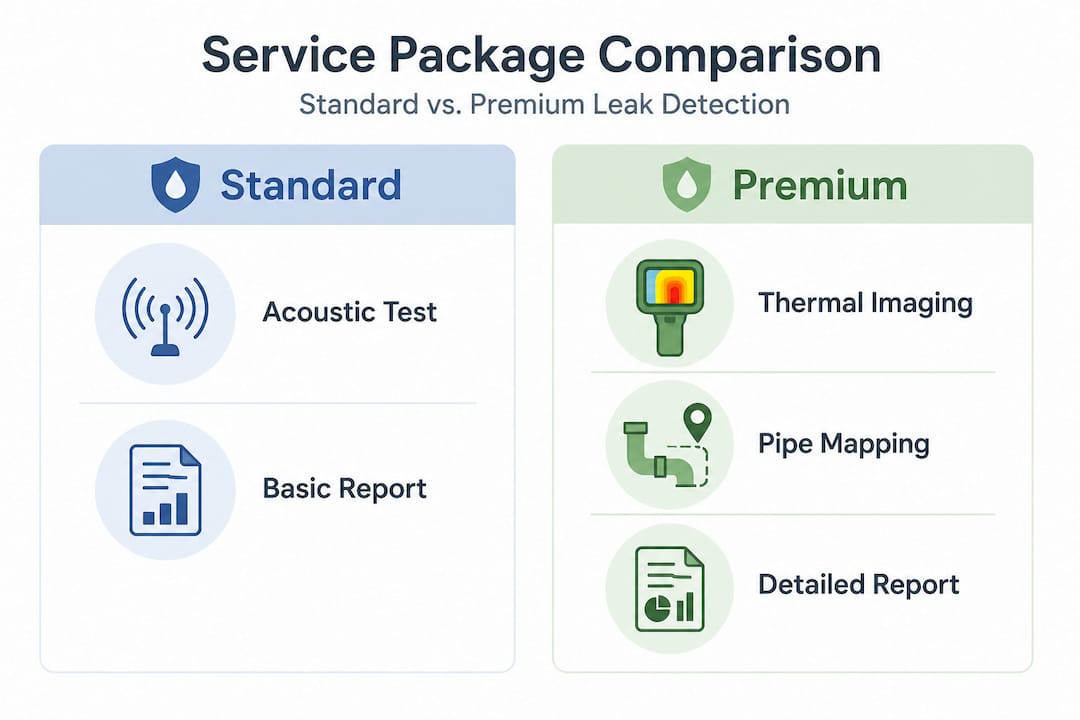
A flat-fee service like the $199 option mentioned by locals typically falls under the standard package column. That’s not a criticism. For most residential slab or supply-line leaks, acoustic detection is sufficient to find the problem accurately.
Before your appointment, confirm these specifics with your plumber:
- Will they provide a written report of findings?
- Is the repair estimate included or separate?
- If advanced imaging becomes necessary mid-job, how is the additional cost handled?
For help planning your overall water leak repair budgeting, we’ve put together a guide covering repair costs alongside detection. It’s also worth understanding why prompt repairs prevent damage from compounding into larger structural problems.
Saving money and avoiding hidden plumbing costs
The best way to spend less on leak detection and repairs is to catch problems early. A small leak found during a routine check costs far less to fix than one discovered after months of undetected water damage. San Antonio’s soil conditions, which are known for expansive clay, constantly shift the ground beneath your slab and stress your pipes year-round. That makes proactive maintenance more important here than in many other cities.
Here are the steps to take when you suspect a leak before calling a professional:
- Check your water meter. Shut off all water-using appliances and fixtures in your home. Note the meter reading. Wait 30 minutes without using any water, then check again. If the meter moved, you have an active leak somewhere in the system.
- Look for visible warning signs. Wet spots on floors, walls that feel damp to the touch, peeling paint, or warped baseboards near plumbing fixtures all indicate moisture where it doesn’t belong.
- Listen for sounds. In a quiet house, active leaks sometimes produce a faint hissing or trickling sound near the floor, especially on slab foundations.
- Review your water bills. A sudden spike in usage with no explanation is one of the clearest early indicators of a hidden leak.
- Inspect exposed pipes. Under sinks, behind toilets, and near your water heater are good starting points. Corrosion, mineral buildup, or moisture on connections signals trouble.
- Document what you find. Take photos and note where you noticed signs of moisture. This information speeds up the diagnostic process and helps your plumber focus immediately on the most likely areas.
“The homeowner who calls us with documented symptoms and a meter reading already gets a faster diagnosis. That preparation often reduces the total time we spend on detection, which directly affects cost.”
Bringing that preparation to the conversation also builds trust. It signals that you’re engaged and paying attention, and reputable plumbers respect that.
Pro Tip: Ask your plumber whether the leak detection fee will be credited toward the repair cost if you hire the same company to fix the problem. Many local companies offer this credit, which reduces your total out-of-pocket expense significantly.
Staying current on regular maintenance tips can help you avoid the reactive scenario entirely. If you ever face emergency conditions like a sudden burst or major moisture intrusion, it’s also smart to know the emergency roof leak steps that protect your home while you wait for help, since water can enter from more than one direction during a serious event.
Expert perspective: What most guides miss about leak detection pricing
Most pricing guides stop at the numbers, and that’s where they fail you. After working with homeowners across San Antonio, including neighborhoods from Alamo Heights to Leon Springs, we’ve observed a pattern that raw data doesn’t capture: the homeowners who focus only on finding the lowest price often end up spending the most.
Here’s why. Leak detection is diagnostic work. The value isn’t in the fee you pay upfront; it’s in the accuracy and completeness of the diagnosis you receive. A plumber who finds your slab leak correctly the first time, documents the location, and explains your repair options clearly is worth far more than one who offers a bargain price but misses a secondary leak point. You’ll pay for two visits, two rounds of repair preparation, and potentially more water damage in between.
We’ve also seen homeowners delay calling because they assume the cost will be prohibitive. That assumption is money literally going down the drain. The longer a hidden leak runs, the more it saturates the soil beneath your slab, weakens your foundation, and drives up your water bill. A $199 detection call made promptly costs a fraction of the foundation stabilization or mold remediation that follows months of undetected water intrusion.
The metrics that actually predict a good outcome include the plumber’s track record of finding leaks on the first visit, whether they use current acoustic or thermal equipment, and whether their findings are documented clearly enough for you to make an informed decision about repairs. Price fits into that picture, but it doesn’t lead it.
We also want to address the need for leak detection in San Antonio specifically. Our soil, our climate, and our housing stock create conditions where leaks develop faster and cause more damage than in many other markets. Waiting to see if a suspected leak gets worse is not a neutral decision. It’s an expensive one.
Affordable leak detection and plumbing help in San Antonio
At Stultz Plumbing, we believe every San Antonio homeowner deserves straight answers and transparent pricing before any work begins. Our leak detection services are built around accuracy, clear reporting, and honest communication. We tell you exactly what we found, where the problem is, and what your realistic repair options look like. No surprise fees, no vague diagnoses. Whether you’re dealing with a suspected slab leak, elevated water bills, or damp spots you can’t explain, our technicians bring the right equipment and the right experience to your home. Explore our full range of affordable plumbing services or reach out directly when you need emergency plumbing help and can’t afford to wait.
Frequently asked questions
How long does professional leak detection take?
Most leak detection jobs in San Antonio are completed within 1 to 2 hours, though complex slab leaks or multi-zone inspections can take longer depending on home size and pipe access.
Are leak detection fees usually credited toward repairs?
Many San Antonio plumbers will apply the detection fee toward your repair cost if you hire the same company to complete the fix, so it’s always worth asking before you book.
What signs suggest I need leak detection at home?
Higher than normal water bills, damp spots on floors or walls, the sound of running water when everything is turned off, and low water pressure are all common indicators of a hidden leak that needs professional diagnosis.
Can I detect leaks myself before calling a pro?
You can identify surface leaks under sinks or at visible connections, and the water meter test is a reliable first step, but slab leaks and leaks inside walls require acoustic listening devices or thermal imaging that only professionals carry.
Recommended
- Water Leak Repair Cost: Budgeting for San Antonio Homes
- Water Leak Detection Cost: San Antonio Facts
- How to Detect Water Leaks in San Antonio Homes?
- How to Detect Water Leaks in San Antonio Homes?
Jean runs growth strategy at AimSetWin, a performance marketing agency specializing in local service businesses across Texas. he's helped plumbers, HVAC companies, pest control operators, and home service brands build predictable revenue systems using data-driven advertising and conversion optimization.


