

Discover the essential types of commercial plumbing services for businesses. Equip yourself with knowledge to manage plumbing crises effectively!
TL;DR:
- Commercial plumbing services include emergency repairs, maintenance, and installations for large-scale systems, unlike residential work. Building a relationship with a reliable local plumber and scheduling regular inspections can prevent costly failures in San Antonio’s hard water conditions. Proactive service and record-keeping are essential for protecting your property, tenants, and bottom line.
When a pipe bursts in your office building at 2 a.m. or a grease trap backs up in the middle of a dinner rush, the last thing you want is to scramble for a plumber who handles only residential jobs. Understanding the types of commercial plumbing services available gives you the knowledge to protect your property, your tenants, and your bottom line. This guide breaks down every major category of commercial plumbing solutions so you can make confident decisions before a crisis forces your hand. If you manage a commercial property in San Antonio, this is the one article you want to read first.
Table of Contents
- Key takeaways
- 1. What are commercial plumbing services and how to choose the right provider
- 2. Emergency plumbing for businesses
- 3. Routine maintenance and preventive plumbing services
- 4. Installation and upgrade services for commercial plumbing systems
- 5. Specialized commercial plumbing solutions
- 6. My perspective on commercial plumbing in San Antonio
- How Stultz Plumbing serves San Antonio commercial properties
- FAQ
Key takeaways
| Point | Details |
|---|---|
| Know your service categories | Commercial plumbing covers emergency, maintenance, installation, and specialized services that residential plumbing does not. |
| Preventive maintenance pays off | Skipping scheduled upkeep can trigger repair bills that dwarf what routine service would have cost. |
| Emergency response time matters | Choose a provider with 24/7 availability before you ever need it, not after a crisis starts. |
| Records protect your business | Keep plumbing service logs for at least 3 to 5 years to satisfy insurance and code compliance requirements. |
| Local expertise is non-negotiable | San Antonio has specific code requirements and hard water conditions that affect which services your property needs most. |
1. What are commercial plumbing services and how to choose the right provider
Before you can pick the right contractor, you need to understand what are commercial plumbing services and how they differ from the residential work you might be more familiar with. Commercial plumbing handles complex piping systems, larger equipment, and the kind of volume that a single-family home never sees. A 10-story office building has a completely different set of demands than a three-bedroom house, and not every plumber is equipped to handle those demands.
Here are the key criteria to evaluate before you hire anyone:
- Service reliability and emergency response. Does the company offer 24/7 coverage, or do they disappear after business hours? A burst pipe does not wait for Monday morning.
- Scope of services. Can they handle everything from preventive maintenance to full installation projects? A single trusted provider saves you the headache of managing multiple contractors.
- Local code compliance. San Antonio has specific code requirements. Any contractor you hire must know and follow them.
- Experience with commercial-scale systems. Ask for references from businesses similar to yours, not just residential clients.
- Transparent pricing. You should get a clear estimate before work begins. Surprises on an invoice are a sign of a contractor worth avoiding.
- Communication. Does the company keep you updated in real time? Good communication is often the difference between a minor disruption and a multi-day shutdown.
Pro Tip: Before signing a service agreement, ask the contractor specifically how they handle after-hours emergencies and what their average response time is. That one question tells you more than most references will.
You can review the commercial services in San Antonio that Stultz Plumbing offers to see what a well-rounded provider looks like in practice.
2. Emergency plumbing for businesses
A plumbing emergency in a commercial setting is not just an inconvenience. It is a direct threat to revenue, safety, and your building’s structural integrity. Emergency plumbing services for businesses address exactly these situations, operating outside normal hours to limit operational disruption and prevent serious damage.
Common commercial emergencies include:
- Burst or frozen pipes causing flooding in occupied spaces
- Sewer backups pushing waste into restrooms or kitchen drains
- Major fixture leaks threatening electrical systems or flooring
- Water heater failures leaving employees or customers without hot water
- Gas line leaks requiring immediate shutoff and repair
The techniques used in these situations are more advanced than a standard plumber carries in the truck. Leak detection tools, acoustic listening devices, and hydro jetting for drains get your systems running again fast without tearing apart walls unnecessarily.
Speed matters in a way that most business owners do not fully appreciate until they have lived through a bad emergency. Every hour a tenant cannot use a restroom or a restaurant cannot run water is money walking out the door.
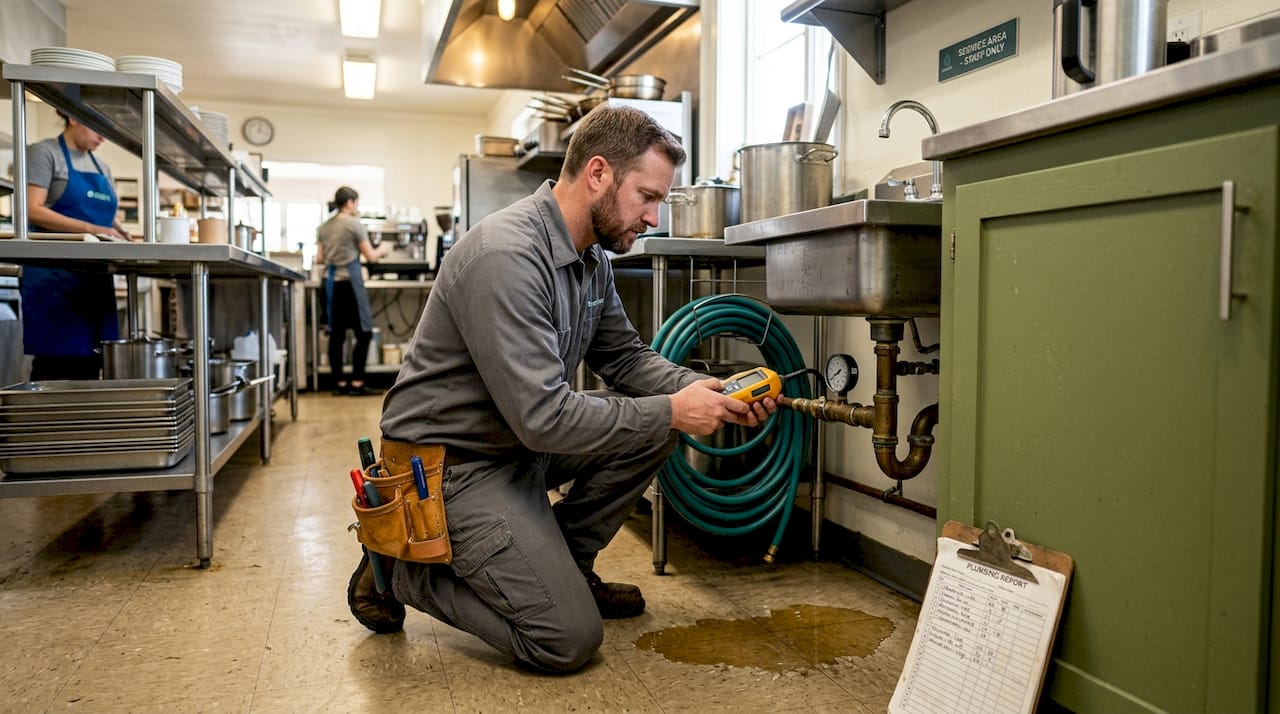
Pro Tip: Create a one-page emergency contact sheet and post it near your utility shutoff valves. Include your plumber’s 24/7 line, the water main location, and the gas shutoff procedure. Your maintenance team should be able to act in the first 10 minutes before the plumber arrives.
For a broader look at what to expect, review this emergency plumbing guide that covers fast response practices for urgent situations.
3. Routine maintenance and preventive plumbing services
If emergency services are the fire department, preventive maintenance is the smoke detector. Scheduled inspections help maintain code compliance and build long-term system reliability before a small leak becomes a flooded basement.
A standard preventive maintenance program for a commercial property typically includes:
- Visual and pressure inspection of all exposed pipes and fittings
- Valve testing to confirm isolation valves close properly
- Fixture servicing including faucets, toilets, and floor drains
- Water heater flushing and anode rod inspection
- Backflow preventer testing, which is required annually in most Texas jurisdictions
- Drain flow testing to identify partial blockages before they become full clogs
The financial argument for preventive maintenance is not subtle. Deferred plumbing maintenance is a critical risk factor that can trigger major financial losses and operational disruption. One documented case involving a 14-story office building showed that two years of neglected maintenance resulted in $67,000 in repairs, $34,000 in tenant rent credits, and an 18% jump in insurance premiums. That is the cost of skipping what would have been routine service visits.
Preventive maintenance does not just protect pipes. It protects your insurance rates, your tenant relationships, and your ability to pass inspections without rescheduling your whole week.
Record keeping is also part of the job. Regulators and insurance underwriters require retention of plumbing records, including backflow test certificates and maintenance logs, for at least 3 to 5 years. Keep a digital copy in addition to any paper records your contractor provides.
For practical guidance tailored to the Texas climate, see these commercial maintenance tips specific to San Antonio properties.
4. Installation and upgrade services for commercial plumbing systems
Whether you are finishing out a new commercial building or updating a 30-year-old system that has finally run out of runway, plumbing installation services cover far more ground than most facility managers realize. Installation and upgrade services include water supply installations, drain and sewer piping, backflow preventer installation, and upgrades to meet modern plumbing codes that improve safety and efficiency.
Here is a comparison of the most common installation types and when each applies:
| Service type | When you need it | Key consideration |
|---|---|---|
| Water supply line installation | New construction or major renovation | Pipe material choice affects water quality and longevity |
| Drain and sewer piping | New buildings or failed existing lines | Slope and diameter must meet code for proper flow |
| Commercial water heater installation | Aging unit or increased demand | Tankless vs. tank depends on usage patterns and space |
| Backflow preventer installation | Required by code in most commercial settings | Must be tested annually after installation |
| Full system repiping | Corroding or lead pipes | Modern materials like PEX or copper significantly extend service life |
A few specific services deserve extra attention:
Commercial water heaters and boilers are among the largest mechanical investments in your building. Sizing them incorrectly costs you efficiency every single day. A 20-unit apartment complex and a restaurant kitchen have wildly different hot water demand curves, and those need to be calculated before any equipment gets ordered.
Backflow preventer installation is not optional in most commercial settings. Cross-contamination between potable and non-potable water is a serious public health risk, and local water authorities inspect for this.
For new builds and renovation projects, construction plumbing services cover the full scope from ground up, ensuring every line meets current code before the walls close in.
5. Specialized commercial plumbing solutions
Some of the most important types of plumbing maintenance and service for commercial properties fall into categories that rarely come up in a residential context. Specialized commercial plumbing includes grease trap servicing, lift stations, water treatment systems, gas line installation, and advanced techniques like hydro jetting and camera inspections.
Here is a breakdown of the most common specialized services and who needs them:
| Service | Primary users | Service frequency |
|---|---|---|
| Grease trap cleaning and servicing | Restaurants, food processors, commercial kitchens | Every 1 to 3 months |
| Lift station maintenance | Properties below sewer grade, car washes, campuses | Quarterly inspections at minimum |
| Water treatment system installation | Medical offices, breweries, food production | Annual servicing plus as-needed repairs |
| Gas line installation and leak detection | Restaurants, industrial facilities, HVAC systems | Inspections after any renovation work |
| Hydro jetting and camera inspection | Any commercial property with older drain lines | Annually or after any slow-drain complaint |
Grease traps deserve special mention. Municipalities in Texas fine businesses for grease overflows into the public sewer system. The fines are real, and they compound quickly if the violation is repeated. A restaurant that skips grease trap service to save a few hundred dollars can end up paying thousands in municipal penalties.
Hydro jetting is worth understanding if you have never heard the term. It uses pressurized water at up to 4,000 PSI to blast through blockages, biofilm, and mineral scale that drain snakes simply cannot remove. Camera inspection follows the jetting to confirm the line is fully clear. These are the best plumbing repairs for commercial drain systems that have been partially blocked for years.
Industrial plumbing services at manufacturing facilities or large campuses often require certified technicians for gas line work specifically. Gas leaks are not a situation where you call a general handyman.
6. My perspective on commercial plumbing in San Antonio
I have spent years working with commercial property owners across San Antonio, and the same pattern shows up repeatedly. The businesses that avoid catastrophic plumbing failures are not the ones with the newest buildings. They are the ones with a relationship with a trusted local plumber and a maintenance schedule they actually follow.
San Antonio’s hard water and mineral-heavy supply accelerate pipe corrosion and water heater scale buildup faster than most national plumbing guides account for. What works in Phoenix or Dallas needs to be adjusted for what comes out of a San Antonio tap.
In my experience, the most expensive plumbing failures I have seen were entirely preventable. Owners deferred maintenance to save a few thousand dollars and ended up spending twenty times that on emergency repairs, tenant compensation, and code-violation fines. The math never works out in favor of procrastination.
Build a relationship with a commercial plumber before you need one urgently. Know who you are calling at 3 a.m. Have your maintenance schedule documented. And do not wait until a slow drain becomes a fully blocked sewer line to pick up the phone.
— Jean
How Stultz Plumbing serves San Antonio commercial properties
At Stultz Plumbing, we work with business owners and facility managers across San Antonio every day. We understand the pressure you are under to keep your building running without surprises. Our team handles everything from 24/7 emergency plumbing to scheduled preventive maintenance programs and full installation projects for new builds and renovations.
We offer transparent pricing, fast response times, and the kind of local expertise that only comes from years of working specifically with San Antonio’s commercial properties. Whether you need a grease trap serviced, a water heater replaced, or a full repiping of an aging system, we are the team to call. Visit our commercial plumbing services page or explore our full range of affordable plumbing solutions to see how we can help your business stay protected.
FAQ
What are commercial plumbing services?
Commercial plumbing services cover installation, maintenance, repair, and emergency work for businesses, multi-unit buildings, and industrial facilities. These services address larger and more complex systems than residential plumbing typically requires.
How often should commercial plumbing be inspected?
Most commercial properties benefit from routine inspections at least twice per year, with annual backflow preventer testing required by code in most Texas municipalities. High-demand facilities like restaurants may need quarterly service.
What counts as a plumbing emergency for businesses?
Burst pipes, sewer backups, major fixture leaks, gas line issues, and water heater failures all qualify as plumbing emergencies. These situations require immediate response to prevent structural damage and protect business operations.
Why is preventive maintenance worth the cost?
Skipping maintenance creates compounding risk. One real-world case showed deferred maintenance costs reaching over $100,000 in repairs, rent credits, and insurance increases for a single commercial building. Preventive programs cost a fraction of that.
What specialized plumbing services do restaurants need?
Restaurants specifically need grease trap cleaning every one to three months, gas line inspections after any kitchen renovation, and hydro jetting for their drain lines to stay compliant with local sanitation codes and avoid municipal fines.
Recommended
- San Antonio business plumbing: Risk, value, and strategy
- Commercial vs. residential plumbing: make the right choice in San Antonio
- Commercial Plumbing Services in San Antonio | Stultz Plumbing
Jean runs growth strategy at AimSetWin, a performance marketing agency specializing in local service businesses across Texas. he's helped plumbers, HVAC companies, pest control operators, and home service brands build predictable revenue systems using data-driven advertising and conversion optimization.


