

Discover the vital role of plumbing codes in your home's safety. Learn how these standards protect health and ensure proper installations.
TL;DR:
- Plumbing codes are legally adopted standards that ensure water systems are safe, effective, and environmentally responsible. They protect public health, prevent structural issues, and are enforced through inspections based on local amendments and current editions. Understanding these regulations helps homeowners and contractors avoid costly mistakes, delays, and safety hazards during construction and renovation.
Plumbing codes are defined as the legally adopted regulatory standards that govern how water supply, drainage, and venting systems must be designed, installed, and inspected in any building. The role of plumbing codes goes far beyond paperwork. These rules protect your family’s health, prevent structural damage, and determine whether your home passes inspection during a sale or renovation. In the United States, two primary model codes shape most local regulations: the Uniform Plumbing Code (UPC), published by the International Association of Plumbing and Mechanical Officials (IAPMO), and the International Plumbing Code (IPC), published by the International Code Council (ICC). If you are building, remodeling, or buying property in San Antonio, understanding plumbing safety regulations is not optional. It is the foundation of every safe, durable plumbing system in your home.
What is the role of plumbing codes in protecting health and safety?
Plumbing codes exist for one core reason: to keep people safe. The public health impact of professional plumbing standards is one of the most significant advances in modern history, protecting nearly 50% of the global population from waterborne disease through safe water delivery and wastewater management. That statistic means that without enforceable plumbing guidelines, contaminated water would reach your tap, your shower, and your kitchen sink.
The benefits of plumbing standards fall into four clear categories:
- Public health protection. Codes require backflow prevention devices, proper pipe materials, and wastewater separation to stop contamination from entering your drinking water supply. Without these requirements, a garden hose left submerged in a bucket could siphon chemicals back into your home’s water line.
- Structural and mechanical safety. Proper venting requirements prevent dangerous sewer gas buildup inside walls. Pressure relief valves on water heaters, mandated by code, prevent catastrophic tank failures. These are not suggestions. They are life-safety requirements.
- Environmental protection. Modern plumbing codes require water-efficient fixtures, approved pipe materials, and in some jurisdictions, greywater reuse systems. These requirements reduce strain on municipal water supplies and protect local waterways from untreated discharge.
- Economic protection. A plumbing system installed without permits or code compliance is a financial liability. Selling a home with unpermitted plumbing work can delay or kill a real estate transaction. Correcting non-compliant work after walls are closed costs far more than doing it right the first time.
Pro Tip: Before starting any renovation in San Antonio, check with the City of San Antonio Development Services Department to confirm which code edition is currently enforced. Using an outdated code version is one of the most common and costly compliance mistakes.
The importance of plumbing regulations becomes most visible when something goes wrong. A burst pipe from improper pressure management, a sewage backup from undersized drain lines, or carbon monoxide intrusion from a poorly vented water heater. All of these failures trace back to code violations that inspections are designed to catch before they become emergencies.
How do plumbing codes vary by location and change over time?
Not every city or county enforces the same plumbing code, and that creates real complexity for homeowners and developers. Model codes like UPC and IPC differ technically in areas like pipe sizing, venting methods, and fixture requirements. Local governments then adopt one of these model codes and layer on their own amendments, creating a patchwork of regulations that varies street by street in some metro areas.
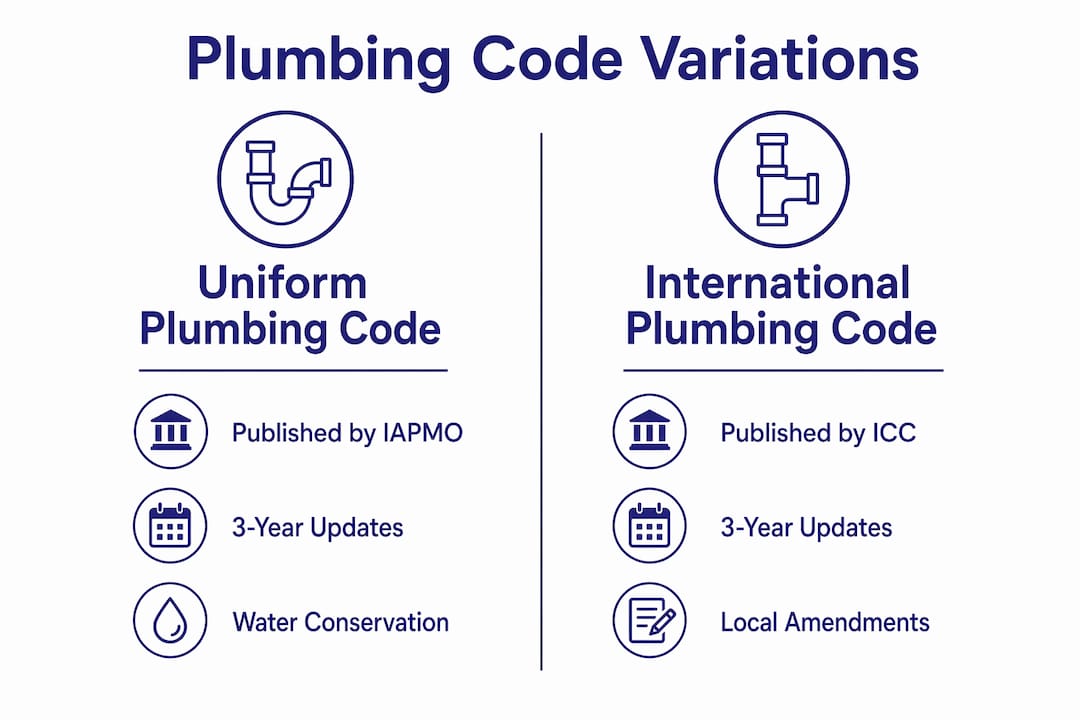
Here is a side-by-side comparison of the two dominant model codes:
| Feature | Uniform Plumbing Code (UPC) | International Plumbing Code (IPC) |
|---|---|---|
| Published by | IAPMO | International Code Council (ICC) |
| Common adoption regions | Western U.S., including parts of Texas | Eastern and Midwestern U.S. |
| Venting approach | More prescriptive individual venting | Allows more flexible engineered venting |
| Update cycle | Every 3 years | Every 3 years |
| Local amendments | Common, especially for water conservation | Common, especially for seismic or climate zones |
Both codes update on a 3-year cycle, integrating new materials, technologies, and safety research. The critical detail for any project is this: the code edition that governs your project is the one adopted by your local jurisdiction at the time your permit is issued. A contractor who quotes you based on the 2021 UPC when your city has adopted the 2024 edition is setting you up for an inspection failure.
Local amendments add another layer. San Antonio and the surrounding Hill Country communities may have stricter water conservation requirements, specific pipe material restrictions, or unique fixture standards that go beyond the base model code. This is why local code knowledge is not a bonus skill for your plumber. It is a baseline requirement.
What happens during a residential plumbing inspection?
Understanding the inspection process removes a lot of anxiety from construction and renovation projects. Plumbing inspections in Texas residential projects follow a structured sequence, and missing a phase can force you to tear open finished walls. Here is how the process works:
- Permit application. Before any work begins, a permit must be pulled from the local building authority. This step establishes which code edition applies and puts the project on record. Skipping this step is the single most expensive mistake a homeowner can make.
- Rough-in inspection. This inspection happens after all pipes, drains, and vents are installed but before walls are closed. The inspector checks pipe sizing, slope, support spacing, and vent connections. This is the most critical phase because corrections at this stage are relatively inexpensive. Our plumbing inspection checklist for San Antonio walks through exactly what inspectors look for at this stage.
- Final inspection. Once all fixtures are installed and the system is operational, a final inspection confirms that everything functions as designed. The inspector tests water pressure, checks for leaks, verifies fixture connections, and confirms that all code requirements are met.
- Correction notices and re-inspections. If an inspection fails, the inspector issues a correction notice listing specific violations. Work must stop on affected areas until corrections are made and a re-inspection is scheduled. Repeated failures can result in fines and project delays.
Failing permits or inspections risks exposing finished materials and triggering expensive renovations. We have seen San Antonio homeowners spend thousands correcting unpermitted bathroom additions because a buyer’s inspector flagged the work during a home sale. The cost of the permit upfront is a fraction of the cost of the correction later.
Pro Tip: Always request a copy of the approved permit and the final inspection sign-off from your contractor. Keep these documents with your home records. They are proof of compliance and protect you during future sales or insurance claims.
For a deeper look at Texas-specific requirements, the plumbing compliance guide from Stultz Plumbing covers the full regulatory picture for San Antonio homeowners.
How does understanding code intent help during construction or renovation?
There is a meaningful difference between a contractor who memorizes code requirements and one who understands why those requirements exist. Code literacy allows contractors to treat plumbing installation as a design discipline rather than a compliance checklist. That distinction directly affects your project’s outcome.
Here is what code literacy looks like in practice for homeowners and developers:
- Fewer redesigns. A contractor who understands that a specific venting requirement exists to prevent sewer gas migration will design the system correctly the first time. A contractor who only knows the rule without understanding the reason may install a technically compliant system that still fails inspection under a different inspector’s interpretation.
- Better material choices. Codes set minimum thresholds, not optimal standards. A code-minimum pipe material may pass inspection but perform poorly in San Antonio’s hard water conditions. A code-literate contractor recommends materials that exceed minimums and deliver long-term durability.
- Smoother inspections. Code-literate contractors anticipate inspector interpretations and document their design decisions in advance. This reduces back-and-forth with inspectors and keeps your project on schedule.
- Long-term system resilience. Plumbing designed to the spirit of the code, not just the letter, performs better over decades. Proper drain slopes, adequate cleanout access, and correctly sized water supply lines all contribute to a system that rarely needs emergency repairs.
When vetting contractors, ask them directly: “Why does this code require this?” If they can answer clearly, you have found someone worth hiring. If they shrug and say “that’s just the rule,” keep looking. The value of experienced plumbers shows up most clearly in projects where code interpretation requires judgment, not just rule-following.
A practical home maintenance approach also supports code compliance over time. Reviewing a home plumbing maintenance checklist annually helps you catch issues before they become violations or failures.
What are the latest sustainability changes in plumbing codes?
Plumbing codes are not static documents. The 2024 update cycles for both UPC and IPC introduced expanded sustainability requirements that directly affect what you can install in a new build or major renovation. These changes reflect growing pressure on water resources and the public health risks of older pipe materials.
| Sustainability Requirement | Code Basis | Practical Impact for Homeowners |
|---|---|---|
| Low-flow fixture mandates | EPA WaterSense standards integrated into code | Toilets, faucets, and showerheads must meet flow rate limits |
| Lead-free pipe and fitting materials | Federal Safe Drinking Water Act, adopted in UPC/IPC | All new installations require lead-free brass and solder |
| Greywater reuse systems | State and local amendments in water-stressed regions | Some jurisdictions now allow or require greywater recycling for irrigation |
| Leak detection requirements | Emerging in high-value or water-restricted zones | Smart shutoff valves and leak sensors may be required in new construction |
| Water heater efficiency standards | Department of Energy (DOE) minimum efficiency rules | Older tank water heaters no longer meet code in new installations |
Sustainability mandates like EPA WaterSense and lead-free material requirements are now embedded in modern plumbing codes to protect health and conserve resources. The upfront cost of compliant fixtures is real, but the long-term savings on water bills and the elimination of lead exposure risk make these requirements worthwhile investments.
For San Antonio homeowners specifically, water conservation is not just a code issue. It is a practical necessity in a region that regularly faces drought conditions. Installing code-compliant pipe materials that meet current lead-free standards also protects your family from health risks that older galvanized or lead-soldered systems carry. Sustainability regulations represent a modest upfront cost increase but yield significant savings and environmental benefits over the lifespan of a plumbing system. That is a trade-off worth making.
Key takeaways
Plumbing codes set the legal minimum for safe, functional plumbing systems, and understanding them protects both your family’s health and your property’s long-term value.
| Point | Details |
|---|---|
| Codes protect public health | Backflow prevention, venting, and material standards stop contamination before it reaches your tap. |
| Local adoption determines compliance | The code edition active when your permit is issued governs your project, not the latest model code. |
| Inspections have two critical phases | Rough-in and final inspections both carry consequences if failed, including fines and wall demolition. |
| Code literacy improves outcomes | Contractors who understand code intent deliver better designs and pass inspections faster. |
| Sustainability requirements are now standard | Lead-free materials, low-flow fixtures, and efficiency standards are embedded in current code editions. |
Why I think most homeowners underestimate plumbing codes until it costs them
I have worked in and around the San Antonio plumbing market long enough to see a clear pattern. Homeowners treat plumbing codes as bureaucratic obstacles right up until the moment they become expensive problems. A seller who discovers unpermitted bathroom work during escrow. A developer who has to open finished walls because a rough-in inspection was skipped. These are not rare edge cases. They happen regularly, and they are entirely preventable.
The most common mistake I see is hiring a contractor based on price alone, without asking whether they pull permits or understand the local code edition. San Antonio has specific amendments layered on top of the base model code, and a contractor who works primarily in Austin or Houston may not know those differences. That gap shows up at inspection time.
My honest advice: view plumbing codes as the floor, not the ceiling. Meeting code means your system is legally acceptable. It does not mean your system is optimally designed for San Antonio’s hard water, high summer demand, or aging infrastructure in older neighborhoods like Alamo Heights or Leon Springs. The best plumbing systems I have seen exceed code requirements in pipe sizing, cleanout placement, and fixture quality. Those systems rarely generate emergency calls.
Ask your contractor to walk you through the permit process before work begins. If they hesitate or suggest skipping it to save time, that is your answer.
— Jean
How Stultz Plumbing keeps your San Antonio home code-compliant

Stultz Plumbing handles code compliance from permit to final inspection for homeowners and developers across San Antonio, Boerne, Alamo Heights, and Leon Springs. Our team knows the local code amendments that apply to your specific address, not just the model code. Whether you need a full repiping service to bring aging pipes up to current lead-free standards, a new water heater installation that meets DOE efficiency requirements, or a complete construction plumbing package for a new build, we pull the permits, schedule the inspections, and make sure your project passes the first time. Contact Stultz Plumbing to schedule a consultation and get your project started on the right side of the code. Explore our full range of plumbing services in San Antonio and find out how we protect your home from the pipe in.
FAQ
What is the role of plumbing codes in home construction?
Plumbing codes define the minimum safety and health standards for water supply, drainage, and venting systems in any building. They protect occupants from contaminated water, sewer gas, and structural damage caused by improper installation.
Which plumbing code applies in San Antonio, Texas?
San Antonio adopts a locally amended version of a model code, and the specific edition in effect at the time your permit is issued governs your project. Always verify the current adopted edition with the City of San Antonio Development Services Department before starting work.
What happens if I skip a plumbing permit or inspection?
Skipping permits or inspections can result in fines, correction notices, and the requirement to open finished walls for re-inspection. Unpermitted work also creates legal and financial complications when selling your home.
How often do plumbing codes get updated?
Both the Uniform Plumbing Code (UPC) and the International Plumbing Code (IPC) update every 3 years, incorporating new safety research, materials, and technology. Local jurisdictions may adopt updates on a different schedule.
Do plumbing codes cover water-efficient fixtures?
Yes. Modern plumbing codes integrate EPA WaterSense standards and lead-free material requirements, meaning low-flow toilets, faucets, and showerheads are now code requirements in new construction and major renovations, not optional upgrades.
Recommended
- Plumbing compliance in Texas: Essential guide for homeowners
- The Role of Plumbers in Home Safety: 2026 Guide
- Types of Residential Plumbing: Your 2026 Homeowner’s Guide
Jean runs growth strategy at AimSetWin, a performance marketing agency specializing in local service businesses across Texas. he's helped plumbers, HVAC companies, pest control operators, and home service brands build predictable revenue systems using data-driven advertising and conversion optimization.


