

Discover the crucial role of plumbing in business. Learn how to mitigate risks and create strategies that keep your operations running smoothly.
TL;DR:
- Plumbing is a critical but often overlooked infrastructure that supports daily business operations and prevents costly emergencies. Regular preventive maintenance significantly reduces the risk of failures, minimizes disruption, and extends asset lifespan, saving money over time. Partnering with a reliable service provider and developing a proactive plumbing plan safeguards revenue, reputation, and safety in San Antonio businesses.
Most business owners think of plumbing the way they think about the building’s foundation. It’s always there, rarely noticed, and only remembered when something goes wrong. But unlike a cracked foundation, a commercial pipe burst can spread through your property in minutes, flooding offices, ruining inventory, and forcing you to close your doors while repairs drag on. This guide is built for San Antonio business owners and property managers who want to understand the real risks, protect their operations, and build a plumbing strategy that keeps revenue flowing.
Table of Contents
- The critical role plumbing plays in business operations
- Plumbing emergencies: Hidden costs and business risk
- Preventive maintenance: Safeguard assets and control costs
- Choosing a commercial plumbing service: What really matters
- A hard truth: Plumbing is easy to ignore… until it costs you everything
- Get proactive and stay open: Plumbing solutions for San Antonio businesses
- Frequently asked questions
Key Takeaways
| Point | Details |
|---|---|
| Plumbing supports business continuity | A dependable plumbing system is essential for daily operations, reputation, and regulatory compliance in commercial settings. |
| Emergencies are expensive | Plumbing failures can shut down businesses quickly, causing heavy financial and reputational loss. |
| Preventive maintenance pays off | Proactive checks and repairs drastically reduce emergency incidents and long-term costs. |
| Choose vendors wisely | The right commercial plumber offers diagnostics, documentation, and rapid service response—beyond simple repairs. |
| Proactivity beats reaction | Contracting ongoing plumbing expertise prevents disasters instead of just cleaning up after them. |
The critical role plumbing plays in business operations
Plumbing is not just pipes and drains. It is the invisible infrastructure that supports everything your business does every single day. Without it, restrooms close. Kitchens shut down. Certain manufacturing and medical processes come to a complete halt. When people start thinking about plumbing as a risk management system rather than a utility, everything changes.
Consider what plumbing directly supports in a typical commercial property:
- Restrooms: Federal and state codes require functional restroom access for employees and customers. A failure here can legally force you to close.
- Food service and kitchens: Restaurants, cafeterias, and catering operations rely entirely on water supply and drainage. A single clog can mean missed service hours and health violations.
- HVAC and cooling systems: Many commercial HVAC systems depend on water-based cooling, meaning plumbing failures can affect climate control during San Antonio’s brutal summer heat.
- Medical and lab equipment: Healthcare facilities and labs often require precise water pressure and temperature for sterilization systems and diagnostic equipment.
- Janitorial and sanitation: Even routine cleaning requires consistent water access. Loss of water pressure affects the ability to maintain sanitation standards.
Understanding key plumbing facts for businesses makes it clear that the risks are not hypothetical. In San Antonio, businesses also face specific regional challenges. The city’s hard water accelerates pipe corrosion and mineral buildup. Seasonal temperature swings, including the occasional hard freeze that catches property owners off guard, create pipe stress that other markets simply don’t experience. And with San Antonio’s business community growing rapidly, older commercial buildings are under heavier water demand than they were ever designed to handle.
“Plumbing emergencies in commercial properties can cascade quickly into water damage, forced closures, and lost revenue that takes far longer to recover from than the original repair.”
That quote from 7 commercial plumbing problems that shut businesses down captures the operational reality. A single plumbing failure is rarely isolated. It disrupts employees, alarms customers, triggers insurance calls, and sometimes creates compliance issues with health inspectors. The reputational cost is harder to quantify, but it is absolutely real.
Plumbing emergencies: Hidden costs and business risk
Now that you understand why plumbing matters operationally, consider what happens when things go wrong. Plumbing emergencies do not politely announce themselves in advance. They escalate fast, often starting as something small that was missed or ignored.
Here is how common emergencies escalate in commercial settings:
- A slow drain in a restroom becomes a full backup during peak hours, forcing closure of the restroom and triggering customer complaints and potential health code violations.
- A small pinhole leak behind a wall goes undetected for weeks, silently rotting drywall, feeding mold growth, and eventually causing structural damage that costs ten times more than the original repair would have.
- A water heater running inefficiently fails completely during a cold snap, leaving a restaurant without hot water and forcing an emergency shutdown on one of the busiest nights of the week.
- A sewer line beginning to back up sends sewage into floor drains during business hours, creating a health emergency, a regulatory violation, and a social media nightmare before the cleanup crew even arrives.
Each of these scenarios carries costs that go well beyond the plumbing bill. Revenue stops. Staff go home. Customers leave and sometimes don’t come back.
| Situation | Average emergency cost | Average preventive cost |
|---|---|---|
| Pipe burst repair | $1,500 to $15,000+ | $150 to $400 per inspection |
| Sewer backup cleanup | $3,000 to $25,000 | $200 to $600 per cleaning cycle |
| Water heater failure | $1,200 to $5,000 | $100 to $300 per annual service |
| Major drain restoration | $500 to $8,000 | $150 to $350 per scheduled service |
The math is clear. Emergencies cost multiples of what prevention costs. And those figures don’t include lost revenue, temporary closure costs, or insurance deductibles.
As noted by 7 commercial plumbing problems that shut businesses down, a commercial pipe burst can flood offices and damage equipment in ways that force prolonged closures. The operational disruption compounds financial damage far beyond repair invoices.
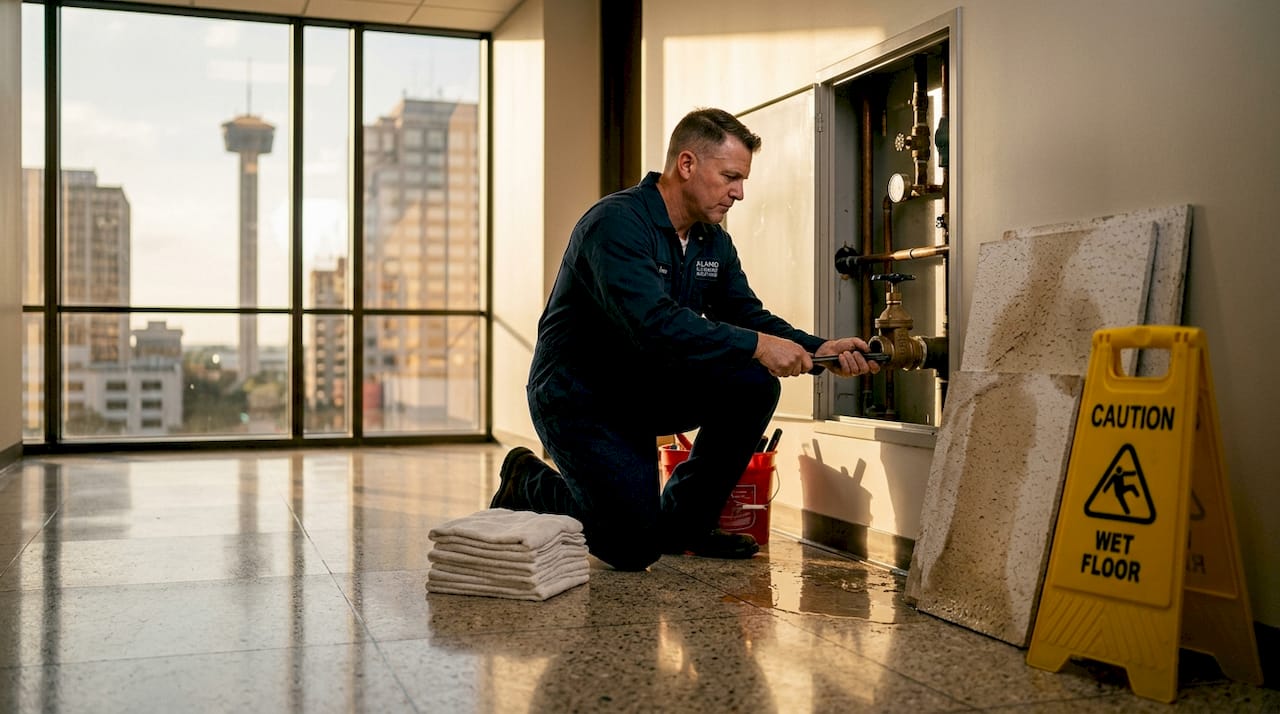
We recommend following a clear set of emergency plumbing steps before a crisis even occurs, so your staff knows exactly how to respond when minutes matter. Your team should know where the main water shut-off valves are located, have a plumber’s emergency number on hand, and understand which situations require immediate evacuation versus simple containment.
Pro Tip: Build a one-page emergency plumbing response plan and post it near your maintenance closet and break room. It should include the building’s main water shut-off location, your plumber’s emergency number, and a basic triage checklist. When water is spreading across your floor, you do not want staff searching for answers.
Strong commercial plumbing maintenance tips for Texas operations can help you prevent these scenarios before they become a crisis, saving you money and the headache of emergency calls.
Preventive maintenance: Safeguard assets and control costs
Given the steep cost of emergencies, the case for preventive plumbing maintenance is straightforward. But many business owners and property managers still treat it as optional, something to consider once the budget allows. That mindset is expensive.
Preventive maintenance is defined as proactive upkeep that reduces downtime and extends asset lifespan by catching issues early. It helps teams plan parts replacement and reduces the need for reactive repairs. In plumbing terms, that means regular inspections, pressure testing, drain flushing, water heater servicing, and checking for corrosion or early-stage leaks before they become visible problems.
The results are measurable. According to commercial plumbing PM program data, businesses on structured preventive maintenance programs report 78% fewer emergency calls and 45% lower total plumbing costs compared to reactive-only approaches. Catastrophic water damage events decrease significantly, and water usage often drops as well once inefficiencies are corrected.
Here is what a solid preventive plumbing maintenance program typically includes:
- Annual full-system inspections: Camera inspections of drain lines, pressure testing on supply lines, valve checks, and water heater evaluation.
- Quarterly drain cleaning: High-volume commercial drains accumulate grease, debris, and mineral deposits. Regular cleaning prevents backups.
- Biannual water heater flushing: Sediment buildup in commercial water heaters reduces efficiency and shortens equipment life. Flushing removes that buildup before it causes a failure.
- Pipe corrosion monitoring: San Antonio’s hard water accelerates corrosion inside older pipes. Monitoring allows for planned repiping rather than emergency pipe replacement.
- Backflow preventer testing: Required by code in many commercial settings, these devices protect the public water supply and must be tested on schedule.
| Factor | Preventive maintenance | Reactive repairs only |
|---|---|---|
| Average annual cost | Lower and predictable | Higher and unpredictable |
| Emergency frequency | Significantly reduced | High |
| Business disruption | Minimal, planned downtime | Unplanned, often during peak hours |
| Insurance claim impact | Fewer claims, better rates | More claims, potential rate increases |
| Equipment lifespan | Extended through early detection | Shortened by unchecked wear |
Learning how to prevent costly plumbing repairs is not about eliminating all risk. It is about controlling when and how you address issues, on your schedule rather than in crisis mode. Using an annual plumbing inspection checklist gives your team and your service provider a consistent framework so nothing gets missed year after year.
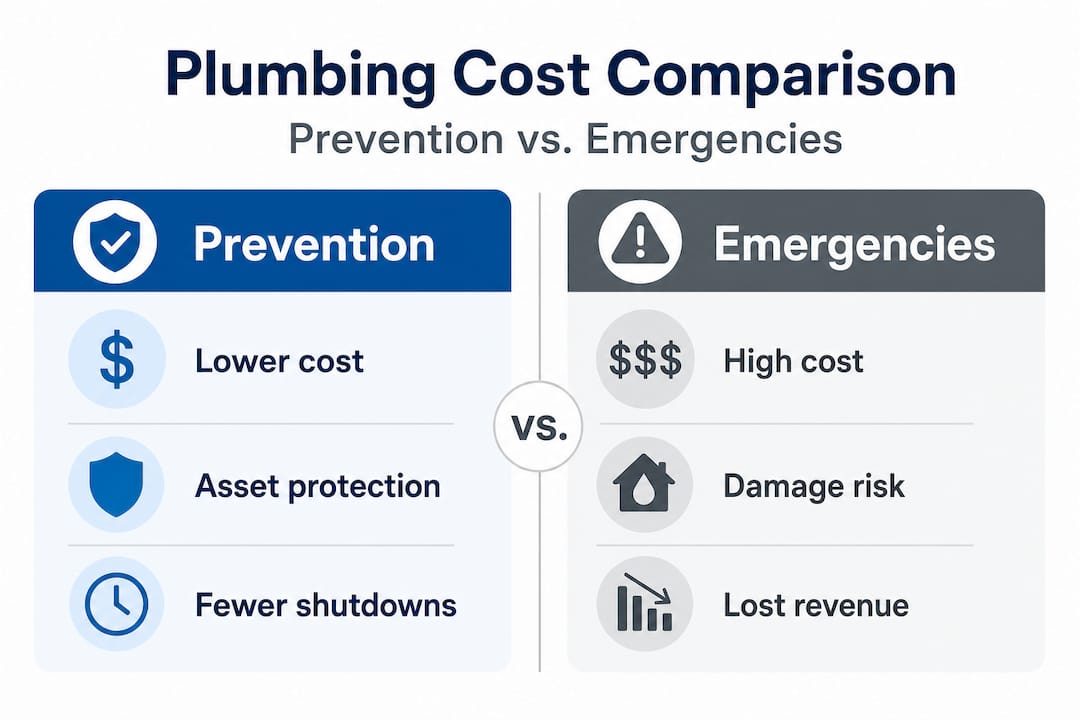
One caution worth mentioning: always validate any vendor’s ROI claims against your own property’s age, usage levels, and system complexity. A 20-year-old restaurant building with five full-service restrooms and a commercial kitchen will see greater benefit from preventive maintenance than a newer single-use office suite. Match the program intensity to your actual risk profile.
Choosing a commercial plumbing service: What really matters
With preventive maintenance established as a high-return investment, the next question is obvious. How do you choose the right service partner to deliver on that investment? Not all commercial plumbing providers are equal, and the difference between a capable partner and an unreliable one shows up at the worst possible time.
When evaluating San Antonio commercial plumbing services, prioritize these capabilities:
- True emergency response: Can they respond within the hour when something goes seriously wrong? Ask directly what their guaranteed response time is and whether they offer 24/7 availability.
- Diagnostic technology: Look for providers using camera inspection for sewer and drain lines, acoustic leak detection, and pressure testing equipment. These tools find problems before they become visible disasters.
- Preventive maintenance programs: Can they offer a scheduled service contract tailored to your building type? A provider without PM capabilities is a reactive contractor, not a strategic partner.
- Commercial experience: Residential plumbing and commercial plumbing are different disciplines. Commercial systems have higher pressure demands, larger pipe diameters, more complex drainage configurations, and stricter code requirements.
- Documentation practices: Does the provider issue written service reports after every visit? Do they maintain a service history file for your property?
According to commercial plumbing maintenance best practices, key diagnostic and service methods to look for include leak detection and diagnostics, camera inspections and sewer clearing, pressure and valve testing, and thorough documentation of all preventive maintenance work. That documentation is not just organizational hygiene. It can protect you during insurance claims, health inspections, and code compliance audits.
Pro Tip: Maintain a documented service history for every plumbing system in your building. When an insurance adjuster asks whether you knew about a slow-developing issue or when a code inspector asks about your backflow preventer, written service records are the difference between a defensible answer and a costly dispute.
The providers who stand out are those who treat your building like an asset to protect, not just a job to complete. Proactive service contracts create accountability on both sides. Your plumber shows up on schedule with the context of your system’s full history. Issues get caught early. And when a real emergency does occur, your plumber already knows your building, your shut-off locations, and your critical systems.
Using a plumbing inspection checklist with your service provider creates a consistent standard across every visit, so annual inspections are thorough rather than cursory.
A hard truth: Plumbing is easy to ignore… until it costs you everything
Here is something most facility articles won’t say plainly. The businesses that suffer the most from plumbing failures are usually not the ones that had bad luck. They are the ones that treated plumbing as invisible until it wasn’t.
We see this pattern repeatedly. A business owner is diligent about insurance, security systems, fire suppression, and technology infrastructure. But plumbing? It gets a call when something breaks. The reasoning is understandable. Plumbing rarely shows up on a revenue dashboard. It doesn’t appear in quarterly reports. It runs silently in the background, making it easy to deprioritize.
The uncomfortable truth is that plumbing failure is one of the fastest ways to lose something that took years to build. A flooded restaurant on a Friday night doesn’t just cost you that night’s revenue. It may close you for days, trigger a health inspection, generate social media exposure you never wanted, and leave customers with an impression that outlasts the repairs. That’s not a facilities problem. That’s a business risk problem.
This is why we believe plumbing maintenance strategies belong in risk management conversations, not just facilities maintenance budgets. Smart business leaders think about plumbing the same way they think about cybersecurity or property insurance. It’s not glamorous. The return on investment is largely invisible when things go right. But when it fails without a plan in place, the cost is severe and sometimes irreversible.
And as preventive maintenance research consistently shows, proactive scheduling and long-term partnerships outperform the call-a-plumber-when-it-breaks approach in both cost and outcomes. The relationship you build with a trusted commercial plumber before a crisis is worth more than the best emergency response you can find during one.
The businesses we see recover most quickly from plumbing incidents are always the ones who knew their service provider by name before the problem started.
Get proactive and stay open: Plumbing solutions for San Antonio businesses
Protecting your business starts with a conversation, not a crisis.
At Stultz Plumbing, we work with San Antonio business owners and property managers every day to build the kind of proactive plumbing programs that prevent disruptions before they happen. Our commercial plumbing experts can assess your current system, identify risks specific to your building type and usage, and create a maintenance schedule that fits your operations. And when the unexpected does occur, our emergency plumbing help is available when you need it most, with rapid response across San Antonio and surrounding communities. Reach out today to schedule a commercial plumbing assessment and take the first step toward a system that protects your revenue, your reputation, and your people.
Frequently asked questions
What are the most common plumbing emergencies in commercial properties?
Pipe bursts, drain clogs, sewer backups, and water heater failures are the most frequent issues, and as noted in common commercial plumbing problems, each can force rapid and costly business disruption.
How often should commercial plumbing preventive maintenance be performed?
Most experts recommend at least one full plumbing inspection per year, with more frequent service for older systems or high-traffic facilities, since proactive maintenance is proven to extend asset life and reduce unplanned downtime.
Is preventive plumbing maintenance really cost-effective for businesses?
Yes. PM programs for commercial plumbing report 78% fewer emergency calls and 45% lower total plumbing costs compared to reactive-only approaches, making it one of the highest-return investments in facilities management.
What should I look for when choosing a commercial plumbing service?
Focus on emergency response time, preventive maintenance capabilities, and whether the provider uses advanced diagnostics. Commercial PM best practices also emphasize clear documentation of all service work to support insurance claims and compliance audits.
Why can’t I just call a plumber when something breaks?
Reactive-only plumbing leads to longer downtimes, greater property damage, and significantly higher repair costs. Research consistently shows that proactive partnerships and scheduled maintenance outperform reactive contracting in both cost and operational outcomes over time.
Recommended
- Commercial plumbing facts San Antonio businesses need in 2026
- Emergency plumbing: Protect your San Antonio home in 2026
- San Antonio home plumbing maintenance: prevent costly repairs
- Why choose local plumbers in San Antonio in 2026
Jean runs growth strategy at AimSetWin, a performance marketing agency specializing in local service businesses across Texas. he's helped plumbers, HVAC companies, pest control operators, and home service brands build predictable revenue systems using data-driven advertising and conversion optimization.


