

Not sure whether to repair or replace your water heater in San Antonio? Use our practical framework to make the right call and avoid wasting money.
TL;DR:
- Proper timing of repair or replacement saves homeowners in San Antonio money and energy.
- Water heater lifespan and signs of failure guide optimal repair or replacement decisions.
- Upgrading to modern tankless or hybrid units can improve efficiency and cost savings long-term.
Most San Antonio homeowners make the same costly mistake: they either repair a unit that’s quietly bleeding money in energy bills, or they replace a heater that had years of reliable service left. Neither outcome is good. The truth is, the repair-or-replace decision is rarely obvious, and getting it wrong can cost you hundreds, sometimes thousands, of dollars. San Antonio’s notoriously hard water adds another layer of complexity, accelerating wear on tank units faster than the national average. This guide gives you a clear, practical framework to make the right call the first time.
Table of Contents
- Understand water heater lifespan and warning signs
- When repair is the smarter choice
- When replacement saves more in the long run
- Comparing water heater types: tank vs. tankless vs. hybrid
- Smart steps for making the final decision
- What most homeowners in San Antonio get wrong — and what to do instead
- Get expert help with your water heater decision
- Frequently asked questions
Key Takeaways
| Point | Details |
|---|---|
| Tank leaks mean replace | A leaking tank signals it’s time for a new water heater. |
| Follow the 50% rule | Repair only if costs are less than half the price of a new unit. |
| Check lifespan first | Most tanks last 8-12 years; over this, replacement is smart. |
| Consider household size | Tankless and hybrid units are best for large, high-demand homes. |
| Get a professional opinion | An expert plumber helps avoid costly mistakes and ensures safety. |
Understand water heater lifespan and warning signs
Before you can make a smart decision, you need to know where your unit stands in its lifecycle. A standard tank water heater typically lasts 8 to 12 years. A tankless unit, with proper maintenance, can last up to 20 years. That’s a significant difference, and it matters a great deal when you’re weighing repair costs against replacement.
San Antonio’s hard water is a real problem. The high mineral content causes scale buildup inside the tank, forcing the heating element to work harder and shortening the unit’s effective life. What might last 12 years in a softer-water city could give out in 8 to 9 years here.
Knowing the water heater warning signs early gives you options. Catching a problem at the symptom stage is almost always cheaper and faster to fix than waiting until the unit fails completely.
Here are the most common warning signs to watch for:
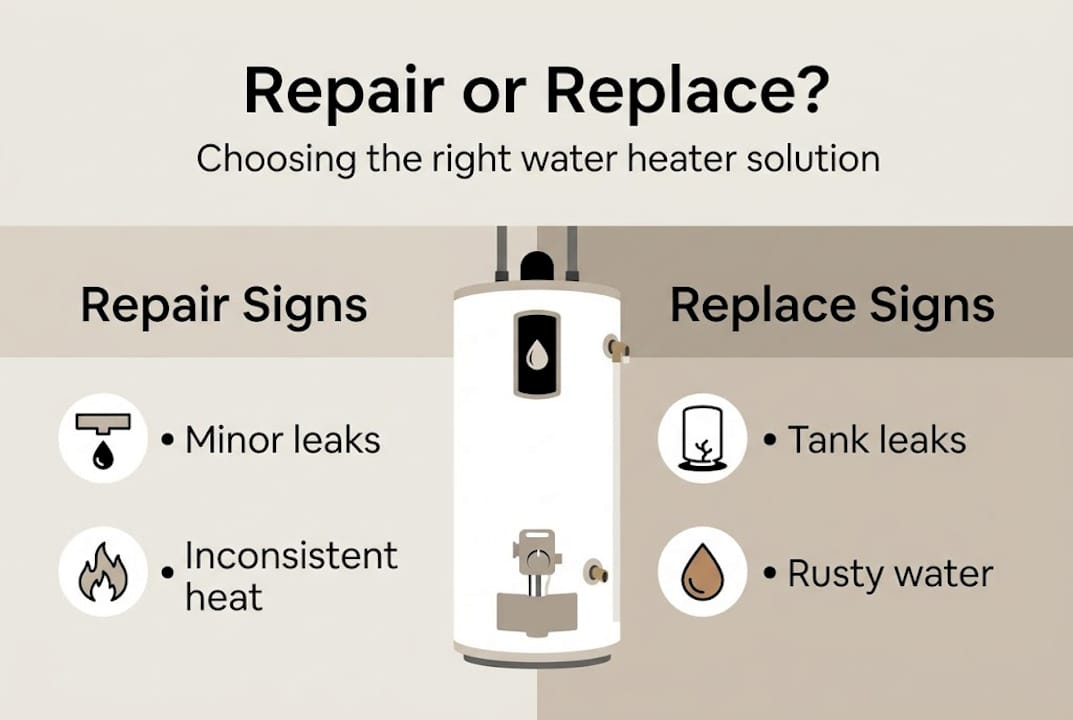
- Inconsistent water temperature: Hot water that fluctuates or runs out faster than it used to
- Rumbling or popping noises: Sediment buildup at the bottom of the tank burning off during heating cycles
- Discolored or rusty water: A sign of internal corrosion, especially in older units
- Visible leaks or pooling water: Water around the base of the unit is a serious red flag
- Higher energy bills: A unit struggling to heat water efficiently will show up on your utility statement
If you recognize any of these signs you need water heater repair, act quickly. Early intervention is almost always cheaper.
One critical rule: A leaking tank almost always means replacement, regardless of the unit’s age. Water escaping from the tank itself signals structural failure that no repair can permanently fix.
When repair is the smarter choice
Not every problem means you need a new water heater. In many cases, a targeted repair is the smarter, more cost-effective move. The key is knowing which situations genuinely favor repair.
Here are the scenarios where repair makes the most sense:
- Your unit is relatively young. A tank heater under 8 years old or a tankless unit under 10 years old is generally worth repairing, provided the issue is isolated.
- The repair cost is well below the 50% threshold. Consumer Reports notes that for units in the 8 to 10 year range, a repair costing 20 to 35% of replacement is generally a sound investment.
- No leaks or corrosion are present. If the tank itself is structurally sound, many internal components can be swapped out affordably.
- The issue is a common, fixable component. Thermostats, heating elements, pilot lights, and pressure relief valves are all relatively inexpensive to replace.
- It’s a tankless unit with a component failure. Tankless heaters are designed with modular parts, making them easier and often cheaper to repair than tank models.
Understanding water heater repair costs in the San Antonio area helps you benchmark whether a quote is reasonable before you commit.
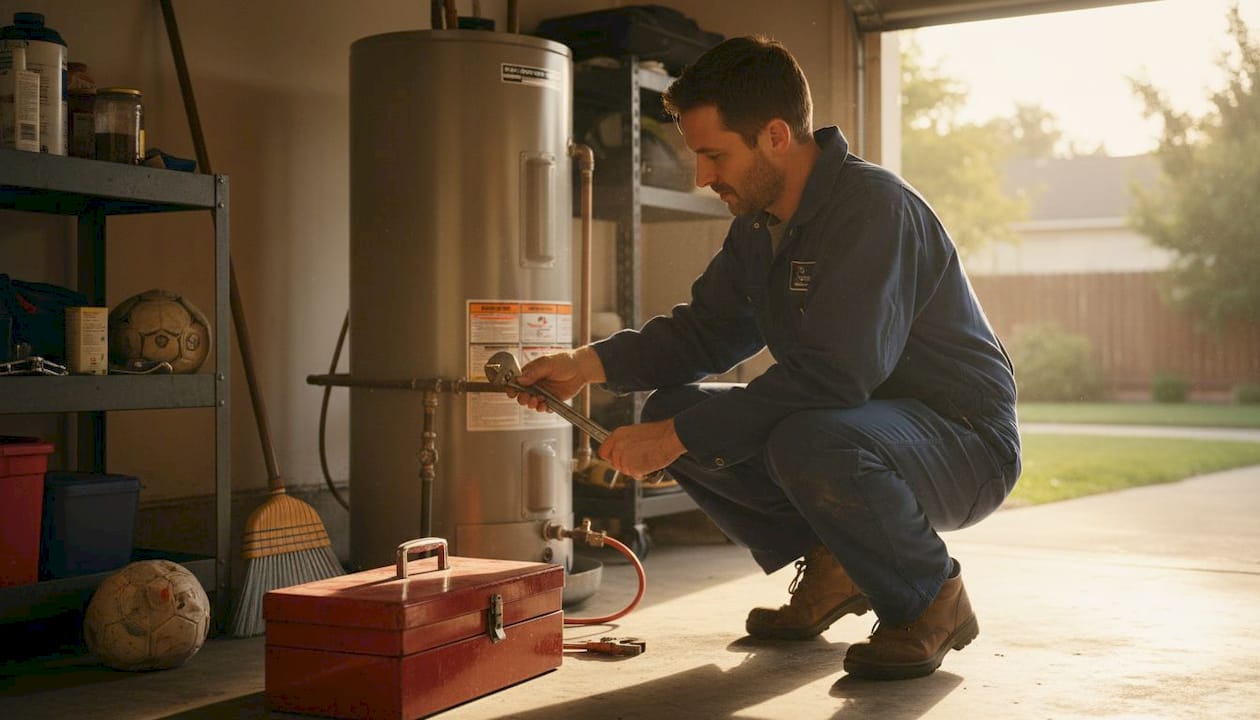
Pro Tip: Before calling for service, check whether your unit is still under manufacturer warranty. Many heating elements and thermostats carry 1 to 6 year warranties that could cover the repair at no cost to you.
If you’re curious about what you can safely handle yourself, our DIY water heater fixes guide walks through which tasks are homeowner-friendly and which ones need a licensed plumber.
When replacement saves more in the long run
Sometimes the most expensive short-term decision is actually the cheapest long-term one. Replacing your water heater before it completely fails can save you from emergency service fees, water damage repairs, and months of inflated energy bills.
Here’s when replacement is the right move:
- The tank is leaking. As noted, a leaking tank signals replacement regardless of age. There is no reliable fix for a compromised tank body.
- The unit is past its expected lifespan. Repairing a 13-year-old tank heater is money going down the drain.
- You’ve had multiple repairs in the past 12 months. One repair is normal. Two or three in a single year is a pattern that signals the unit is failing system-wide.
- Repair costs exceed 50% of replacement. This is the widely accepted threshold for when replacement becomes the financially smarter option.
- Visible rust or corrosion on the tank exterior. Surface rust can indicate deeper structural decay.
For more detail on what to look for, our guide on signs to replace water heater covers the full picture specific to San Antonio homes.
The efficiency argument is real. Modern water heaters are significantly more efficient than models made even 8 years ago. Replacing an aging unit can reduce your water heating energy costs by 20 to 30%, which adds up quickly on a monthly San Antonio utility bill.
If you’re dealing with an active leak, don’t wait. Our water heater leak repair tips explain how to safely manage the situation until a technician arrives.
Comparing water heater types: tank vs. tankless vs. hybrid
If replacement is the right call, your next decision is choosing the right type of unit. Each option has real trade-offs, and the best choice depends on your household’s size, budget, and hot water habits.
| Type | Upfront cost | Lifespan | Efficiency | Best for |
|---|---|---|---|---|
| Tank | Low ($400-$900) | 8-12 years | Moderate | 1-3 person households |
| Tankless | Medium-high ($1,000-$3,000) | Up to 20 years | High | Larger families, high demand |
| Hybrid (heat pump) | High ($1,200-$3,500) | 10-15 years | Very high | High-usage homes with space |
Tank water heaters are familiar, affordable upfront, and easy to install. They work well for smaller households that don’t put heavy simultaneous demand on hot water. The trade-off is higher long-term energy costs and a shorter lifespan.
Tankless units heat water on demand, which means no standby heat loss. They cost more upfront but pay back the difference over time for families with higher usage. According to tankless vs. tank comparisons, efficiency gains are most pronounced in larger households, while smaller homes see more modest savings.
Hybrid heat pump water heaters are the most efficient option available, but they require more physical space and a specific installation environment. They’re best suited for high-usage homes where the efficiency payback justifies the higher purchase price.
Our local repair vs. replace guide includes San Antonio-specific cost breakdowns to help you compare real numbers.
Pro Tip: Check for CPS Energy rebates in San Antonio before purchasing. Heat pump water heaters often qualify for utility rebates that can offset several hundred dollars of the upfront cost.
Smart steps for making the final decision
With all the factors laid out, here’s a practical checklist to guide your final call. Work through these steps in order before spending a dollar on repair or replacement.
- Check the unit’s age. Find the manufacture date on the label. Compare it to the expected lifespan for your type of unit.
- Document your repair history. How many times has it been serviced in the last two years? One repair is fine. Multiple repairs suggest a bigger problem.
- Get a written repair estimate. A licensed plumber should be able to tell you exactly what’s wrong and what it will cost to fix.
- Compare that estimate to replacement cost. Apply the 50% rule for water heaters as your baseline benchmark.
- Factor in energy efficiency. If your current unit is old and inefficient, a new model’s monthly savings may tip the math toward replacement even if the repair cost alone seems acceptable.
- Check for rebates and incentives. Local utility programs and federal tax credits for high-efficiency units can meaningfully reduce the cost of a new installation.
Here’s a quick reference table to apply the decision framework:
| Situation | Recommended action |
|---|---|
| Unit under 8 years, minor issue | Repair |
| Unit 8-12 years, repair under 35% of replacement | Repair, monitor closely |
| Unit 8-12 years, repair over 50% of replacement | Replace |
| Unit over 12 years, any repair needed | Replace |
| Active tank leak, any age | Replace immediately |
| Multiple repairs in 12 months | Replace |
For a deeper look at how these factors interact, our guide on explained signs and decision tips walks through real-world scenarios.
What most homeowners in San Antonio get wrong — and what to do instead
After years of servicing water heaters across San Antonio, we’ve seen the same pattern repeat itself: homeowners wait too long, patch the problem, and end up paying far more than they needed to.
The “patch it up” approach feels responsible in the moment. But in San Antonio’s hard-water environment, a unit that’s already showing signs of scale buildup and corrosion is on borrowed time. Every repair you make on a compromised unit is money spent on something that won’t last. Worse, a failing water heater running inefficiently is quietly adding $20 to $40 to your monthly energy bill, month after month.
The smarter move, in our experience, is to make the replacement decision before the unit fails completely. An early, planned replacement lets you shop for the right unit, schedule installation at your convenience, and take advantage of rebates. An emergency replacement after a tank floods your garage gives you none of those options.
Our local water heater decision guide reflects what we’ve learned from thousands of San Antonio service calls. Trust the data, not the hope that one more repair will hold.
Get expert help with your water heater decision
If you’re still weighing your options, a professional assessment removes the guesswork entirely. At Stultz Plumbing, we provide honest evaluations of your current unit and clear, transparent estimates for both repair and replacement. We’re not here to sell you a new water heater you don’t need. We’re here to give you the right answer for your home and your budget. Explore our affordable plumbing services or read through our San Antonio water heater guide to see how we approach these decisions. When you’re ready to talk, our team is available across San Antonio and surrounding communities.
Frequently asked questions
What is the 50% rule for water heaters?
If a repair costs 50% or more of replacement price and your unit is near end-of-life, replacement is the recommended choice. For mid-age units, the threshold may be lower, around 20 to 35%.
Should I replace my water heater if it’s leaking?
Yes. A leaking tank signals replacement regardless of its age, since structural failure in the tank body cannot be reliably repaired.
How long do tank and tankless water heaters last?
Tank units typically last 8 to 12 years, while tankless units can last up to 20 years with regular maintenance and proper water treatment.
Is tankless always more efficient than a tank heater?
Tankless efficiency gains are most significant for larger households with high hot water demand. For smaller homes, the savings are real but more modest.
What’s a key sign replacement is better than repair?
Multiple repairs within a single year or a steady rise in energy bills signal replacement is likely the smarter and more cost-effective long-term move.
Recommended
- Repair or Replace Your Water Heater | Stultz Plumbing
- Water heater repair vs replace guide for San Antonio 2026
- How to fix your water heater: DIY guide San Antonio 2026
- Signs You Need Water Heater Repair | Stultz Plumbing
- Appliance Upgrades vs. Repairs: Expert Advice in 2025
Jean runs growth strategy at AimSetWin, a performance marketing agency specializing in local service businesses across Texas. he's helped plumbers, HVAC companies, pest control operators, and home service brands build predictable revenue systems using data-driven advertising and conversion optimization.


