

Unlock your DIY potential with our plumbing terminology guide! Understand essential terms and communicate effectively with professionals.
TL;DR:
- Understanding plumbing terminology helps homeowners communicate effectively with professionals and avoid costly mistakes.
- Key concepts include the distinction between pressurized supply lines and gravity-based DWV systems, along with essential parts like P-traps, vents, and fixtures.
If you’ve ever stared blankly at a plumber’s estimate or tried to describe a dripping fixture and couldn’t find the right words, you already know the frustration that comes with not having a solid plumbing terminology guide in your back pocket. Plumbing has its own language, and when you don’t speak it, you’re at a real disadvantage. You might order the wrong parts, misread a repair quote, or simply not know what question to ask. This guide breaks down the most important plumbing terms explained in plain language, so you can handle more repairs yourself, communicate clearly with professionals, and make smarter decisions about your home’s plumbing system.
Key Takeaways
| Point | Details |
|---|---|
| Two systems, two vocabularies | Home plumbing splits into supply lines and DWV systems, each with distinct terms and functions. |
| Core terms cover most situations | Ten essential terms cover roughly 90% of common plumbing issues you will encounter. |
| DWV traps and vents work together | Traps hold water to block sewer gas; vents balance pressure so that water seal stays intact. |
| Pipe materials are not interchangeable | PVC and ABS serve DWV lines; PEX and CPVC serve pressurized supply lines. Using the wrong one violates code. |
| Terminology saves time and money | Knowing estimating terms like fixture rough-in helps you read bids accurately and avoid unnecessary service calls. |
Your plumbing terminology guide starts here: supply vs. DWV
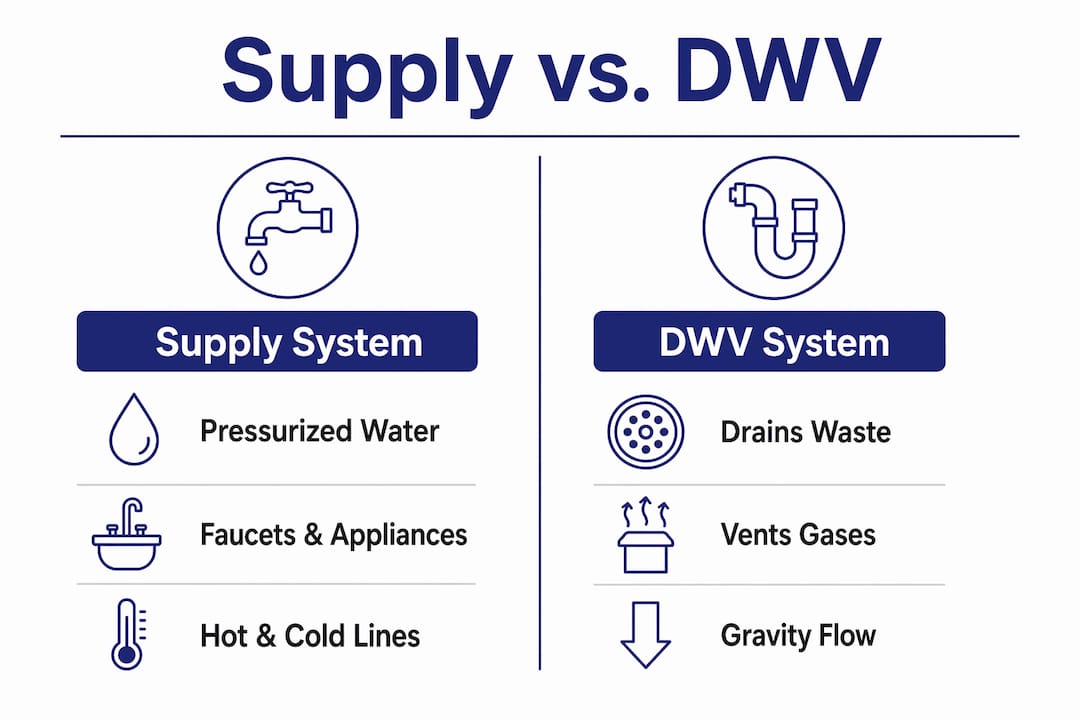
Before you can master any plumbing glossary, you need to understand that every home plumbing system is really two systems running side by side.
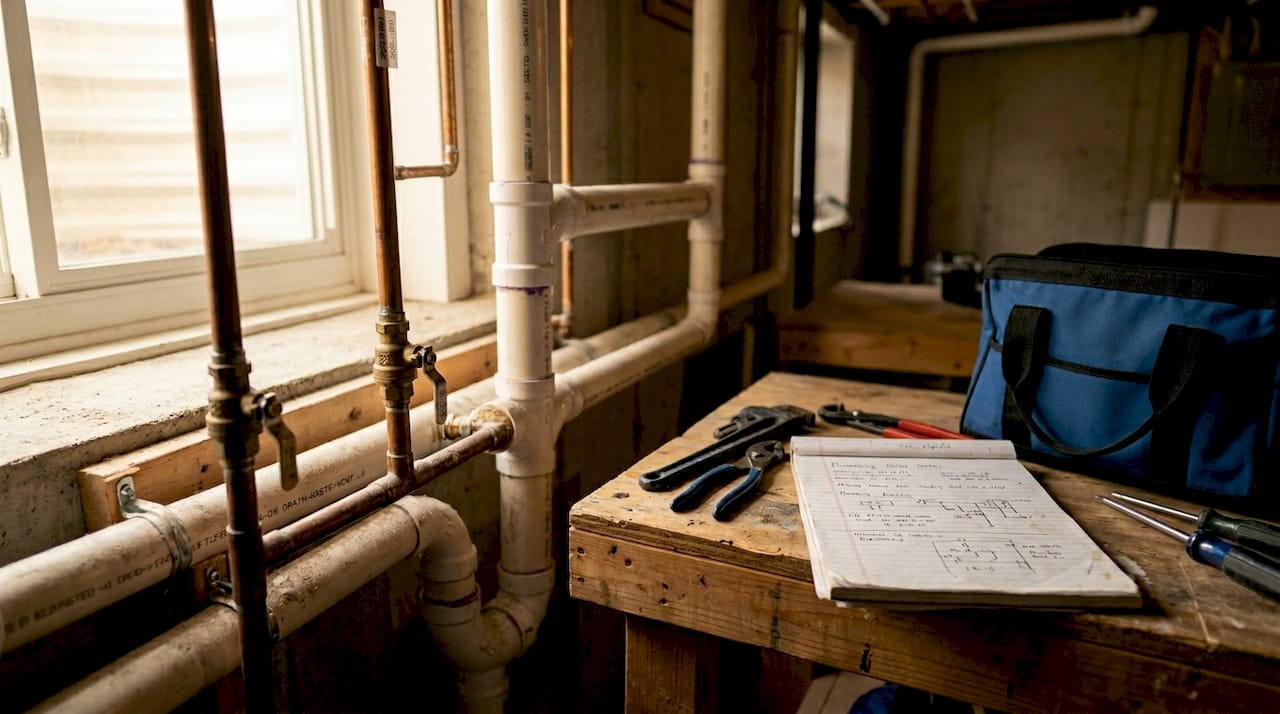
The first is the supply system. It delivers pressurized, potable water to every faucet, toilet, and appliance in your home. These lines run under pressure, typically between 40 and 80 PSI (pounds per square inch). Common supply line materials include PEX (cross-linked polyethylene) and CPVC (chlorinated polyvinyl chloride). You’ll also hear terms like shut-off valve, angle stop, and water meter in conversations about this side of the system.
The second is the drain-waste-vent system, almost always called the DWV system. It works entirely by gravity-driven drainage, carrying wastewater from fixtures down through pipes and out to the sewer or septic system. Unlike supply lines, DWV pipes are not pressurized. They rely on slope, gravity, and proper venting to move waste efficiently.
Think of your plumbing as a tree. The trunk is the main stack, a large vertical pipe that runs from your basement or slab up through the roof. Branches connect individual fixtures. Each branch feeds into the stack, which connects to the sewer. Visualizing this layout makes it far easier to understand why specific terms exist and what role each component plays.
- Supply side terms to know: PEX, CPVC, shut-off valve, angle stop, PSI, GPM (gallons per minute), ball valve, gate valve, pressure reducing valve (PRV)
- DWV side terms to know: P-trap, vent stack, drain stack, cleanout, slope, branch drain, sanitary tee, wye fitting
Pro Tip: If a plumber says they need to “check your stack,” they’re looking at the main vertical drain pipe that every fixture in your home ties into. Knowing this prevents confusion when reviewing a repair scope.
Core plumbing vocabulary every homeowner should recognize
This section is your working plumbing terminology list. These are the terms that come up constantly, whether you’re watching a YouTube repair tutorial, reading a plumber’s quote, or standing in the plumbing aisle at your local hardware store.
- Shut-off valve — A valve that stops water flow to a specific fixture or section of pipe. Every toilet, sink, and washing machine should have one nearby. When something goes wrong, this is the first thing you reach for.
- P-trap — The curved pipe under your sink that holds a small amount of standing water. That water creates a seal that keeps sewer gases from coming back up through the drain. If you smell rotten eggs near a drain, a dry P-trap is often the culprit.
- Water closet — The industry term for a toilet. You’ll see this on blueprints, permits, and plumbing estimates constantly.
- GPM (gallons per minute) — A flow rate measurement. Shower heads are typically rated at 2.0 GPM or less. Low GPM from a fixture usually means a clogged aerator or a pressure issue.
- PSI (pounds per square inch) — The measurement of water pressure. Ideal home water pressure sits between 40 and 60 PSI. Anything over 80 PSI can damage pipes and appliances over time.
- Flapper — The rubber seal inside a toilet tank that opens to let water flow into the bowl during a flush, then closes to allow the tank to refill. Running toilets are most often caused by a worn flapper.
- Main line — The primary pipe that carries water into your home from the municipal supply or well. A clog here affects every fixture in the house simultaneously.
- PEX — A flexible plastic tubing used for supply lines. It’s popular in repiping projects because it resists corrosion, expands slightly in freezing temperatures, and is faster to install than rigid pipe.
- Closet flange — The fitting that connects the toilet base to the drain pipe in the floor. If your toilet rocks, there’s a good chance the closet flange is cracked or sitting too low.
- Auger — A flexible, coiled tool used to break up or retrieve clogs deep inside a drain line. A toilet auger is different from a drain auger, so make sure you buy the right one.
Here’s a quick comparison of the two main plumbing code systems you may encounter in documentation and permits:
| Code System | Where It’s Used | Key Differences |
|---|---|---|
| UPC (Uniform Plumbing Code) | Western U.S., including San Antonio area | Stricter wet-vent rules, requires specific trap arm lengths |
| IPC (International Plumbing Code) | Eastern and central U.S. | More flexibility in venting configurations |
San Antonio follows the UPC, so any DIY work or contractor you hire needs to follow those specific rules on venting and trap configuration.
DWV system terminology in detail
The DWV system has the most misunderstood vocabulary in all of basic plumbing. Most homeowners can identify a clogged drain but struggle to explain why it’s slow, why it smells, or why fixing one problem seems to create another. The answer is almost always in the traps and vents.
Traps are the water-holding, curved sections of pipe located directly below or near every fixture drain. The most common type is the P-trap, named for its shape. The water sitting inside the trap forms a physical barrier. Sewer gas cannot pass through standing water, so the trap seal is your home’s first defense against foul odors and harmful gases like methane and hydrogen sulfide. A trap water seal is typically 2 to 4 inches deep, and anything that evaporates or siphons that water away creates an immediate odor problem.
Vents are equally critical and far less obvious. Vent pipes run upward from the drain lines, through the walls, and out through the roof. Their job is to introduce atmospheric pressure into the DWV system. Without venting, the rushing water in a drain line creates a partial vacuum that sucks water out of traps, destroying that protective seal. When you hear a gurgling sound after flushing or draining a tub, you’re almost certainly dealing with a venting problem, not just a blockage.
Here’s a quick reference table for diagnosing DWV issues:
| Symptom | Likely Cause | Related Term |
|---|---|---|
| Gurgling after flushing | Vent obstruction or absence | Vent stack, air admittance valve |
| Sewer smell near drain | Dry or siphoned trap | P-trap, trap seal |
| Slow drain in one fixture | Partial blockage or improper slope | Branch drain, pipe slope |
| Slow drains throughout home | Main line issue | Main stack, cleanout |
Pipe slope is another term that trips up DIYers. Drain pipes must slope at a specific grade, typically 1/4 inch of drop per foot of horizontal run. Too little slope and waste sits in the pipe. Too much slope and the water runs ahead of the solids, leaving debris behind to accumulate.
Cleanouts are Y-shaped or T-shaped fittings with removable caps installed at strategic points in the drain line. They give plumbers (and motivated DIYers) direct access to clear blockages without disassembling pipe sections.
Pro Tip: If your plumber mentions an “air admittance valve” or AAV, that’s a mechanical device used instead of a roof-penetrating vent in locations where running a full vent stack isn’t practical. They’re allowed under UPC in certain situations, but not as a blanket replacement for a proper venting system.
Plumbing materials and fixture terms that matter
Not all plastic piping is the same, and using the wrong type for the wrong application is one of the most common and costly DIY mistakes we see. Here’s how the materials break down:
- PVC (polyvinyl chloride): Used exclusively for DWV applications. White or gray in color. Cannot handle the temperature of hot supply water.
- ABS (acrylonitrile butadiene styrene): Another DWV material, typically black. Common in older homes and in western states. Not compatible with PVC cement; requires its own solvent.
- CPVC (chlorinated polyvinyl chloride): A supply line material that handles both hot and cold water. Cream or yellow in color. Cheaper than PEX but more rigid and more prone to cracking under impact.
- PEX: The current standard for residential supply line repiping. Flexible, color-coded (red for hot, blue for cold), and easier to install around obstacles than rigid pipe. Material choice matters for both code compliance and longevity.
Here’s a comparison to keep on hand when buying materials:
| Material | Use | Temperature Rating | Flexibility |
|---|---|---|---|
| PVC | DWV only | Up to 140°F (drain) | Rigid |
| ABS | DWV only | Up to 140°F (drain) | Rigid |
| CPVC | Hot and cold supply | Up to 200°F | Semi-rigid |
| PEX | Hot and cold supply | Up to 200°F | Highly flexible |
On the water heater side, two terms cause consistent confusion: closed system and thermal expansion. A closed system exists when a check valve or pressure reducing valve prevents expanded water from pushing back into the municipal supply line. When water heats up, it expands. In a closed system, that expanding water has nowhere to go, and pressure builds rapidly. The solution is an expansion tank, a small pressurized vessel mounted on the cold water inlet to absorb that extra volume. Both UPC and IPC code require expansion tanks in closed water heater systems. If your water heater’s pressure relief valve is dripping, a missing or waterlogged expansion tank is the first thing to check.
Putting plumbing vocabulary to work for you
Knowing the terms is one thing. Using them to solve real problems is where the learning pays off. Here’s how to put your plumbing vocabulary into practice right away.
- Diagnose before you call. When you hear a gurgling drain, you can now say “I think I have a venting issue, possibly a blocked vent stack.” That single sentence tells a plumber far more than “my drain sounds weird” and can cut the diagnostic visit short.
- Read estimates accurately. When a quote includes “fixture rough-in,” that means the labor and materials to run supply and drain lines to the location of a new fixture before the actual fixture is installed. Understanding this term prevents surprises when you see line items on a bill.
- Buy the right parts the first time. If you need to replace a toilet wax ring, you now know to check whether your closet flange sits flush with or below the finished floor, because the answer determines which wax ring thickness you need.
- Use the right terminology when buying parts. Instead of describing a “round plastic thing under the sink,” you can ask for a 1.5-inch P-trap with a slip joint connection. You’ll get what you need faster and avoid the wrong-size return trip to the hardware store.
Pro Tip: When reviewing any plumbing estimate, ask the contractor to define any term you don’t recognize before signing. Contractors who use terms like “unit price” in their bids are quoting per fixture or per item, meaning costs scale with quantity. Knowing this helps you negotiate scope.
For a deeper look at diagnosing common plumbing problems yourself using correct terminology, that step-by-step resource walks through real scenarios from start to finish.
My honest take after years in the field
By Jean
I’ve watched countless homeowners make the same mistake. They treat plumbing terminology like it’s optional knowledge, something only professionals need. Then they end up buying the wrong pipe, creating a code violation, or calling us to undo a repair they made worse.
The ASSE Plumbing Dictionary contains hundreds of terms that carry precise technical and safety meanings. You don’t need to memorize all of them. But if you’re a homeowner handling your own repairs, you absolutely need the core vocabulary. Terms like trap seal, vent stack, and closet flange are not jargon for jargon’s sake. They describe real physical components that work together in specific ways, and misidentifying one can cascade into a bigger problem.
What I’ve seen work consistently is this: homeowners who take 30 minutes to understand the two system halves and the 10 core terms before starting a project make fewer mistakes, spend less, and feel more confident throughout the repair. The fear of plumbing usually comes from unfamiliarity. Once you can name what you’re looking at, the work feels far less intimidating.
Don’t wait for a leak to start learning. Start now, while things are dry.
— Jean
Get expert plumbing help from Stultz Plumbing in San Antonio
Now that you have a solid foundation in plumbing terms, you know where your knowledge ends and where a licensed professional adds real value. Some jobs, like repiping a home, replacing a water heater, or clearing a stubborn main line clog, need more than vocabulary. They need experience and the right tools.
At Stultz Plumbing, our licensed technicians serve San Antonio and surrounding communities with professional plumbing services built around honest pricing and reliable workmanship. Whether you need water heater repair or replacement, a drain cleared fast, or an emergency plumber at your door today, we’re ready. Call Stultz Plumbing when the job is beyond your toolbox. We’ll speak your language and get it done right.
FAQ
What is a DWV system in plumbing?
DWV stands for drain-waste-vent. It’s the side of your home plumbing that removes wastewater using gravity and prevents sewer gases from entering through a network of traps and vent pipes.
What does P-trap mean in plumbing?
A P-trap is the curved pipe section beneath a drain fixture that holds standing water to form a seal against sewer gases. A dry or damaged P-trap is the most common cause of drain odors.
Why does my drain gurgle after flushing?
Gurgling drains usually signal a venting problem, not a clog. A blocked or absent vent creates a vacuum that pulls air through nearby traps, producing that gurgling sound.
What is the difference between PEX and PVC pipe?
PEX is a flexible pipe used for pressurized supply lines carrying hot and cold water. PVC is a rigid pipe used only in drain-waste-vent systems. Using PVC for supply lines is a code violation in most jurisdictions.
What is a fixture rough-in in plumbing estimates?
Fixture rough-in refers to the work of running supply and drain lines to the location where a fixture will be installed, before the fixture itself is set. It’s a common line item in remodeling estimates and new construction bids.
Recommended
- Types of Residential Plumbing: Your 2026 Homeowner’s Guide
- Residential plumbing troubleshooting: a step-by-step guide
- Plumbing emergencies defined: San Antonio homeowner’s guide
Jean runs growth strategy at AimSetWin, a performance marketing agency specializing in local service businesses across Texas. he's helped plumbers, HVAC companies, pest control operators, and home service brands build predictable revenue systems using data-driven advertising and conversion optimization.


