

Learn how to troubleshoot water heaters effectively and save money. This guide helps you identify issues, ensure safety, and restore your hot water!
TL;DR:
- Troubleshooting water heaters involves a systematic check of power, fuel source, components, and plumbing to identify issues quickly.
- Most problems can be resolved with basic tools, but safety precautions, like turning off power or gas, are essential before diagnosing.
Knowing how to troubleshoot water heaters can save you hundreds of dollars and restore hot water before a cold shower ruins your morning. Water heater troubleshooting is the process of systematically identifying whether the problem lies in the power supply, fuel source, internal components like Rheem heating elements or thermostats, or the distribution plumbing itself. Most repairs require only basic household tools: a flathead screwdriver, a multimeter, and a thermometer. Safety is non-negotiable throughout this process. Turn off power or gas before touching any component. This guide walks you through every major failure point so you can diagnose the problem accurately and decide whether to fix it yourself or call a professional.
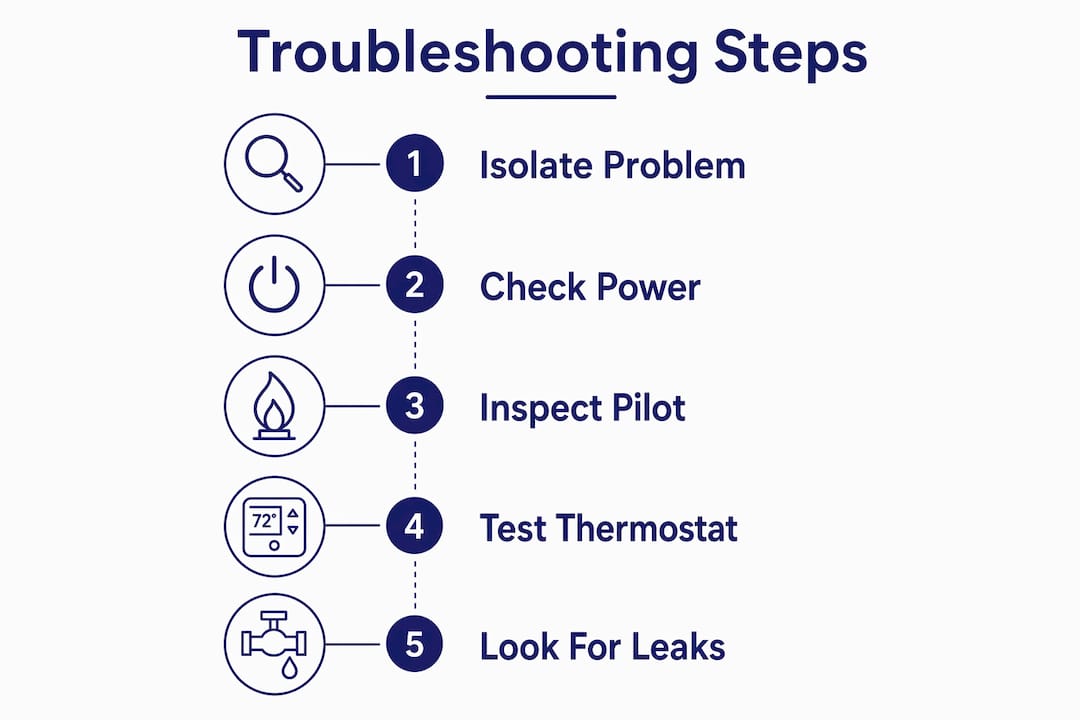
How to troubleshoot water heaters: start by isolating the problem
Before you open any panel or touch any valve, answer one question: is the lack of hot water affecting your entire home or just one fixture? That single answer determines everything about your next step.
Test multiple faucets throughout the house, including the kitchen sink, a bathroom sink, and the shower. If only one faucet runs cold, the water heater is almost certainly not the problem. A faulty cartridge, a failed mixing valve, or a cross-connection in that fixture’s supply line is the more likely cause. This distinction matters because replacing a $15 cartridge is very different from diagnosing a 50-gallon tank.
If every hot water outlet in the house runs cold or lukewarm, the water heater is the source. At that point, identify your heater type before doing anything else:
- Electric water heater: Check the circuit breaker panel first. A tripped breaker is the most common reason an electric heater stops working entirely.
- Gas water heater: Check the pilot light through the viewing window. A pilot that has gone out will prevent the burner from firing.
- Tankless water heater: Check the error code display on the unit. Brands like Rinnai and Navien show fault codes that point directly to the failed component.
- Heat pump water heater: Check that the surrounding air temperature is within the operating range, typically above 40°F, since these units draw heat from ambient air.
Pro Tip: Write down your water heater’s model number, serial number, and installation date before you start troubleshooting. This information is on the label affixed to the tank and will be required if you call a plumber or order parts.
What are the electrical troubleshooting steps for electric water heaters?
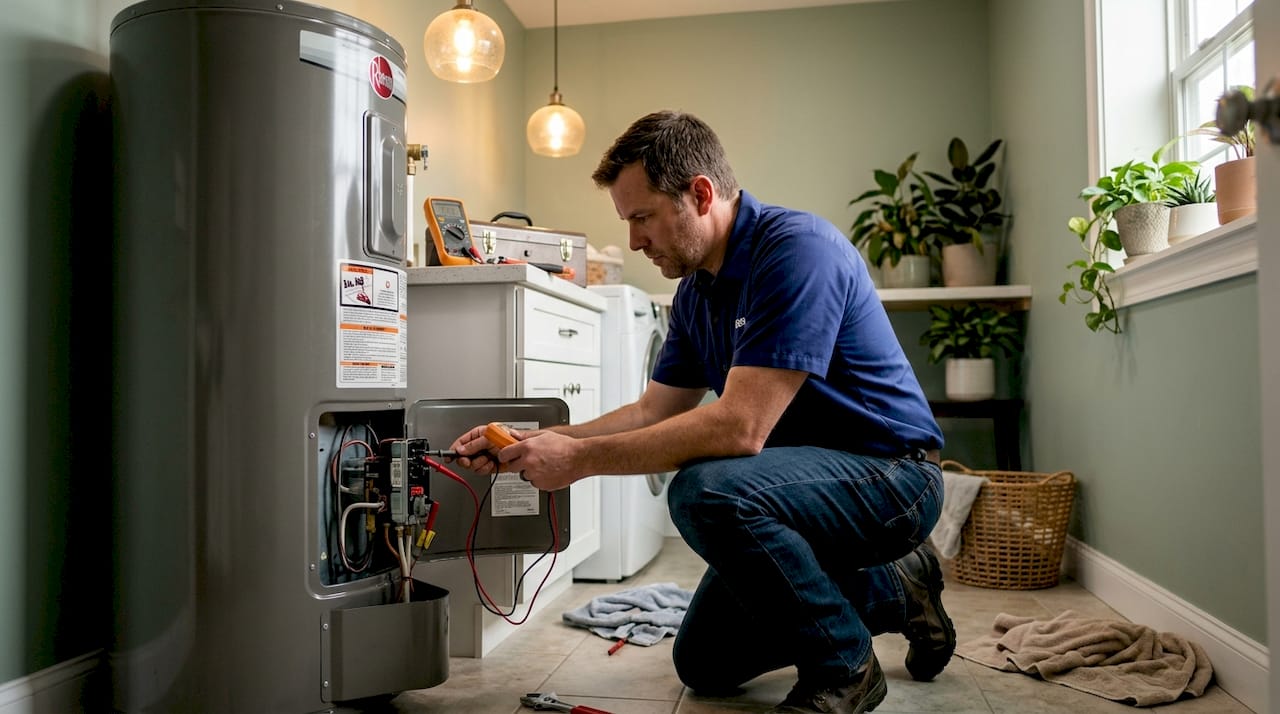
Electric water heaters fail for a predictable set of reasons, and you can work through them in order without any specialized training. Reset the breaker at the main panel as your first move. A tripped breaker is the primary reason electric heaters stop heating, and persistent trips after resetting indicate an underlying electrical fault that needs a licensed electrician.
Follow these steps in sequence:
- Turn off the breaker at the main panel before opening the heater’s access panels. This is not optional. Electric water heaters run on 240 volts, which is lethal.
- Remove the upper access panel and pull back the insulation to expose the high-limit switch, also called the reset button. It is a red button located above the upper thermostat.
- Press the reset button firmly until you hear a click. Replace the insulation and panel, restore power, and wait 30 to 60 minutes. If hot water returns, the high-limit switch tripped due to overheating, which itself signals a thermostat problem worth investigating further.
- Test the thermostats with a multimeter set to continuity mode. A thermostat that shows no continuity is defective and needs replacement. Rheem and A.O. Smith thermostats are widely available at hardware stores for under $30.
- Test the heating elements with a multimeter set to resistance (ohms). A reading of zero or infinity indicates a burned-out element. Most standard elements cost $20 to $40 and are a straightforward DIY replacement.
- Call a licensed plumber or electrician if the breaker continues to trip after a reset, or if you find wiring that looks burned, corroded, or melted. These are signs of a fault that goes beyond the heater itself.
Pro Tip: A water heater that runs out of hot water faster than it used to, but still produces some hot water, almost always has one failed heating element rather than two. The lower element does the bulk of the heating work, so its failure is felt first.
Most homeowners in San Antonio deal with hard water, which accelerates heating element failure by depositing mineral scale directly on the element surface. Checking your elements annually is a smart addition to any water heater maintenance checklist.
How do I troubleshoot gas water heater pilot light and thermocouple problems?
Gas water heater problems follow a different diagnostic path than electric units, and the stakes are higher because natural gas is involved. Pilot light failure and thermocouple failure are the two most common causes of a gas heater producing no hot water. Work through these steps carefully:
- Look through the pilot light viewing window on the front of the unit. If the pilot flame is out, that is your starting point.
- Turn the gas control knob to “Pilot” and press it down to allow gas to flow to the pilot tube. Use a long lighter or the built-in igniter to light the pilot while holding the knob down.
- Hold the knob down for 30 to 60 seconds after the pilot lights. This heats the thermocouple, which is the small metal probe positioned in the pilot flame. If the pilot goes out the moment you release the knob, the thermocouple has failed and is not sending the signal that keeps the gas valve open.
- Replace the thermocouple if it fails this test. A thermocouple costs $10 to $20 at any hardware store and threads directly into the gas valve. This is one of the most cost-effective DIY repairs on any gas appliance.
- Check the gas supply if the pilot will not light at all. Confirm the gas shutoff valve on the supply line to the heater is fully open. Check that other gas appliances in the home, such as the stove or furnace, are working normally.
Safety warning: If you smell gas at any point during this process, do not attempt to light the pilot. Do not operate any electrical switches. Leave the house immediately, leave the door open, and call your gas utility provider and 911 from outside. A gas smell indicates a leak, and any ignition source can cause an explosion.
Brands like Bradford White and State Water Heaters use gas control valves that occasionally fail independently of the thermocouple. If a new thermocouple does not solve the problem, the gas valve itself may need replacement. That repair is best handled by a licensed plumber.
What signs indicate sediment buildup, leaks, or other issues?
Some water heater problems announce themselves loudly. Others show up as subtle changes in water quality or small puddles you might ignore for weeks. Catching these early warning signs before they become failures is the core of any good water heater maintenance guide.
Noise problems and what they mean:
- Rumbling or popping sounds during heating cycles signal sediment buildup at the bottom of the tank. Sediment acts as a thermal barrier between the burner and the water, forcing the heater to work harder and run longer. This reduces heat transfer efficiency and shortens tank life.
- High-pitched whining often points to scale buildup on electric heating elements.
- Ticking or tapping sounds are usually normal thermal expansion in the pipes and not a cause for concern.
Leak locations and what they tell you:
| Leak location | Likely cause | Repair or replace? |
|---|---|---|
| Pressure relief valve | Excess pressure or faulty valve | Replace valve (DIY or pro) |
| Inlet/outlet fittings | Loose connections or corrosion | Tighten or replace fittings |
| Drain valve | Worn valve seat | Replace drain valve |
| Tank body or bottom | Internal corrosion | Replace the water heater |
Water pooling near the tank along the tank side or base almost always signals internal corrosion. Once the tank itself is leaking, repair is not an option. You need a replacement. For guidance on that decision, the signs your heater needs replacement resource from Stultz Plumbing lays out the specific indicators clearly.
Discolored or smelly water:
Rusty or brown water from hot taps points to a corroding anode rod or a rusting tank interior. A rotten egg smell in hot water is caused by sulfur-reducing bacteria reacting with a magnesium anode rod. Replacing the anode rod with an aluminum or zinc rod typically eliminates the odor.
Flushing the tank:
Flushing annually removes sediment, extends tank life, and reduces noise. San Antonio’s hard water makes annual flushing especially important. Connect a garden hose to the drain valve, run it to a floor drain or outside, turn off the cold water supply, and open the valve until the water runs clear. The full process takes about 30 minutes and requires no special tools.
Pro Tip: Check your flushing schedule based on your local water hardness. In San Antonio, where water hardness regularly exceeds 200 mg/L, flushing every six months is a smarter interval than the standard annual recommendation.
How do you fix water that’s too hot or not hot enough?
Temperature problems are among the most fixable water heater issues, and they rarely require replacement. The fix depends on whether you have an electric or gas unit, and whether the water is running too hot or too cold.
Follow this sequence to diagnose and correct temperature issues:
- Measure the actual outlet temperature using a cooking thermometer or an infrared thermometer at the nearest hot water faucet. Run the tap for two minutes first to flush standing water from the pipes.
- Compare to the target. Set the thermostat to 120°F for safe, efficient operation. Water above 140°F causes scalding in under five seconds and accelerates mineral buildup inside the tank.
- Adjust the thermostat dial on electric heaters by removing the access panel and turning the dial with a flathead screwdriver. Most units have upper and lower thermostats. Set both to the same temperature to prevent uneven heating.
- Adjust the gas control knob on gas heaters. The dial is on the front of the gas valve and is typically marked with settings like “Warm,” “Hot,” and “Very Hot” rather than specific temperatures. Turn it to “Hot” and recheck the outlet temperature after a full heating cycle.
- Check for a cross-connection if the water is lukewarm even at the correct thermostat setting. A cross-connection occurs when a single-handle faucet or a faulty mixing valve allows cold water to bleed into the hot supply line. Test by turning off the cold water supply to the house and opening a hot tap. If water still flows, a cross-connection exists.
- Inspect the mixing valve on the water heater itself if one is installed. Thermostatic mixing valves from brands like Watts or Honeywell can fail internally, causing them to blend too much cold water into the output. Replacing a mixing valve is a straightforward repair that restores accurate temperature control.
Pro Tip: Thermostat contacts can weld shut due to electrical arcing, causing uncontrolled heating and repeated breaker trips on electric heaters. If your water is scalding hot and the breaker keeps tripping, a welded thermostat contact is the likely cause. Replace the thermostat before the high-limit switch burns out entirely.
Key takeaways
Effective water heater troubleshooting requires isolating the problem source first, then working through power, fuel, and component checks in a logical sequence before touching any part.
| Point | Details |
|---|---|
| Isolate the problem scope | Test multiple faucets first to confirm the issue is the heater, not a single fixture. |
| Safety before diagnosis | Turn off power or gas completely before opening any panel or valve. |
| Electric heaters: check the breaker first | A tripped breaker is the most common cause of total loss of hot water in electric units. |
| Gas heaters: thermocouple is the usual suspect | A $15 thermocouple replacement fixes most pilot light failures in gas water heaters. |
| Annual flushing prevents most noise and efficiency problems | Sediment removal extends tank life and restores heating efficiency, especially in hard-water areas like San Antonio. |
What I’ve learned after years of water heater calls in San Antonio
The most common mistake I see homeowners make is skipping straight to part replacement without isolating the actual fault first. Someone replaces a heating element when the real problem is a tripped breaker. Someone buys a new thermocouple when the gas supply valve was simply turned off by accident. Efficient troubleshooting distinguishes between tank faults and distribution plumbing issues before any money is spent on parts.
The second mistake is ignoring early warning signs. A rumbling noise is not just annoying. It is the tank telling you that sediment is shortening its life. A small drip from the pressure relief valve is not just a minor leak. It is a sign that operating pressure is too high or the valve is failing. Catching these signals early keeps a $400 repair from becoming a $1,200 emergency replacement.
My honest advice: handle the basics yourself. Check the breaker, relight the pilot, flush the tank once a year, and adjust the thermostat. Those four tasks cover the majority of water heater complaints we hear. But the moment you smell gas, see water pooling under the tank, or find burned wiring, stop and call a licensed plumber. The cost of a professional repair is always less than the cost of a flooded utility room or a gas incident.
— Jean
Need water heater help in San Antonio? Stultz Plumbing has you covered.

When troubleshooting points to a problem beyond a DIY fix, Stultz Plumbing is the team San Antonio homeowners trust. We handle everything from heating element replacement and thermocouple swaps to full tank replacements and emergency plumbing calls when a leak can’t wait. If you’re weighing whether to repair or replace your current unit, our repair vs. replace guide for San Antonio homeowners walks through the exact decision criteria we use in the field. We serve San Antonio and surrounding communities with transparent pricing and same-day availability. Call us before a small problem becomes a costly one.
FAQ
Why is my water heater not producing any hot water?
The most common causes are a tripped circuit breaker on electric units or a pilot light that has gone out on gas units. Check the breaker panel or pilot light first before inspecting any internal components.
How do I know if my water heater needs repair or replacement?
Water pooling at the base of the tank, rust-colored water from hot taps, and a unit older than 10 to 12 years are the clearest signs that replacement is the better choice over repair. Valve and element failures on newer tanks are almost always worth repairing.
What causes a water heater to make rumbling or popping noises?
Sediment buildup at the bottom of the tank causes rumbling and popping sounds during heating cycles. Flushing the tank annually removes this sediment and restores normal, quiet operation.
Is 120°F the right temperature setting for a water heater?
Yes. The U.S. Department of Energy and most plumbing professionals recommend 120°F as the standard setting. It prevents scalding, slows mineral buildup, and reduces energy consumption compared to higher settings.
When should I call a plumber instead of troubleshooting myself?
Call a licensed plumber if you smell gas, see water pooling under the tank, find burned or melted wiring, or if the circuit breaker trips repeatedly after resetting. These conditions go beyond safe DIY repair territory.
Recommended
- Water heater troubleshooting guide San Antonio 2026
- Common Water Heater Problems Every Homeowner Should Know
- Water Heater Repair Guide: DIY Fixes for San Antonio
- Essential Water Heater Basics for San Antonio Homeowners
Jean runs growth strategy at AimSetWin, a performance marketing agency specializing in local service businesses across Texas. he's helped plumbers, HVAC companies, pest control operators, and home service brands build predictable revenue systems using data-driven advertising and conversion optimization.


