

Discover the drain cleaning process explained for San Antonio homes. Learn how to prevent clogs and when to call for professional help!
TL;DR:
- Clogged drains in San Antonio often result from mineral buildup, hair, grease, and debris caused by local hard water and heat. Professional methods like snaking and hydro jetting effectively restore flow, with hydro jetting providing a more thorough clean for persistent buildup. Regular maintenance and timely professional intervention prevent costly repairs and prolong pipe lifespan.
If you’ve ever watched water pool in your sink or shower and slowly inch toward the drain, you already know the frustration. Clogged drains are one of the most common plumbing problems San Antonio homeowners face, and with the city’s notoriously hard water and hot climate accelerating buildup inside pipes, the issue is rarely a one-time fix. Understanding the drain cleaning process explained by professionals means you can make smarter decisions, avoid costly mistakes, and know exactly when to call for help instead of reaching for that bottle of chemical cleaner.
Table of Contents
- Understanding common drain clog problems in San Antonio homes
- What you need to know before starting a drain cleaning job
- Step-by-step overview of professional drain cleaning methods
- Common mistakes and safety tips during drain cleaning
- Verifying drain cleaning success and maintaining healthy pipes
- A fresh perspective on professional drain cleaning: why upfront investment saves you money and stress
- Professional drain cleaning services in San Antonio by Stultz Plumbing
- Frequently asked questions
Key Takeaways
| Point | Details |
|---|---|
| Common clog causes | Hair, grease, soap scum, and local hard water contribute to frequent drain blockages in San Antonio homes. |
| Professional methods | Drain snaking and hydro jetting are the main effective methods used by professionals, each suited to different clog types. |
| Safety risks | Using chemical drain cleaners involves safety hazards requiring protective gear and proper handling to avoid burns and pipe damage. |
| Early intervention saves | Addressing drain clogs promptly prevents costly repairs and emergency plumbing services later. |
| Maintenance matters | Routine maintenance and professional cleaning reduce recurring blockages and extend pipe life. |
Understanding common drain clog problems in San Antonio homes
Most drain clogs don’t happen overnight. They build slowly, layer by layer, until water has no clear path through the pipe. The common reasons for clogged drains in San Antonio homes include a predictable list of culprits:
- Hair and soap scum combining in bathroom drains to form dense, stubborn mats
- Grease and food waste coating kitchen drain walls over months of use
- Mineral deposits from hard water that narrow pipe interiors over time
- Debris and sediment entering older drain lines, especially in homes built before the 1990s
- Tree root intrusion in main sewer lines, which is more common in established San Antonio neighborhoods
San Antonio’s hard water and intense heat accelerate plumbing problems including drain clogs beyond what most homeowners expect. The calcium and magnesium in the local water supply cling to pipe walls, and when grease or soap scum passes through the same line, it sticks to those mineral deposits. The result is a clog that’s denser and more resistant than a simple hair blockage.
Older pipes compound the problem. Cast iron and galvanized steel pipes common in homes built decades ago corrode from the inside, creating rough interior surfaces that trap debris far more easily than smooth PVC. A minor slow drain today can become a full blockage or even a burst pipe in months if left untreated.
Having identified clog causes, next we explore what you need to know before attempting any drain cleaning.
What you need to know before starting a drain cleaning job
Before picking up a plunger or ordering chemicals online, understanding your options and their risks is essential. There are four main drain cleaning techniques used today, each suited to different situations:
- Mechanical methods: Plungers and drain snakes physically break apart or pull out blockages. Best for accessible, localized clogs.
- Chemical cleaners: Liquid or gel products that dissolve organic matter. Effective for grease and hair, but with significant limitations.
- Enzymatic cleaners: Biological products using bacteria and enzymes to break down waste slowly. Safe but best for maintenance, not active clogs.
- Hydro jetting: High-pressure water forced through the pipe by a professional technician. The most thorough method available.
Our guide to unclogging drains and toilets breaks down these approaches in more detail, but the safety angle deserves special attention here. Professional-grade chemical drain cleaners are classified as corrosive hazards requiring trained handling and full personal protective equipment. Even consumer-grade products can splash back and cause chemical burns or release harmful fumes in poorly ventilated bathrooms.
| Method | Best for | DIY-friendly? | Pipe safety |
|---|---|---|---|
| Plunger | Minor, surface clogs | Yes | Safe for all pipes |
| Drain snake | Localized blockages | With caution | Safe for most pipes |
| Chemical cleaner | Grease and hair | Limited | Risk to older pipes |
| Hydro jetting | Heavy buildup, roots | No (professional only) | Requires pipe assessment |
| Enzymatic cleaner | Routine maintenance | Yes | Safe for all pipes |
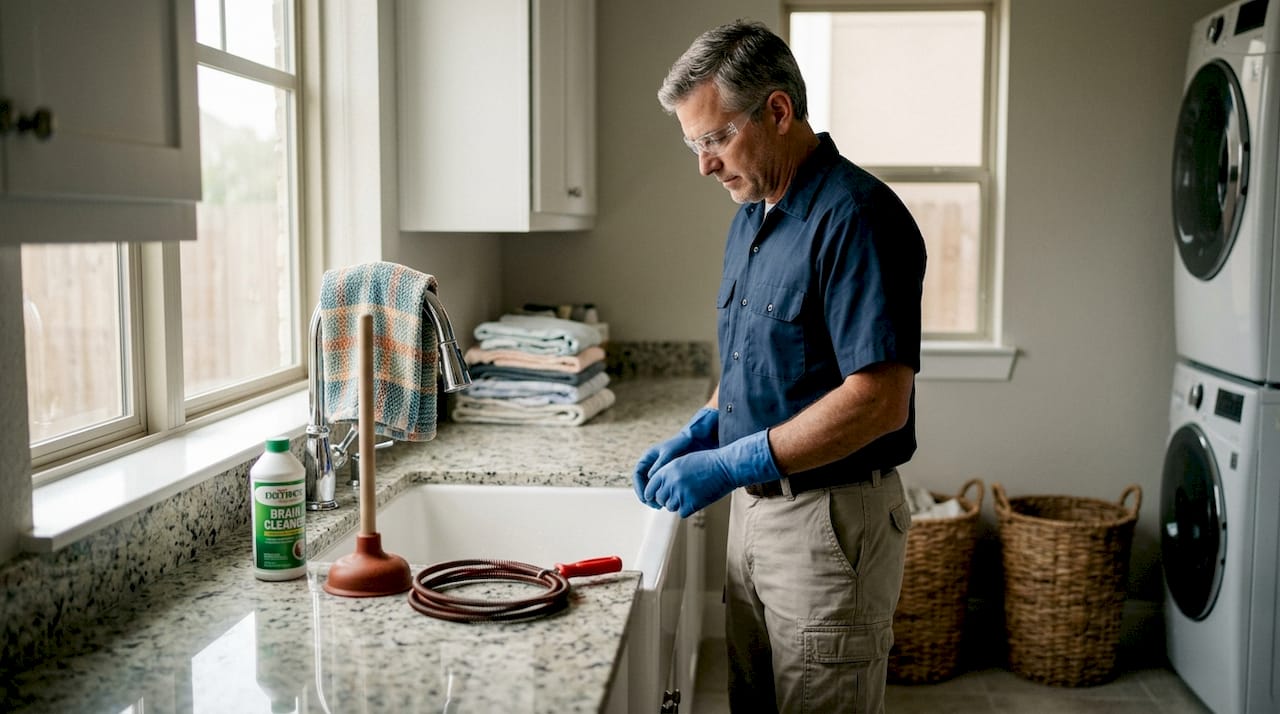
Before starting any job, gather the right gear. Rubber gloves, safety glasses, and adequate ventilation are minimum requirements even for DIY attempts. If you are uncertain about what is blocking the pipe or what material the pipe is made of, that uncertainty is itself a reason to call a professional.
Pro Tip: Never pour chemical cleaners into a drain that is already holding standing water. The dilution reduces effectiveness, and if the cleaner fails to clear the clog, you now have a sink full of corrosive liquid that is dangerous to remove.
With tools and safety clear, let’s walk through the step-by-step drain cleaning methods used by professionals.
Step-by-step overview of professional drain cleaning methods
This is where the drain cleaning process explained by professionals diverges sharply from what most homeowners attempt at home. Two methods dominate professional drain cleaning: snaking and hydro jetting.
How professional snaking works:
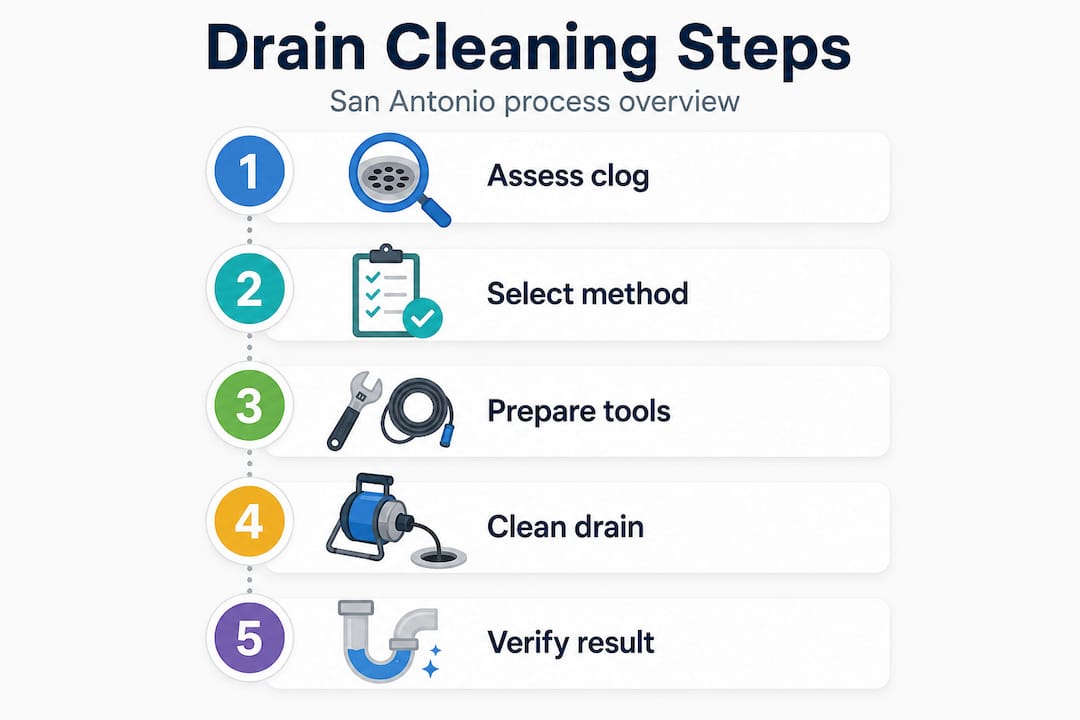
- The technician identifies the drain access point closest to the blockage.
- A flexible metal cable with a cutting or retrieval head is fed into the pipe.
- The cable is rotated mechanically, breaking apart or snagging the clog.
- The debris is either pulled back out or broken into pieces small enough to flush through.
- Water is run through the drain to confirm flow is restored.
Snaking is fast and cost-effective. Standard drain cleaning jobs typically take one to two hours in San Antonio, costing about $130 to $275. It’s the right call for a first-time clog or a straightforward soft blockage.
How hydro jetting works:
- A camera inspection is performed first to evaluate pipe condition and locate the blockage precisely.
- A specialized nozzle connected to a high-pressure water line is inserted into the drain.
- Water is blasted through at 1,500 to 4,000 PSI, scouring the pipe walls and pushing debris toward the main sewer line.
- The camera is often used again after jetting to confirm the pipe is clear and undamaged.
Snaking breaks blockages mechanically for localized clogs, while hydro jetting uses high-pressure water to clean pipe walls and remove persistent buildup that snaking simply cannot reach. Hydro jetting costs more, typically $300 to $800, but it cleans the entire interior surface of the pipe rather than just punching a hole through the obstruction.
| Factor | Snaking | Hydro jetting |
|---|---|---|
| Cost range | $130 to $275 | $300 to $800 |
| Time required | 1 to 2 hours | 2 to 3 hours |
| Clears pipe walls completely | No | Yes |
| Safe for older cast iron pipes | Generally yes | Requires inspection first |
| Camera inspection needed | Sometimes | Always recommended |
Pro Tip: Ask your plumber about pipe material before agreeing to hydro jetting. Older cast iron pipes or pipes with existing cracks may not withstand jetting pressure. Our drain cleaning San Antonio experts always perform a camera inspection first to avoid causing more damage than the original clog.
After detailing how drain cleaning is performed, let’s discuss common mistakes and safety tips to avoid complications.
Common mistakes and safety tips during drain cleaning
The majority of homeowner drain cleaning errors fall into one of two categories: using the wrong product or ignoring warning signs. Both are expensive in the long run.
Avoid these mistakes:
- Mixing chemical cleaners. Combining different products can produce toxic gases or violent reactions inside your pipes. Never do this.
- Using chemical cleaners repeatedly. Repeated exposure softens and weakens PVC and can pit older metal pipes, leading to leaks.
- Ignoring multiple slow drains. If two or more drains in your home are slow simultaneously, the problem is in the main line, not in individual fixture traps. Chemical cleaners will not fix this.
- Forcing a drain snake too aggressively. Forcing a snake through a turn in the pipe can cause perforations, particularly in older plumbing.
“A slow drain is a warning. A completely blocked drain is a consequence. The gap between the two is where most homeowners lose money.”
OSHA mandates proper hazard communication and PPE use when handling chemical drain cleaners to avoid burn and inhalation risks. Licensed plumbers follow these protocols every time because the risks are real, not theoretical.
For minor clogs, mechanical methods are the safer first choice. A plunger is effective, free of chemical risk, and gentle on pipes. The DIY drain unclogging methods that actually work are almost always mechanical. Learn more about the safest approaches in our what is drain cleaning guide for San Antonio homeowners.
Pro Tip: If the same drain clogs more than twice in a single year, stop treating the symptom and get a camera inspection. You likely have a structural issue, root intrusion, or a section of pipe that needs replacement.
With safety and mistakes covered, let’s address what results you should expect and how to maintain clear drains.
Verifying drain cleaning success and maintaining healthy pipes
Clearing a clog is only half the job. Confirming the line is fully open and keeping it that way is the part that saves you money over time.
Signs that drain cleaning was successful:
- Water drains at full speed with no pooling in sinks, showers, or tubs
- No gurgling sounds coming from the drain after flushing water through
- No sewage odors returning up through the drain
- Consistent flow across multiple fixtures connected to the same line
Prompt clearing of slow drains prevents expensive emergency repairs, which commonly cost over $800 if delayed in San Antonio. That number matters. A service call at $130 to $275 today beats an emergency call at $800 or more next month.
Pro Tip: Enzymatic drain maintenance products, which use live bacteria cultures to digest organic buildup, work best when used monthly as a preventive measure. They don’t clear active clogs, but they dramatically slow the rate of new buildup in well-used drains.
| Maintenance action | Frequency | Cost level | Effectiveness |
|---|---|---|---|
| Enzymatic drain treatment | Monthly | Low | Preventive |
| Drain hair catcher (bathroom) | Ongoing | Very low | Highly preventive |
| Professional snaking | Annually or as needed | Moderate | Reactive |
| Hydro jetting | Every 2 to 3 years | Higher | Preventive and reactive |
You should schedule drain cleaning in San Antonio on a routine basis, especially if your home has older pipes or a history of recurring blockages. Waiting until water stops draining entirely is a costly habit.
Now that you know how to verify and maintain, here’s a fresh perspective on drain cleaning most homeowners don’t hear.
A fresh perspective on professional drain cleaning: why upfront investment saves you money and stress
Here’s something most homeowners don’t consider until they’ve already spent hundreds of dollars on repeated service calls: snaking is the right tool for a specific job, and that job is not “every drain clog.”
The conventional approach favors snaking because the immediate cost is lower. That reasoning makes sense for a one-time soft clog. But when a drain clogs repeatedly every few months, snaking is only poking a hole through the same stubborn buildup that keeps regenerating. The grease coating the pipe walls, the mineral scale from San Antonio’s hard water, the soap scum layer bonded to that scale, none of that is removed by a snake. It punches through, flow returns briefly, and the buildup closes back in.
Spending more now on hydro jetting saves you multiple service calls and repairs over years. We’ve seen this pattern repeatedly with homeowners across San Antonio who finally opted for jetting after their third or fourth snaking visit in a calendar year. After jetting, the same drains ran cleanly for two to three years without a single service call.
The homeowner’s guide to drain cleaning we’ve put together reflects this reality. The goal isn’t just to restore flow today. It’s to understand what condition your pipes are in, address the actual cause of the blockage, and make a decision based on the full picture rather than just the lowest number on the invoice. A plumber who walks you through camera footage, explains your pipe condition honestly, and recommends the method that actually solves your problem is worth every dollar.
Professional drain cleaning services in San Antonio by Stultz Plumbing
If recurring clogs or slow drains are wearing you down, it’s time to bring in professionals who know San Antonio’s plumbing conditions inside and out.

At Stultz Plumbing, we offer a full range of drain cleaning services in San Antonio built around what your specific pipes actually need. From standard snaking for quick fixes to full hydro jetting with camera inspection for persistent or serious blockages, we bring the right tools to every job. Our pricing is transparent, starting at $130 for standard cleaning, and our licensed technicians follow all safety and code requirements so you never have to worry about damage or shortcuts. Explore our fast drain cleaning services or browse our full range of affordable plumbing services to find the right solution for your home.
Frequently asked questions
How long does a professional drain cleaning take in San Antonio?
A typical professional drain cleaning in San Antonio takes one to two hours, depending on the clog location and the method used by the technician.
Are chemical drain cleaners safe to use at home?
Consumer-grade products can be used cautiously for minor organic clogs, but professional-grade chemical cleaners are highly corrosive and require trained handling with full protective equipment.
When should I call a professional plumber for a drain clog?
Call a professional when clogs recur frequently, multiple drains slow simultaneously, you notice sewage odors, or DIY methods fail. Multiple simultaneous fixture failures are a clear signal that the main sewer line needs professional attention.
What is the difference between snaking and hydro jetting?
Snaking clears localized clogs mechanically with a cable, while hydro jetting blasts water at high pressure to scour pipe walls clean, making it far more effective for persistent or widespread buildup.
How much does professional drain cleaning cost in San Antonio?
Standard drain cleaning costs typically range from $130 to $275 in San Antonio, while hydro jetting runs between $300 and $800 depending on the complexity and length of the affected line.
Recommended
- How professional drain cleaning works for San Antonio homes
- Top drain cleaning benefits for San Antonio homes
- Drain Cleaning Services In San Antonio | Get Estimate Today
- Why Drain Cleaning Matters: Protect Your San Antonio Home
Jean runs growth strategy at AimSetWin, a performance marketing agency specializing in local service businesses across Texas. he's helped plumbers, HVAC companies, pest control operators, and home service brands build predictable revenue systems using data-driven advertising and conversion optimization.


