

Not sure if your San Antonio property needs commercial or residential plumbing? Learn the key differences, how to classify your property, and who to hire.
TL;DR:
- Commercial plumbing systems are larger, more complex, and subject to stricter codes than residential systems.
- Proper classification depends on units, stories, food service, and property use to avoid costly mistakes.
- Always hire a licensed, experienced plumber familiar with San Antonio’s residential and commercial plumbing requirements.
Many San Antonio homeowners tackle a renovation or investment property project only to discover mid-permit that they chose the wrong type of plumbing service. That mistake is more common than you might think, and it can trigger code violations, expensive rework, and project delays that stretch weeks. Whether you own a duplex, a short-term rental, or a property with a commercial kitchen, the line between residential and commercial plumbing is not always obvious. This article breaks down the real differences, shows you how to classify your property correctly, and gives you the tools to make a confident decision before the first pipe is touched.
Table of Contents
- The core differences between commercial and residential plumbing
- How to determine your property type and avoid costly mistakes
- Who should you hire? Licensing, expertise, and liability explained
- Special considerations for San Antonio homes with commercial features
- Our perspective: What most homeowners get wrong about plumbing classifications
- Get expert help with your next plumbing project
- Frequently asked questions
Key Takeaways
| Point | Details |
|---|---|
| Classification matters | Knowing whether your property is residential or commercial determines code requirements, inspections, and who you should hire. |
| Edge cases create risk | Multi-family, rentals, and mixed-use properties need special attention to avoid costly code violations. |
| Hire licensed plumbers | Using a TSBPE-licensed and experienced plumber prevents fines, insurance issues, and rework. |
| Ask about local regulations | San Antonio uses unique versions of state and national codes, so always verify what applies to your property. |
The core differences between commercial and residential plumbing
At its simplest, residential plumbing serves single-family homes and small two-family dwellings. Think of a standard San Antonio house with two bathrooms, a kitchen, and a water heater in the garage. Commercial plumbing, by contrast, covers everything from office buildings and restaurants to apartment complexes and medical facilities. The scale is larger, the systems are more complex, and the rules are stricter.
The code difference alone is significant. Residential construction follows the International Residential Code (IRC) and the International Plumbing Code (IPC) for one and two-family homes. Commercial buildings fall under the International Building Code (IBC), which carries heavier inspection requirements, mandatory backflow prevention, ADA-compliant fixture heights and clearances, and in many cases, grease traps for food service. As commercial plumbing standards outline, commercial systems require stricter code compliance, frequent inspections, ADA features, backflow prevention, and grease traps, while residential rules remain simpler under IRC/IPC.
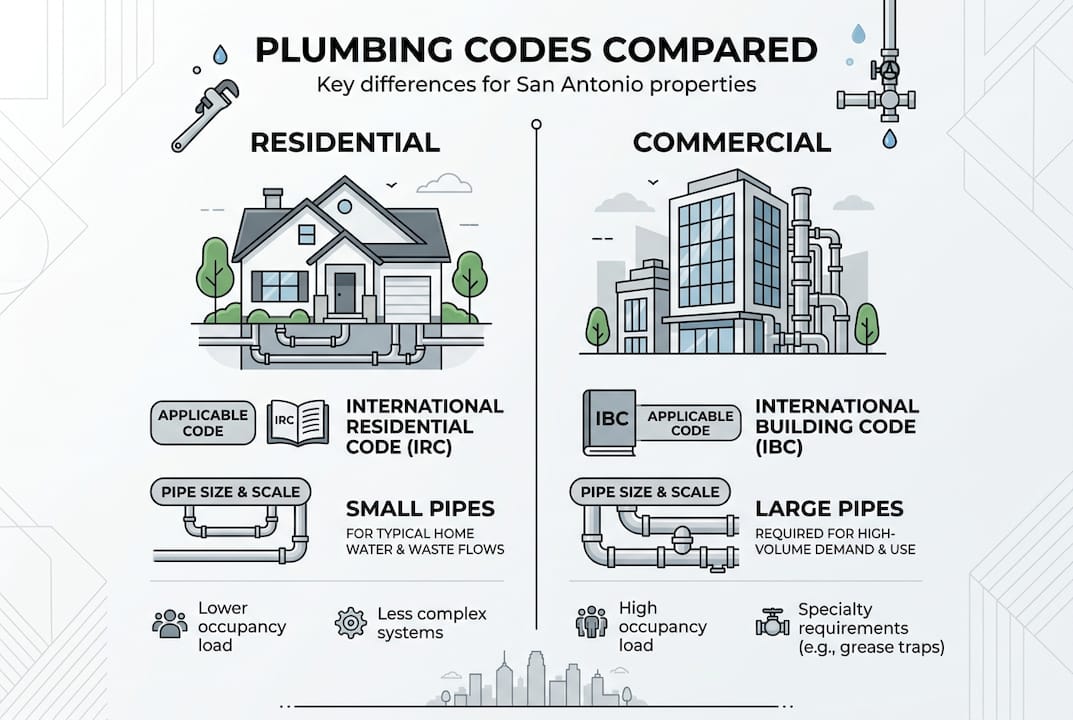
Here is a quick side-by-side look at how the two categories compare:
| Feature | Residential | Commercial |
|---|---|---|
| Governing code | IRC / IPC | IBC / IPC |
| Pipe sizing | Smaller diameter | Larger, calculated loads |
| Inspections | At permit milestones | Frequent, ongoing |
| Backflow prevention | Sometimes required | Almost always required |
| ADA compliance | Not typically required | Required in public spaces |
| Grease traps | Not required | Required for food service |
| System complexity | Low to moderate | Moderate to high |
Beyond the table, commercial spaces also demand features that most homeowners never think about. Restaurants need grease interceptors to keep fats and oils out of the city sewer. Medical offices require specialized medical gas lines and enhanced backflow protection. Multi-story buildings need hydraulic calculations to ensure adequate water pressure on upper floors. Our San Antonio commercial plumbing services are built specifically to handle that level of complexity.
Key differences that often surprise property owners include:
- Pipe materials and sizing: Commercial systems frequently use larger diameter pipes to handle simultaneous high-demand use.
- Water heater capacity: A commercial building may require multiple tankless or high-capacity units working in sequence.
- Drainage design: Commercial drain lines must handle greater volume and often require floor drains, interceptors, and cleanouts at specific intervals.
- Permit timelines: Commercial permits in San Antonio typically take longer to approve because of the additional plan review requirements.
“The biggest mistake we see is a property owner assuming that because a building looks like a house, it follows house rules. The moment you add a commercial kitchen or rent to four or more families, the rules change completely.”
How to determine your property type and avoid costly mistakes
Understanding the general differences is one thing. Knowing exactly where your San Antonio property falls is another. Texas and the City of San Antonio use specific thresholds to define residential versus commercial for plumbing and construction purposes.
Here is how Texas generally draws the line:
| Property type | Classification |
|---|---|
| Single-family home | Residential (IRC) |
| Duplex or two-family | Residential (IRC) |
| Three-story or less, 1-3 units | Residential in most cases |
| Four or more units OR more than three stories | Commercial (IBC) |
| Short-term rental (single-family) | Residential, with conditions |
| Restaurant or retail with plumbing | Commercial |
| Medical or dental office | Commercial |
Edge cases are where homeowners get into trouble. As Texas construction classifications confirm, restaurants need grease interceptors, hospitals require medical gas and backflow systems, and any multi-family property exceeding three stories is classified as commercial. That classification triggers a completely different permit process and inspection schedule.
Here is a practical checklist to help you avoid costly classification errors:
- Count your units and floors. If you have four or more rental units or your building exceeds three stories, plan for commercial codes from day one.
- Identify any food service. Even a small kitchenette used for catering can require a grease interceptor under San Antonio code.
- Check your short-term rental status. A single-family Airbnb is usually still residential, but a purpose-built multi-unit STR property may not be.
- Pull your permit history. The City of San Antonio’s permit records will often show how previous work was classified.
- Consult before you renovate. A quick call to a licensed plumber before you start can save you from tearing out work that fails inspection.
For ongoing guidance on keeping commercial properties up to code, our commercial maintenance tips cover the most common issues we see in San Antonio buildings. You can also browse our local DIY plumbing advice for residential projects where you have more flexibility.
Pro Tip: When in doubt, call the City of San Antonio Development Services Department before pulling a permit. A five-minute conversation can confirm your property classification and prevent a failed inspection down the road.
Who should you hire? Licensing, expertise, and liability explained
Knowing your property’s status, the next logical step is to understand who is qualified to do the work and why that choice really matters.
In Texas, all plumbers must be licensed through the Texas State Board of Plumbing Examiners (TSBPE). Licenses are tiered: Apprentice, Tradesman, Journeyman, and Master Plumber. For commercial work, you generally need a Master Plumber overseeing the project, and certain commercial systems require additional endorsements. Hiring someone without the right license tier for your project type is not just risky; it can void your homeowner’s insurance and expose you to personal liability if something goes wrong.
The risks of hiring the wrong plumber are real:
- Failed inspections that require full removal and reinstallation of completed work
- Code violation fines that can run into thousands of dollars in San Antonio
- Insurance claim denials if unlicensed work caused water damage
- Permit revocation on active construction projects
- Resale complications when unpermitted work is discovered during a home inspection
As San Antonio plumbing guidance makes clear, homeowners should hire TSBPE-licensed plumbers experienced in both residential and commercial work, and avoid using residential-only contractors for rental or investment properties that include commercial elements.
When evaluating a plumbing company, look for these qualities:
- Active TSBPE Master Plumber license with no disciplinary history
- Documented experience with your specific property type
- Familiarity with San Antonio permit processes and inspectors
- Verifiable reviews from both residential and commercial clients
- Clear, written estimates before any work begins
Understanding the value of hiring experienced plumbers goes beyond credentials. Experience means a plumber has seen the edge cases, knows the local inspectors, and can anticipate problems before they become expensive. The benefits of working with a licensed plumber in San Antonio are especially clear when your project sits on the line between residential and commercial codes.
Pro Tip: Ask any plumber you are considering for their TSBPE license number and look it up directly on the TSBPE website. It takes 30 seconds and confirms their license tier, status, and any complaints on record.
Special considerations for San Antonio homes with commercial features
As you consider specific property features or renovations, special rules and techniques come into play. Many San Antonio properties blur the line between residential and commercial, and that is where planning matters most.
Common mixed-use scenarios we encounter include:
- Live/work properties. A homeowner who runs a salon, bakery, or small restaurant out of part of their home may need commercial plumbing for that portion of the building while the living quarters follow residential code.
- Short-term rental conversions. Converting a garage apartment or adding an ADU (accessory dwelling unit) for rental income can change your permit requirements depending on how the unit is classified.
- Properties with commercial kitchens. Even a residential property with a full commercial kitchen for catering requires a grease interceptor and may trigger commercial inspection requirements.
- Multi-family buildings over three stories. These require hydraulic calculations, larger supply lines, and a full commercial permit package regardless of how the units are used.
“Skipping the grease trap on a commercial kitchen remodel is one of the most expensive mistakes we see. The city will require it, and retrofitting after the fact costs two to three times more than installing it correctly the first time.”
Some industry sources warn that residential plumbers simply cannot handle commercial scale or codes, while others note there is overlap for small jobs. The honest answer is that it depends on the specific system and the plumber’s actual experience, not just their license tier. For any project involving a commercial kitchen, multi-unit building, or mixed-use space, a specialist is the safer call.
For kitchen-specific work, our San Antonio kitchen remodel plumbing page covers what to expect during a full kitchen renovation. For new builds or larger mixed-use projects, our construction plumbing help team handles everything from BIM modeling to hydraulic calculations.
Pro Tip: Before starting any renovation on a property with both residential and commercial features, request a pre-permit consultation with the City of San Antonio. This meeting can clarify exactly which codes apply and prevent costly surprises during inspection.
Our perspective: What most homeowners get wrong about plumbing classifications
We have seen this scenario play out many times. A homeowner buys a duplex, hires a residential plumber they trust, and discovers six months later that the city requires a commercial permit and a full system redesign. The rework costs more than the original job.
The real issue is not ignorance. It is that the classification system is genuinely confusing, and most contractors do not volunteer information that might cost them a job. Pipe sizing, pressure calculations, and system design are more technical than they appear, and getting them wrong creates problems that show up years later as leaks, pressure failures, or failed inspections.
Our honest advice: treat any property with more than two units, any food service element, or any public-facing space as potentially commercial until a licensed expert confirms otherwise. Reviewing bathroom renovation plumbing tips is fine for straightforward residential work, but the moment your project gets complicated, bring in someone who works across both classifications every day. That upfront investment in the right expertise almost always costs less than fixing a misclassified project.
Get expert help with your next plumbing project
Ready to make sure your next project is handled by true experts? Stultz Plumbing offers fully licensed residential and commercial plumbing under one roof, so you never have to guess which type of contractor to call. Whether you need affordable plumbing services for your home or specialized San Antonio commercial plumbing for a mixed-use property, our team has the licenses, experience, and local knowledge to get it done right the first time. We also handle water heater experts for both residential and commercial installations. Contact us today for a free estimate and let us take the guesswork out of your next plumbing project.
Frequently asked questions
What is the main difference between commercial and residential plumbing in San Antonio?
Commercial plumbing has stricter code requirements and more frequent inspections, and it handles larger, more complex systems than residential plumbing. The governing codes, pipe sizing, and required features like backflow prevention and ADA compliance are all more demanding on the commercial side.
How do I know if my multi-family property is classified as commercial in Texas?
If your property has more than three stories or four or more units, it is considered commercial under Texas law and must follow IBC requirements. San Antonio also requires annual maintenance permits for R-2 properties with more than four units.
Can a residential plumber handle small commercial jobs in San Antonio?
Some small jobs may overlap between residential and commercial work, but complex commercial systems require a specialist with the right license tier and experience. Hiring the wrong contractor risks failed inspections, code violations, and costly rework.
Do all properties in San Antonio need backflow prevention devices?
Most commercial properties require backflow prevention devices, and some residential homes with irrigation systems or special plumbing configurations may also need them. Your licensed plumber can confirm the requirement based on your specific property and water connection type.
Recommended
- Why choose local plumbers in San Antonio in 2026
- Plumbing Services in Boerne TX | Stultz Plumbing
- Plumbing maintenance: prevent costly repairs in San Antonio
- Get Affordable Plumbing Services In San Antonio
Jean runs growth strategy at AimSetWin, a performance marketing agency specializing in local service businesses across Texas. he's helped plumbers, HVAC companies, pest control operators, and home service brands build predictable revenue systems using data-driven advertising and conversion optimization.


